Best Craft Pricing Calculator: Five Tools Compared
The best craft pricing calculator is the one that works out your true cost per item, including your time, then adds the fees of where you sell and shows what you keep. For most makers that means a handmade pricing calculator with fees built in. Craft fair sellers should look at the Fairstall planner, and everyone else at Profit Loom or Craft Profit Compass.
Pricing handmade work can feel more complicated than the making itself, because materials, time, packaging, fees and tax all pull the number in different directions. This page walks you through what to check, so you can pick a tool with confidence rather than guess.
Key facts at a glance
- A craft pricing calculator is a spreadsheet or app that turns your materials, time, overheads and selling fees into a recommended price and a profit figure.
- Four of the five tools here work in Excel, and three of those also work in Google Sheets; Craft Profit Compass runs offline in your browser instead.
- Only Craft Fair Planner Spreadsheet is built around the season of a market stall, with a Go / Maybe / Pass scorecard for each fair.
- Hue & Margin links a price list of up to 5 products to up to 150 materials, so prices update when a material cost changes.
- Profit Loom and Craft Profit Compass both state that they need no subscription.
 Craft Fair Planner Spreadsheet | Fairstall Excel Holiday Market Vendor Planner with Pricing Calculator & Profit Tracker
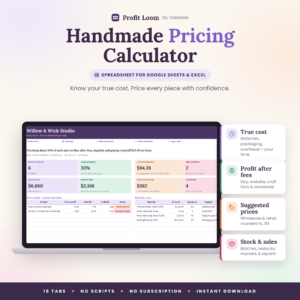 Handmade Pricing Calculator Spreadsheet | Profit Loom Excel & Google Sheets Product Pricing Template with Etsy Fees, Profit Dashboard, Inventory & Craft Fair Planner
 Craft Profit Compass | Handmade Pricing Calculator for Retail & Wholesale Prices, Cost Per Item & Profit Margin, Offline App
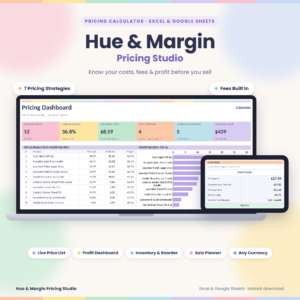
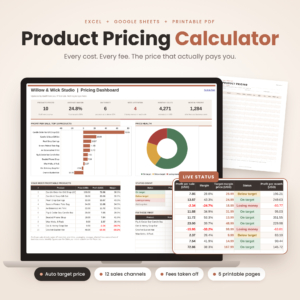
Table of Contents Toggle
- What should the best craft pricing calculator include?
- How do these craft pricing calculators compare?
- Which craft pricing calculator suits which seller?
- How do you use a craft pricing calculator step by step?
- What mistakes should you avoid when pricing handmade items?
- What affects the cost of a craft pricing calculator?
- How do you choose with peace of mind?
- Common questions
What should the best craft pricing calculator include?
A good craft pricing calculator should cover six things: your time, your selling fees, both retail and wholesale prices, a format you will actually open, a link to your materials, and something you can print. Not every maker needs all six, so it helps to know which ones matter for the way you sell.
Does it count your time as a real cost?
A craft pricing calculator should treat your hourly rate as part of the cost of every item, not as whatever is left over. Profit Loom builds your hourly wage into each true cost and shows earnings per hour, while Craft Profit Compass takes your time and hourly rate as part of its guided five-step calculator.
If a tool only adds up materials, it will suggest a price that feels fine and quietly pays you nothing.
Does it include the fees of where you sell?
Selling fees are the charges a marketplace, payment provider or fair takes from each sale, and they change the price you need. Profit Loom lists 2026 fees for 8 sales channels. Hue & Margin builds marketplace and payment fees into its pricing, and the Product Pricing Calculator Spreadsheet includes an Etsy fee calculator.
Fairstall goes further for market sellers, counting booth fees, mileage, card fees and sales tax against each fair.
Does it give wholesale as well as retail prices?
Wholesale pricing is the lower price you charge a shop that buys in bulk and then sells on, so it has to leave you a margin after the discount. Craft Profit Compass and Profit Loom both suggest wholesale and retail prices side by side. If you might ever sell to a shop, choose one of those.
Does it work in the software you already use?
The format decides whether you will use the tool in month three. Profit Loom, Hue & Margin and the Product Pricing Calculator Spreadsheet work in both Excel and Google Sheets. Fairstall is an Excel file. Craft Profit Compass runs offline in your browser, which suits anyone who would rather not manage a spreadsheet at all.
Does it link prices to your materials list?
A linked materials list means a price updates itself when you pay more for wax, yarn or leather. Hue & Margin does this most fully, with a price list for 5 products tied to 150 materials. Craft Profit Compass lets you add materials by the pack and keeps a product library.
Can you print it?
Printed pricing sheets are useful at a stall, on a wholesale call or when you want to check numbers away from a screen. The Product Pricing Calculator Spreadsheet comes with six printable pricing pages in A4, US Letter, A5 and Half Letter. Craft Profit Compass offers printable line sheets, and Fairstall includes a printable user guide and a booth packing checklist.
How do these craft pricing calculators compare?
The five calculators differ mainly in format, in how far they go beyond a single price, and in who they are built for. The table below sets out what each one states it includes.
Which craft pricing calculator suits which seller?
Each of these tools suits a different kind of seller, and choosing by selling style beats choosing by feature count.
Market and fair sellers. Craft Fair Planner Spreadsheet is the one that treats a fair as a business decision. It shows the true profit of each booth after cost of goods, mileage, card fees and sales tax, so you can see whether a fair with a high stall fee is really worth it.
Online sellers on more than one platform. Handmade Pricing Calculator Spreadsheet (Profit Loom) shows the profit you keep on Etsy, your own website, craft fairs and wholesale. That comparison is where makers often find that the same item earns very different amounts depending on where it sells.
Makers who want guidance rather than a blank grid. Craft Profit Compass walks you through five steps and shows cost and profit as you type. It also has a monthly goal planner, which helps if you want to work backwards from an income target.
Growing ranges with many materials. Pricing Calculator Spreadsheet (Hue & Margin) suits anyone whose costs move. Its price list reprices itself when a material changes, it compares 7 pricing strategies, and it handles up to 2 taxes and any currency.
Anyone who wants a plain, printable answer. The Product Pricing Calculator Spreadsheet for Small Business is the simplest of the five. Add materials, time and fees, and print the pricing page.
How do you use a craft pricing calculator step by step?
Using a craft pricing calculator takes six steps, and doing them in this order stops the most common errors.
- List every material for one item, including small ones such as glue, thread or fixings, and enter what you paid per pack.
- Time one full make, including cutting, finishing and photographing, and set an hourly rate you would accept from an employer.
- Add packaging and a share of overheads such as workspace, tools and software.
- Choose where the item will sell, so the correct fees are applied.
- Read the break-even price first, then the suggested retail and wholesale prices.
- Test the result against your market. If the price feels too high, change the design or the batch size, not your wage.
What mistakes should you avoid when pricing handmade items?
The most costly pricing mistakes are leaving out your own time, ignoring fees and copying a competitor's price without checking their costs.
- Pricing from materials alone. A price that covers only materials makes your labour free. Count it, even if you later choose to discount it.
- Forgetting fees on one channel. Fees on a marketplace, a card reader and a fair are all different. A tool that shows profit per channel stops you assuming they match.
- Skipping wholesale. If a shop asks for a trade price and your retail price has no room, you either refuse or lose money. Work out the wholesale price before the request arrives.
- Never updating costs. Material prices drift. A linked price list, such as the one in Hue & Margin, or a yearly review, keeps your margins honest.
- Judging a fair by takings. A busy fair can still lose money once the stall fee, travel and card charges come off. Fairstall's profit per fair and per hour is built to expose that.
What affects the cost of a craft pricing calculator?
The cost of a craft pricing calculator depends mostly on how much it does beyond a single price. The simple printable template costs less up front than the larger tools with dashboards, stock tracking and planners.
Features that tend to raise the cost include multiple tabs, linked material lists, fee data for several channels and fair planning. Format matters too. A spreadsheet is a one-off file you keep, while some pricing tools charge by subscription. Profit Loom and Craft Profit Compass both state that there is no subscription, which is worth checking for any tool you consider.
Check the live product cards for current prices, and weigh them against how many hours the tool will save you.
How do you choose with peace of mind?
Choose by how you sell: Fairstall for fairs, Profit Loom for several channels, Craft Profit Compass if you prefer an app, Hue & Margin for large ranges, and the Product Pricing Calculator Spreadsheet for simple printable pricing.
If you cannot decide, use this rule. Pick the tool that matches your busiest selling channel today, not the one with the longest feature list. You can browse all 5 options below and compare them against it.
Common questions
What is a good profit margin for handmade products?
There is no single correct margin, because it depends on your costs, channel and goals. A sound approach is to set your hourly rate and overheads first, then see what margin that produces. Tools such as Profit Loom show profit and earnings per hour so you can judge it.
Should I include my own wages in the price?
Yes, if you want the business to last. Your time is a real cost, and leaving it out means your hourly earnings fall below what you think. Craft Profit Compass and Profit Loom both ask for an hourly rate and build it into the cost.
Can I use these calculators on a Mac or tablet?
Profit Loom, Hue & Margin and the Product Pricing Calculator Spreadsheet work in Google Sheets as well as Excel, which suits most devices with a browser. Craft Profit Compass runs offline in your browser. Fairstall is an Excel file, so check your device can open it.
Do I need separate prices for markets and online?
Often yes, because the fees differ. A fair has stall and travel costs, while online platforms take listing and payment fees. Profit Loom shows profit across Etsy, your website, craft fairs and wholesale, so you can see whether one price works everywhere.
How often should I review my prices?
Review them whenever a main material cost changes, and at least once a year. A linked price list such as Hue & Margin's updates automatically, but you should still check the result. If your margin has slipped, adjust the price before the next batch.