Best Anger Management for Kids: Printable Workbooks
Choosing the best anger management for kids comes down to age, how much guidance you want as the grown-up, and whether your child will actually use it. The three printable workbooks below teach children to spot anger in their body and practise calming tools. Wobble to Steady is the broadest, FeelBright Kids the most modular, and Calm Compass the best for older children.
At a glance
- All three are instant-download PDFs, so you print what you need at home rather than waiting for a parcel.
- Wobble to Steady and FeelBright Kids cover ages 5 to 12, while Calm Compass is written for ages 7 to 12.
- Every product comes in both US Letter and A4, which matters if you print on a standard UK printer.
- Each includes cut-out cards, trackers and certificates, so a child has something to hold as well as something to read.
- Calm Compass and FeelBright Kids are fillable on screen, which suits tablets and telehealth sessions.
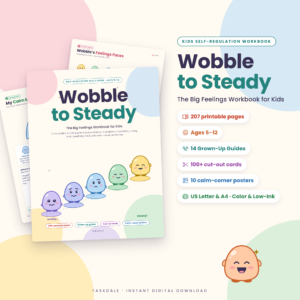 Kids Self-Regulation Workbook Printable | Wobble to Steady 207-Page Big Feelings & Coping Skills Book with Calm Corner Posters | Emotional Regulation Worksheets, Ages 5–12 | US Letter & A4
Table of Contents Toggle
- What should you look for in anger management resources for kids?
- How do the best anger management workbooks for kids compare?
- Who does each anger management workbook suit?
- How do you use an anger management workbook with a child?
- What mistakes should you avoid when helping a child with anger?
- What affects the price of printable anger management resources?
- Which anger management resource should you choose for your child?
- Common questions
Helping a child with anger can feel like a lot to take on, particularly when every shop and website seems to offer something slightly different. The good news is that you don't need a specialist qualification to pick well. You need to match the resource to your child's age and temperament, and to how much time you can realistically give it each week. We'll take each of those in turn.
What should you look for in anger management resources for kids?
The best anger management resource for a child is one that teaches them to notice anger early, gives them a small set of calming tools, and gives you clear guidance on how to support them. Five factors separate a useful workbook from one that gets abandoned after a week.
Is the age range a genuine fit?
A workbook's stated age range tells you the reading level and the type of activity to expect. Wobble to Steady and FeelBright Kids both span ages 5 to 12, which means a younger child will need you beside them to read the pages, while an older child can work alone. Calm Compass starts at age 7, so it assumes a child who can read prompts and write short answers.
If your child is at the bottom or top edge of a range, be realistic. A 5-year-old will enjoy the cut-out cards and posters far more than a worksheet, and a 12-year-old may find childish artwork off-putting.
Does it teach the reason behind anger, or only tell the child to calm down?
Children cope better when they understand what is happening in their body. Wobble to Steady explains why stress and emotions happen, then teaches children to spot body clues before moving on to breathing, grounding and problem-solving. It packages this as the STEADY Steps, a simple routine a child can remember under pressure.
Calm Compass works from feelings and triggers through to anger and problem-solving, which suits a child who needs to work out what sets them off. A resource that skips this stage and goes straight to "take a deep breath" tends to feel like another instruction.
Is there proper guidance for the grown-up?
Grown-up guidance is the section written for you, explaining how to introduce an activity and how to respond afterwards. Wobble to Steady includes a Grown-Up Guide for every one of its 14 chapters. FeelBright Kids puts grown-up tips in each of its 12 workbooks and adds a user guide and a 30-day plan.
Calm Compass is lighter on adult instruction in its description, so it suits a parent or practitioner who is comfortable improvising. If you want to be told what to say, favour the first two.
Are there physical tools a child can use in the moment?
Cut-out cards turn a lesson into something a child can pick up when they're upset. Wobble to Steady offers 100+ cut-out cards and 10 calm-corner posters, which help if you want to set up a dedicated quiet space at home. FeelBright Kids provides 72 coping cards, 24 affirmation cards and 12 feelings cards. Calm Compass has 99 cut-out coping and speak-up cards, and the speak-up cards help children put words to what they need.
Can you print it, type on it, or both?
Printing suits children who like to colour, cut and stick. Typing suits tablets and remote sessions. FeelBright Kids is printable and fillable, with clickable tabs for finding your way around. Calm Compass can be typed on screen for telehealth or printed. Wobble to Steady is a print-focused workbook, but it offers colour and low-ink versions, which helps if you're printing 207 pages at home.
How do the best anger management workbooks for kids compare?
The three workbooks differ most in length, age range and structure. This table shows the differences that affect your choice.
| Product | Ages | Structure | Cards and extras | Format |
|---|---|---|---|---|
| Kids Self-Regulation Workbook Printable | Wobble to Steady 207-Page Big Feelings & Coping Skills Book with Calm Corner Posters | Emotional Regulation Worksheets, Ages 5–12 | US Letter & A4 | 5–12 | 207 pages, 14 chapters, Grown-Up Guide for each chapter | 10 calm-corner posters, 100+ cut-out cards, trackers, certificate | PDF in US Letter and A4, colour and low-ink |
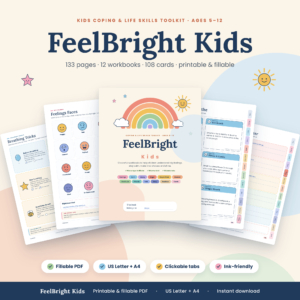 FeelBright Kids Coping Skills Toolkit | Printable & Fillable Kids Therapy Worksheets for Feelings, Anger, Anxiety & Calm | Ages 5-12, US Letter & A4 | 5–12 | 12 separate workbooks, 133 pages, 30-day plan | 72 coping cards, 24 affirmation cards, 12 feelings cards, posters, trackers, certificates | Printable and fillable PDFs, US Letter and A4, user guide |
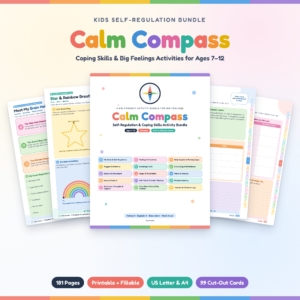 Calm Compass Kids Self-Regulation Bundle | 181-Page Coping Skills & Emotional Regulation Worksheets, Calm Down Cards & Trackers for Ages 7-12 | Printable & Fillable PDF, US Letter & A4 | 7–12 | 181 pages, 150 activity pages in 15 colour-coded sections | 99 cut-out coping and speak-up cards, trackers, reward chart, certificates | Printable and fillable PDF, US Letter and A4 |
The topic spread differs too. FeelBright Kids covers anger alongside anxiety, worry, sleep, friendship and gratitude, so anger is one subject among many. Wobble to Steady and Calm Compass are built around self-regulation as a whole, with anger as a core use.
Who does each anger management workbook suit?
Each workbook suits a different household, and the right choice depends mostly on the child's age and how you like to work.
Wobble to Steady suits a parent who wants one complete programme to follow from start to finish. Its chapter-by-chapter Grown-Up Guides take the guesswork out of what to do next, and the calm-corner posters help if you want a visible, permanent calm space. It is the longest of the three, so it asks for the most printing and the most patience.
FeelBright Kids suits a family who want to dip in and out. Because it is split into 12 separate workbooks, you can print only the anger workbook this week and the sleep one next month. The 30-day plan helps if you prefer a daily routine to a free-form approach. It's also a sensible pick for a child whose anger comes tangled up with worry or friendship troubles.
Calm Compass suits children aged 7 to 12 who can work through prompts themselves. The 15 colour-coded sections make it easy to find the right page quickly, and the reward chart gives a concrete way to recognise effort. Therapists and parents using video sessions will appreciate that it can be typed on screen.
How do you use an anger management workbook with a child?
Using an anger management workbook works best in short, calm sessions held when your child is settled, never in the middle of an outburst. Follow these steps.
- Print only the pages for the first session, plus any cards you want to cut out, so your child isn't faced with a thick pile.
- Choose a time when your child is relaxed, such as after a snack or before bedtime, and keep the first session to 10 to 15 minutes.
- Read the grown-up notes for that section first, so you can explain the idea in your own words.
- Complete the activity together, letting your child lead and giving help only when they ask.
- Put any cards or posters somewhere visible, such as a calm corner or the fridge, so the tools are in sight when feelings run high.
- Revisit the tracker briefly each day or week and praise the noticing, not just the calm.
- Move on only when your child feels comfortable with the current tool.
What mistakes should you avoid when helping a child with anger?
The commonest mistake is teaching coping tools while the child is already upset, when the thinking part of their brain is least available. Practise when things are calm so the tool is familiar by the time it's needed.
- Treating the workbook as a punishment. If a child is sent to complete worksheets after misbehaving, they will link the tools with being in trouble.
- Printing everything at once. A tall stack looks like homework. Print a few pages at a time.
- Expecting quick change. Skills like breathing and grounding take repeated practise, and setbacks are normal.
- Choosing by page count alone. A bigger book is only better if your child will use it. A shorter bundle completed beats a long one left in a drawer.
- Ignoring signs that need more help. If anger leads to harm, or is getting worse, speak to your GP, your child's school or a qualified child therapist. A workbook supports that help but doesn't replace it.
What affects the price of printable anger management resources?
The price of a printable anger management resource is shaped mainly by how much content it holds, how many formats it includes, and how much adult guidance comes with it. A longer programme with a guide for every chapter, such as Wobble to Steady, generally costs more up front than a shorter bundle.
Other factors include the number of cards and posters, whether the files are fillable as well as printable, and whether both US Letter and A4 versions are included. There's also a running cost you control yourself, which is your own printing. Choosing a low-ink version and printing only the pages you need keeps that down. Current prices are shown on the product cards beside this text.
Which anger management resource should you choose for your child?
Choose by age first, then by how you like to work. For a child under 7, or if you want step-by-step adult guidance, pick Wobble to Steady. For a family who prefer short, separate workbooks covering anger plus related worries, pick FeelBright Kids. For a child aged 7 to 12 who can work independently, or for use in screen-based sessions, pick Calm Compass.
If you're unsure, start with the one whose sample activities you can imagine your child sitting down to. Browse all 3 options below and compare them against that test.
Common questions
Can a workbook replace a therapist for a child with anger problems?
No. A workbook teaches everyday coping skills and gives you a structure for practising them. If your child's anger is frequent, intense, or causing harm to themselves or others, speak to your GP or school about professional support. Many therapists use printable resources alongside sessions.
Do I need a colour printer to use these workbooks?
Not necessarily. Wobble to Steady includes both colour and low-ink versions, so a standard home printer works. For the others, you can print in black and white if you prefer, though colour may help younger children stay interested in the cards and posters.
Can more than one child use the same download?
The files are PDFs, so you can print fresh copies of the pages for each child. Check the seller's licence terms on the product page for exactly what is permitted, particularly for classroom or professional use.
How long should each session with my child last?
Ten to fifteen minutes suits most children aged 5 to 12, and a younger child may manage less. Short and regular sessions work better than a long weekly one. Stop while your child is still engaged, so they come back willingly.
What if my child refuses to do the activities?
Don't force it. Try starting with the cut-out cards or posters, which feel more like play than schoolwork, and let your child choose the activity. Doing a page yourself alongside them can also help. If refusal continues, leave it a week and try again.