A free safe-to-spend calculator (a paycheck budget template with dates) should answer one question: how much can I spend before my next payday without running short? This free 14-day planner answers it in one tab. Enter your payday, your balance and the bills due in the next two weeks, and it shows the lowest day of the period, how much room you have above the cushion you want to keep, and a safe-to-spend figure.

Free Safe-to-Spend Calculator: 14-Day Paycheck Budget Template
A one-tab Excel and Google Sheets planner for one payday: enter your balance, pay, cushion and up to 12 bills to see your safe-to-spend figure, tightest day and a 14-day timeline.
Want everything unlocked?
The free file is a sample. The full version has every page, tab and feature, plus the user guide.
See the full versionThe download is free. You enter your email address to get the file, and free downloads are limited to 3 per day.
Why a paycheck budget needs dates, not just totals
Most budget templates add up a month of income and a month of bills. If the totals balance, the budget says you are fine. But bills don’t leave your account on average. They leave on dates. When rent is due on the 1st and your paycheck arrives on the 3rd, a balanced month can still leave you overdrawn for two days.
A paycheck-to-paycheck budget fixes that by looking at each day between paydays:
- Start with your balance at the end of the day before payday.
- Add your paycheck on payday.
- Subtract each bill on the day it is due.
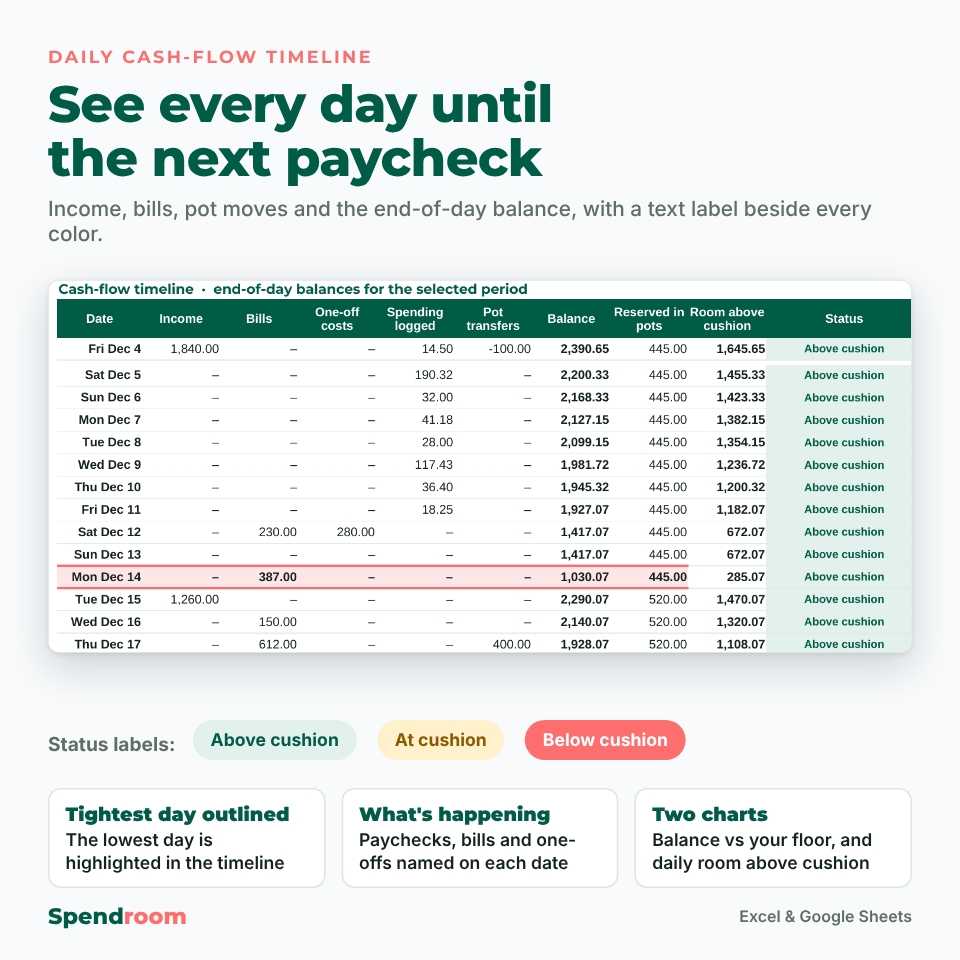
- Find the lowest end-of-day balance in the period. That day decides what you can spend.
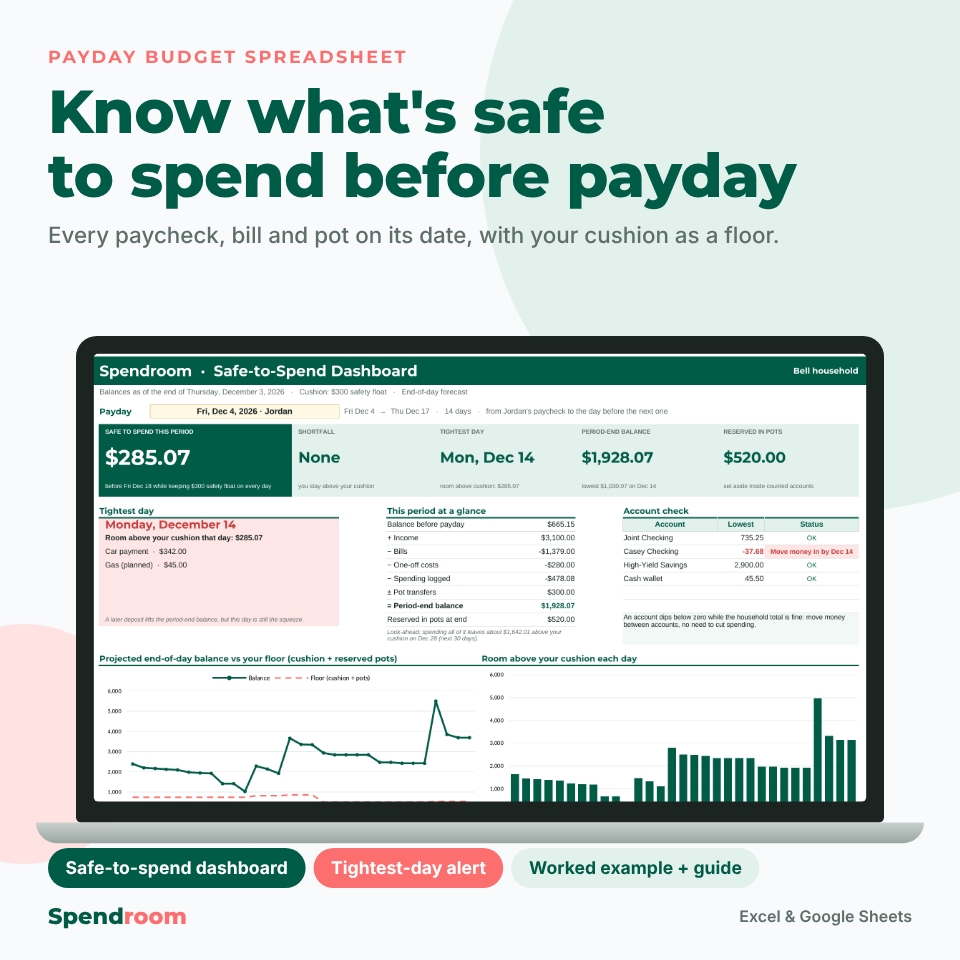
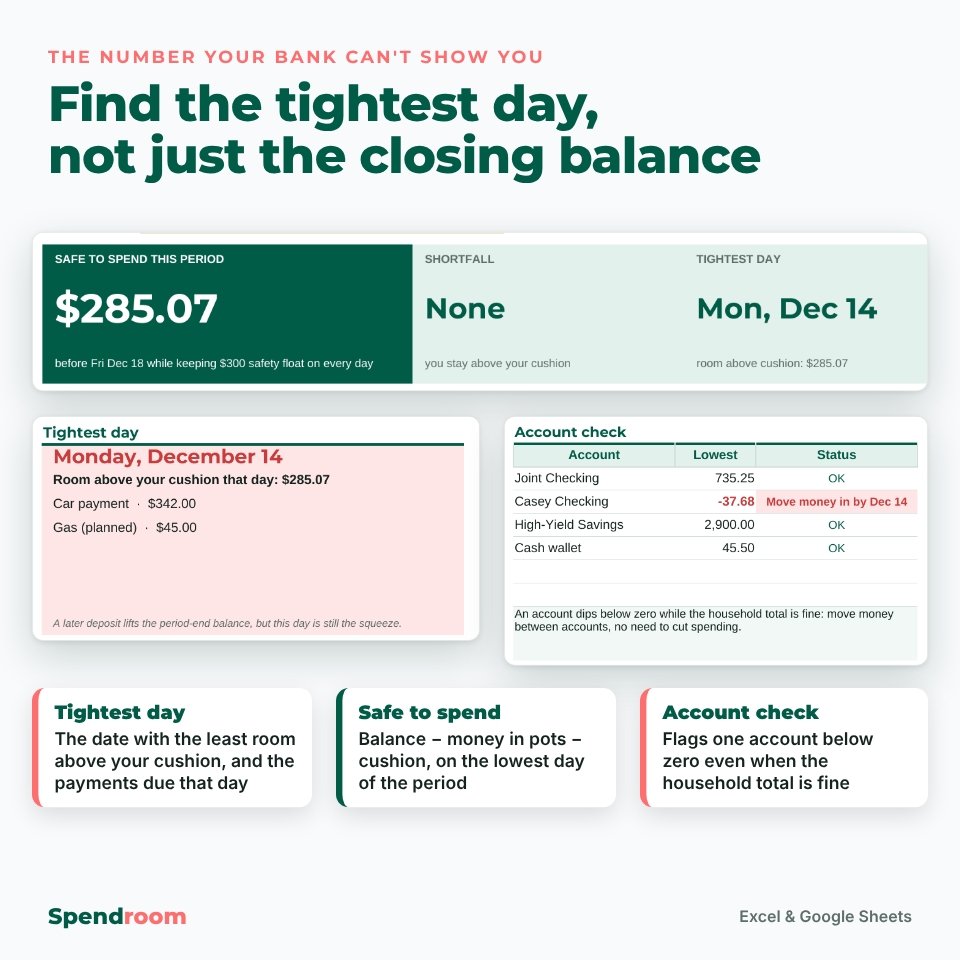
That low point is the tightest day. It often falls in the middle of the period, right before a second paycheck or just after a big bill, not on the last day. In the full Spendroom payday budget spreadsheet, the tightest day gets its own dashboard card, with the payments due that day listed underneath.
What “safe to spend” means
Safe to spend is not your balance. It is the smallest amount of room you have above your cushion on any day before the next paycheck:
- Room above cushion = end-of-day balance − your minimum cushion
- Safe to spend = the smallest room in the period (zero if it is negative)
If you spend that amount today, every later day in the period still keeps your cushion. If the smallest room is negative, you are already short. The template then shows a shortfall, which tells you to wait for a deposit, move a bill or trim a cost.
How to use the free safe-to-spend calculator
- Type your currency symbol. The default is $. Every money heading follows it.
- Enter your payday date and take-home pay. Use what actually lands in your account, after taxes and deductions.
- Enter your balance at the end of the day before payday. Use the cleared balance, not the available balance with pending card holds.
- Choose your cushion. This is the amount you never want to go below, for example $300. Give it a label such as “safety float”.
- List the bills and costs due in the next 14 days. Enter the date and amount, and mark estimates so you remember to check them.
- Read the result. The large tile shows safe to spend, the next tile shows the tightest day, and the timeline below shows every day with a text label: Above cushion, At cushion or Below cushion.
Here is a short example. You are paid $1,840 on Friday and have $605 left the night before. Over the next two weeks you have groceries, electric, internet, a $280 brake repair, a $342 car payment, a card payment and $212 of car insurance. The lowest day is the Thursday before the next payday, with $803 above a $300 cushion. That $803 is what you can safely spend this fortnight, and it is far less than the $2,445 your balance shows on payday.
Tips for a budget that holds up between paydays
- Plan essentials as bills. Put weekly groceries and gas in the bill list as estimates. Safe to spend then means money that is genuinely free.
- Watch annual and quarterly bills. Insurance premiums, subscriptions and registrations are easy to forget because they don’t come every month. The full Spendroom bill calendar places them on their real dates for 400 days.
- Set your cushion for real life. It should cover a purchase you forgot to note or a bill that posts a day early.
- Count pending card payments. If a card hold hasn’t cleared yet, subtract it yourself.
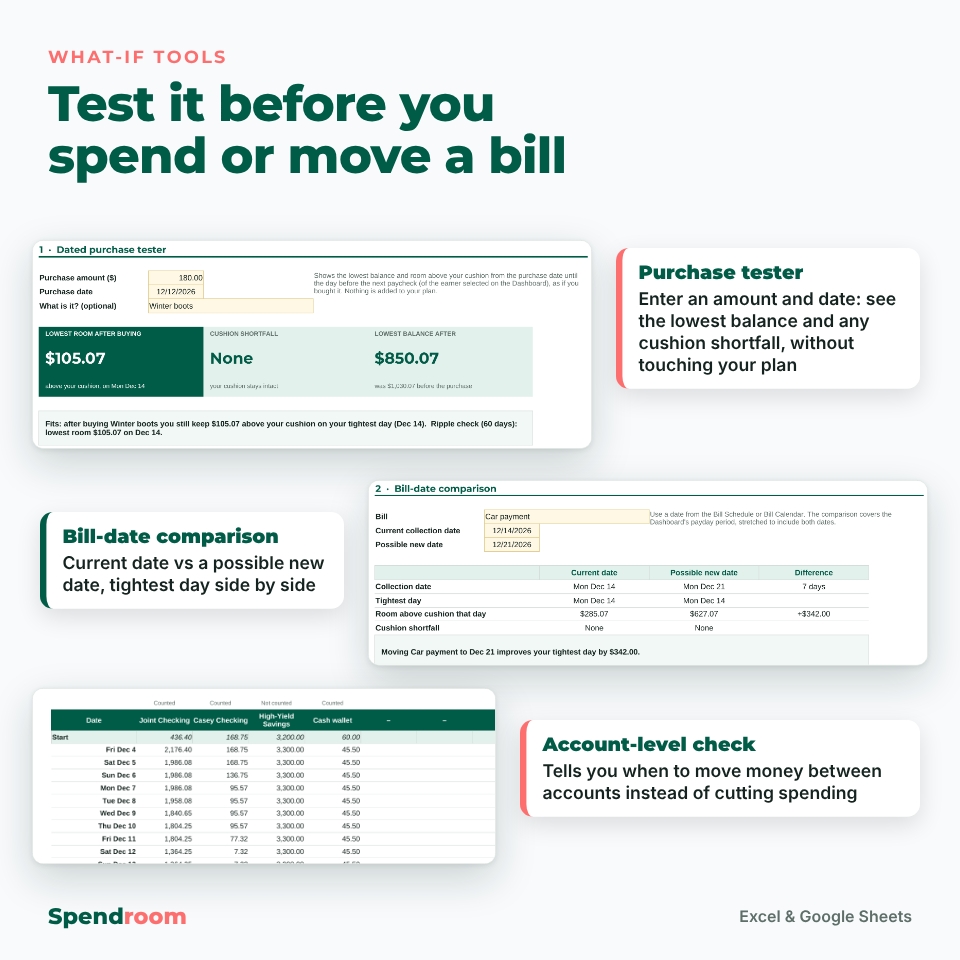
- Move bills, not just spending. If the tightest day sits right before payday, ask the provider to move the due date a few days later. Many providers allow it. Try the new date first with the bill-date comparison in the full workbook.
- Check each account. Your total across accounts can look fine while the account your rent leaves from runs dry. Move money between your own accounts before the date, rather than cutting spending you can afford.
When the free version is not enough
The free planner covers one earner, one payday and 12 bills. Most real households need more than that:
- Two earners paid on different schedules, such as every two weeks and the 15th and last day of the month
- Bills that repeat weekly, monthly, quarterly or annually, without retyping them every fortnight
- Savings pots for insurance, gifts or annual costs, which should count as unavailable even though the money sits in checking
- A way to log purchases mid-period and see what is still safe to spend today
Get the full Spendroom payday budget spreadsheet
- Up to 4 earners and 40 recurring bills on a 400-day daily forecast
- A payday selector with safe to spend, shortfall, tightest day and period-end balance
- 10 savings pots that reserve money and fund bills
- An account-by-account check that tells you when to move money
- A purchase tester, a bill-date comparison, a mid-period check and a printable decision sheet
- A worked example and an illustrated user guide, for Excel and Google Sheets
$29.99: instant download.
How the full version handles a real fortnight
The worked example in Spendroom follows a fictional two-earner household for two weeks. Jordan is paid every two weeks and Casey twice a month. The household starts the period with $665 across its counted accounts. After Jordan’s paycheck, a brake repair, the car payment and the weekly grocery budget all land before Casey’s mid-month paycheck. The tightest day is a Monday in the middle of the period, with $285 of room above a $300 cushion. That happens even though the fortnight ends with a balance of $1,928.
Two other things stand out. First, one partner’s checking account dips $37.68 below zero on that Monday while the household total is fine. The account check flags it as a transfer to make by that date, not a reason to cut spending. Second, the bill-date comparison shows that moving the car payment one week later would add $342 of room on the tightest day, which is worth a phone call to the lender.
Free safe-to-spend calculator FAQ
Does the free template work in Google Sheets?
Yes. Upload the .xlsx file to Google Drive and open it with Google Sheets, or open it in Excel 2016 or later.
Is my balance on payday what I can spend?
No. Your payday balance still has to cover every bill until the next paycheck. Safe to spend is what is left above your cushion on the lowest day.
What cushion should I choose?
Pick an amount that would absorb a forgotten purchase or a bill that posts early. Many people start with one week of groceries and adjust from there.
Can the free planner handle two paychecks?
The free planner covers one earner. The full Spendroom workbook handles up to four earners on different schedules.
Ready to try it? Download the free 14-day planner below, then upgrade when you want the full household forecast.
For planning and education only; not financial advice. Not affiliated with any bank. Personal use only.