A letter on its own is just a shape. Put a picture of a sun beside the S, say “sss, sun” together, and the shape suddenly means something. That link between a letter, its sound and a real object is the heart of early phonics, and alphabet coloring pages with objects are one of the easiest ways to build it at home.
This guide is for parents, preschool teachers and homeschoolers who want letter-and-sound learning printables that actually teach sounds, not just letter names. You will learn why objects matter so much, how to pick the right object for each letter (and which common choices cause confusion), a list of three easy objects for every letter, sound games that use your finished pages, and four Taskdale printables for different ages.
Quick picks for letter-and-sound pages
| Product | Best for | Price | Link |
|---|---|---|---|
| Letter Parade Alphabet Coloring Book A to Z | One letter, one object, one sound per page | $3.99 | View |
| Crayon Campus Preschool Learning Coloring Worksheets | Matching, color words and object sorting | $4.99 | View |
| Little Explorers Preschool Coloring Book | Naming everyday objects with toddlers | $3.49 | View |
| Enchanted Forest Coloring Book | Hidden-object I spy for older siblings | $3.49 | View |
Why objects make letter sounds click
Letter names and letter sounds are two different things. The letter called “aitch” says “h”. The letter called “double-you” says “w”. For a four-year-old, that is genuinely confusing. An object gives them something solid to hang the sound on. H is for hat. The first sound in hat is “h”. Simple.
Objects also make sounds memorable. A child might forget that M says “mmm”. They will not forget the moon they colored silver last Tuesday. Next time they see M, the moon pops into their head, and the sound comes with it.
And objects bring the letter into real life. Once a child knows “b, ball”, they start noticing balls, bikes, buses and bananas everywhere. That is when phonics stops being a lesson and starts being a game they play on their own.
Parents often notice the moment it happens. A child in the grocery checkout line points at a sign and says, “B! Like ball!” That small shout is a big step, and it usually comes from weeks of quietly coloring objects beside letters.
Picking the right object for each sound
Not every object works equally well. A few rules save a lot of confusion later on.
1. Use the plain, short sound
Choose words where the letter makes its most common, simple sound. A for apple (short a), not acorn (long a). E for egg, not eagle. I for igloo, not ice cream. Start with short vowel sounds and save the rest for later.
2. Avoid blends and pairs
Skip words that start with two letters working together. S for sun, not ship (sh) or star (st). C for cat, not chair (ch). T for tiger, not three (th). The first sound should be that letter alone.
3. Avoid words that sound like the letter name
“Bee” for B sounds like the letter name, not the sound. “Jay” for J, “tea” for T. These blur the line between name and sound. Ball, jam and tent are clearer.
4. Pick familiar objects
A child who has never seen a quill or a yak will not link it to Q or Y. Choose things from their daily life: cup, dog, hat, sock.
5. Pick drawable objects
If the picture is unclear, the child guesses wrong. A fish is unmistakable. A “fern” is not, for most four-year-olds.
6. Match your accent
Say the word out loud the way your family says it. If the first sound in your accent is not the plain letter sound, pick another object. A child learns sounds from your voice, so the object should match what they actually hear at home.
Three easy objects for every letter
Here are three objects per letter that follow the rules above. Use one for the coloring page and the other two for sound games.
| Letter | Objects | Letter | Objects |
|---|---|---|---|
| A | apple, ant, alligator | N | nest, net, nut |
| B | ball, bus, bear | O | octopus, olive, ox |
| C | cat, cup, carrot | P | pig, pan, pumpkin |
| D | dog, duck, door | Q | queen, quilt, question mark |
| E | egg, elephant, elbow | R | rabbit, ring, rocket |
| F | fish, fan, fox | S | sun, sock, seal |
| G | goat, gift, gate | T | tiger, tent, teddy |
| H | hat, hen, house | U | umbrella, up arrow, under the table |
| I | igloo, insect, ink | V | van, vase, violin |
| J | jam, jellyfish, jug | W | whale, web, worm |
| K | kite, key, kangaroo | X | box, fox, six (x at the end) |
| L | lion, leaf, lemon | Y | yo-yo, yak, yarn |
| M | moon, mouse, mug | Z | zebra, zip, zigzag |
A few notes. W for whale works because most children hear it as a plain “w”. X rarely starts a simple word, so use words that end in it. U is tricky to draw, so “up” with an arrow, or “under” with a cat under a table, both work.
How to use an alphabet page with objects
The routine matters more than the page. Keep it the same every time and your child will settle into it within a week.
- Say the sound, not the name. “This letter says mmm.” The name can come later.
- Point to the object. “Mmm, moon. Moon starts with mmm.”
- Color the letter while repeating the sound together.
- Color the object. Ask, “What else starts with mmm?”
- Trace or draw. Trace the letter on the lines, or draw another M object in a spare box.
That last step is gold. When a child draws their own “mmm” thing, like mum or a monkey, they are doing the hardest part of phonics: hearing the first sound in a word all by themselves.
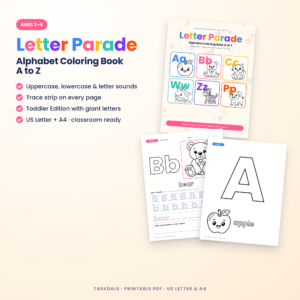
Letter Parade Alphabet Coloring Book A to Z
Price: $3.99 | Best for: ages 3 to 6 learning letter sounds
Each of the 26 pages shows a big uppercase and lowercase letter, a framed picture that starts with the letter’s sound (apple, bear, cat, dog, through to zebra), the word in hollow letters, three trace rows and a “Draw something else that starts with…” box. It also has letter hunts, matching pages and a Toddler Edition, in US Letter and A4.
For more ideas on fitting a letter into each day of the week, our guide to planning a themed preschool week shows how to build a letter-of-the-week routine.
Sound hunts and sorting games
Finished object pages can become a set of sound games that need no extra printing.
Beginning sound hunt
Draw or print a page with six small objects. Three start with the target sound, three do not. Your child colors only the ones that match. Sock, sun and seal get colored. Cat, dog and hat stay white.
Odd one out
Show three objects: ball, bus, cat. Which one does not start with “b”? Children love being the one who spots the trickster.
Make it harder over time by choosing tricksters that sound close: ball, bus and doll. The “d” and “b” sounds are both short and punchy, so a child really has to listen. Getting it right feels like a proper win.
Two-sound sort
Once two letters are learned, mix their objects. Your child sorts them into two piles, or colors one group red and the other blue. This is a step up, because now they have to listen carefully to each word.
Matching pairs
Matching pages help children spot what belongs together. The same skill they use to match a shadow to an object helps them match a sound to a letter later.
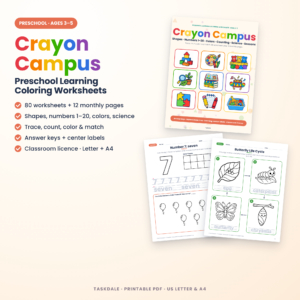
Crayon Campus Preschool Learning Coloring Worksheets
Price: $4.99 | Best for: ages 3 to 5, matching and word pages
Includes six matching pages (match the same, find the shadow, match the halves, which one is different and more), plus ten color pages where children trace a color word and color four objects that are usually that color. Shapes, numbers 1 to 20, counting and simple science round it out, with answer keys, in US Letter and A4 PDFs.
Bring in real objects: the sound basket
Pages are great, but nothing beats holding the real thing. A sound basket takes ten minutes to set up and gives you a week of games.
- Pick this week’s letter. Say it is B.
- Fill a basket with four or five B things from around the house: a ball, a button, a banana, a book, a toy bus.
- Add one or two tricksters that start with a different sound, like a spoon.
- Take each object out together. Say its name, stretch the first sound: “b-b-ball”. Does it go in the B pile?
- Color the letter page afterwards, with the basket beside you.
Children who struggle with paper often shine with a sound basket. Holding a banana and saying “b-b-banana” makes the sound feel physical. Then the coloring page becomes a record of what they found.
Rotate the basket each week and keep a photo of what was inside. After a few weeks, flick through the photos together and see how many objects your child can name by their first sound. It is a quick, playful review that costs nothing.
For toddlers: name the objects first
Two- and three-year-olds are usually not ready to hear first sounds in words. That is fine. What they can do is learn the names of lots of everyday objects, which is the vocabulary phonics will build on later.
At this age, choose coloring pages with clear, familiar objects: a puppy, a ball, a duck, a fire engine. Name them as your toddler colors. “Duck. Quack quack. Yellow duck.” Every new word is a small deposit in the bank they will draw on in preschool.
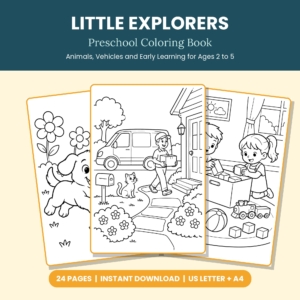
Little Explorers Preschool Coloring Book
Price: $3.49 | Best for: toddlers building first words
Twenty-four thick-outline pages of familiar animals and vehicles, from a puppy chasing a ball and a duck family parade to a digger, fire engine and tow truck. An early learning section adds counting ducks, animal homes and a tidy toy room full of objects to name. US Letter and A4 PDFs plus single-page PNGs are included.
For older siblings: hidden-object I spy
Older brothers and sisters often want to join in, but letter pages feel too babyish for an eight-year-old. Give them something harder instead: a detailed scene full of hidden objects. Then play I spy together. “I spy something beginning with f.” The older child finds the fox. The younger one shouts “fff, fox!”
It keeps everyone at the same table, and the preschooler gets extra sound practice from listening to the game.

Enchanted Forest Coloring Book
Price: $3.49 | Best for: older kids, teens and grown-ups
Thirty detailed woodland scenes with objects to search for as you color: a moonlit owl in an oak, a mushroom cottage, a fox among ferns, a hedgehog’s tea garden and more. It suits older kids, teens and adults who like fine linework, and comes as US Letter and A4 PDFs for personal use. Perfect for an older sibling or parent coloring beside a preschooler.
For a full A to Z of simple letter pages to go alongside, see our guide to alphabet coloring pages from A to Z.
A four-week letter-sound plan
Here is a gentle start for a four-year-old, about ten to fifteen minutes a day. It covers four high-use letters that are easy to hear and easy to draw: S, A, T and P. With just those four, a child can already build words like sat, pat, tap and sap later on.
| Week | Letter | Page | Game |
|---|---|---|---|
| 1 | S | Sun page, draw a sock | Sound basket: sock, spoon, sponge |
| 2 | A | Apple page, draw an ant | Odd one out with S and A objects |
| 3 | T | Tiger page, draw a tent | Beginning sound hunt for T |
| 4 | P | Pig page, draw a pan | Two-sound sort: T and P |
By the end of the month, your child knows four sounds well, can pick out first sounds in familiar words and has four colored pages to show for it. That is a real start, and a lovely thing to notice together.
Frequently asked questions
Why do alphabet pages need pictures?
The picture links the letter to a real word and its first sound. That link helps children remember the sound far better than the letter shape alone.
Should I teach letter names or letter sounds first?
Many families focus on sounds, because sounds are what children use to read. Names can be learned alongside without much effort.
What is a good picture for the letter X?
Very few simple words start with the x sound, so use a word that ends with it, like box or fox.
Why avoid “ship” for S or “chair” for C?
Those words start with a two-letter sound (sh and ch), not the plain letter sound. They can confuse children who are just learning.
What age are letter-and-sound coloring pages for?
Most children are ready around ages 3 to 5. Toddlers benefit from naming objects first, and the sounds follow later.
How do I know my child is hearing the first sound?
Ask them to name something else that starts the same way. If a child colors a moon and says “mum” or “milk”, they are hearing it. If they say “spoon”, give them a little more time with that letter.
Your next step
Choose this week’s letter, fill a basket with four objects that start with its sound and color the matching page together. Next week, add a second letter and play the two-sound sort. When you are ready for all 26 pages with pictures, Letter Parade has them done.