Twenty-six letters, twenty-six pages, one happy preschooler. Alphabet coloring pages are one of the simplest ways to introduce letters at home, and you can start tonight without spending anything. A thick marker, a sheet of paper and a few minutes per letter will get you from A to Z.
This guide is for parents, grandparents and preschool teachers looking for alphabet coloring pages A to Z, with free printable letters for preschoolers. You will learn what makes a good letter page, honest places to find free ones, a full A to Z list of easy pictures to draw for each letter, tips for the tricky letters, games to play with finished pages and how to turn them into a homemade ABC book. When you would rather not draw all 26, we also cover three Taskdale sets that do it for you.
Quick picks for A to Z pages
| Product | Best for | Price | Link |
|---|---|---|---|
| Letter Parade Alphabet Coloring Book A to Z | Full alphabet with tracing and a toddler edition | $3.99 | View |
| Roar to Z Dinosaur Coloring Book A to Z | An alphabet for dinosaur fans | $4.49 | View |
| Crayon Campus Preschool Learning Coloring Worksheets | Shapes, numbers and colors alongside letters | $4.99 | View |
What a good alphabet coloring page includes
Not every letter page teaches equally well. The best ones connect four things a child needs to know about a letter: its shape, its name, its sound and a word that starts with that sound. When all four sit on one page, the letter sticks.
- A big hollow letter to color. Big enough to fill a third of the page.
- Uppercase and lowercase together. So “B” and “b” become a pair in the child’s mind.
- One clear picture that starts with the letter’s main sound. Bear for B, not “bee”, which is easy to confuse with the letter name.
- The word written clearly underneath.
- A tracing row for children ready to try forming the letter.
A plain outline letter with nothing else is still fine for a toddler. For a four-year-old, the picture and sound make a big difference.
One more thing to check: the letter shapes themselves. Some fonts use a curly “a” with a hat on top, or a “y” with a loop. Children learn to write the simple round versions, so pages that use those same shapes avoid confusion later. A quick glance at the “a”, “g” and “y” will tell you.
Where to find free alphabet pages
Free alphabet pages are easy to find. A full, matching A to Z set that is clean, consistent and printable is a bit harder. Here are the honest options.
Ad-supported coloring websites
Big free coloring sites usually have an alphabet section. You can often find all 26 letters, though the style may change from letter to letter, and pages may carry the site name across the bottom. Expect some pop-ups on the way to the download.
Teacher-sharing sites
Teachers sometimes share their own letter pages free. Quality varies. Some are lovely, some are blurry. Check a few letters before printing the whole set.
Free samples
Many paid alphabet books offer the letter A or a few sample pages free. These are a good way to test a style, but you only get a taste.
Your own marker
The surest free source is you. A homemade letter page takes five minutes, and the next section gives you a picture idea for every letter so you are never stuck.
Before you print a free set
Print one letter first and check three things. Are the outlines dark enough after printing? Is the picture clearly the right word, so a duck does not look like a chicken? Does the page fit your paper without the edges being cut off? If the first page passes, the rest usually will too.
For a wider look at what is out there, free and paid, our guide to where to find good printable coloring pages compares the main options.
Make your own A to Z set: a picture for every letter
Here is how to draw a letter page in five minutes. Write the letter in pencil, about the height of your hand. Draw an outline around it a finger’s width out. Go over the outline in black marker and erase the pencil. Add a simple picture and the word. Done.
The hardest part is picking a picture that is easy to draw and starts with the right sound. This table does that for you.
| Letter | Easy picture | Letter | Easy picture |
|---|---|---|---|
| A | Apple | N | Nest |
| B | Ball | O | Octopus |
| C | Cat | P | Pig |
| D | Duck | Q | Queen’s crown |
| E | Egg | R | Rainbow |
| F | Fish | S | Sun |
| G | Goat | T | Turtle |
| H | Hat | U | Umbrella |
| I | Igloo | V | Van |
| J | Jar | W | Whale |
| K | Kite | X | Box (ends in x) |
| L | Leaf | Y | Yo-yo |
| M | Moon | Z | Zigzag |
Most of these are a circle, a few lines and a bit of detail. Even if you “can’t draw”, a sun is a circle with lines and a fish is an oval with a triangle tail. Your child will love that you made it.
Tips for the tricky letters
A few letters trip up parents and children alike. Here is how to handle them.
Vowels
A, E, I, O and U each make more than one sound. For preschoolers, stick with the short sound: a as in apple, e as in egg, i as in igloo, o as in octopus, u as in umbrella. Avoid “eagle” or “ice cream” for now, because they use the long sound, which can muddle things.
C and G
Choose hard sounds first: cat and goat, not circle and giraffe. The soft sounds can wait until later.
Q
Q almost always comes with U. “Queen” is the classic. Draw a simple crown if a whole queen feels too hard.
X
Very few easy words start with the X sound. Many teachers use a word that ends in X, like box or fox, and say “x makes a ks sound, like at the end of box”. It is honest and it works.
b, d, p and q
These lowercase letters are mirror images, and lots of preschoolers mix them up. Teach them on different weeks, never back to back, and always with their picture: b for ball, d for duck.
W and Y
The names of these letters do not sound like their sounds at all. “Double-you” says “w”, and “why” says “y”. Lean on the picture more than the name here. Whale and yo-yo give children a clear sound to hold onto, and the letter name can catch up later.
Games to play with finished letter pages
Once a few letters are colored, the pages become a game kit.
- Letter hunt: spread five pages on the floor. Call out a sound. Your child jumps onto the right letter.
- Find it at home: after coloring M, find three things in the house starting with M. Mug, mat, mitten.
- Letter snap: print two copies of six letters. Color both. Play snap when two match.
- Name spotting: line up the letters of your child’s name in order. Mix them up. Can they put them back?
- Sound walk: take the S page on a walk. Spot sun, sky, stones, shop.
- Mystery letter: cover a colored page with a sheet of paper and slide it down slowly. Who can guess the letter first?
Games turn a stack of colored pages into ten minutes of fresh practice every time, without printing anything new.
Turn your pages into an ABC book
A homemade alphabet book is one of the nicest things a preschooler can make. It also gives you a reason to keep going all the way to Z.
- Color one letter a week, or two if your child is keen.
- Keep finished pages in a folder so they stay flat.
- Make a cover together: “My ABC Book by Maya.”
- Punch holes and tie with ribbon, or slide pages into a cheap display book with clear pockets.
- Read it together. Your child “reads” the book to you, pointing at each letter and saying its sound.
Many children carry their ABC book around for weeks, showing anyone who will look. That pride is worth more than any sticker chart. Add a photo of your child holding each finished page, and the book becomes a keepsake as well as a learning tool. Toddlers can make one too, with just the big letter and a picture per page. Our preschool coloring pages guide has tips on paper and crayons for small hands.
When a ready-made A to Z set is worth it
Drawing your own pages is lovely, but many parents run out of steam halfway. Life gets busy. The letter J sits undrawn for three weeks. If that sounds familiar, a full printable set saves the effort and keeps the style consistent from A to Z.
A good set should give you every letter with a picture, uppercase and lowercase, tracing, and a few extras like matching and hunt pages so you have games built in.
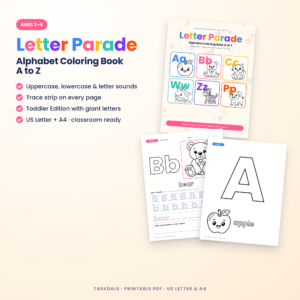
Letter Parade Alphabet Coloring Book A to Z
Price: $3.99 | Best for: preschoolers ages 3 to 6 and toddlers
Twenty-six pages from apple to zebra, each with a big hollow uppercase and lowercase letter, a framed picture, the word and three trace rows with start dots. Extras include an alphabet chart, four big-and-small matching pages, three letter hunts and a certificate. The Toddler Edition gives each letter its own giant page, and both come in US Letter and A4.
The tap-to-jump contents make it easy to print one letter at a time, so you can still go at your child’s pace and build your ABC book week by week.
You can also mix the two approaches. Use printed pages for most letters, and draw your own for the letters in your child’s name or for a family pet. A homemade “R is for Rufus” page sitting in a printed book is the page your child will show everyone.
Themed alphabets for kids with a passion
Some children do not care about apples and balls. They care about dinosaurs, or trucks, or horses. For these kids, a themed alphabet can be the key that unlocks letter learning.
A dinosaur alphabet works especially well, because every letter has a real dinosaur with a big, exciting name. A for Ankylosaurus. T for Tyrannosaurus. Children who would never sit for “A is for apple” will happily color, sound out and shout dinosaur names all afternoon.
The long names are part of the fun. A four-year-old does not need to read “Velociraptor”. They just need to hear that it starts with “vvv”, color the big V and practice saying the name with the say-it guide. The letter learning happens on the way to the dinosaur.
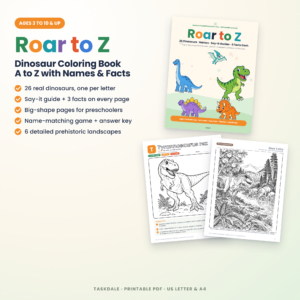
Roar to Z Dinosaur Coloring Book
Price: $4.49 | Best for: dinosaur-mad preschoolers and up
An alphabet adventure from Ankylosaurus to Zuniceratops, with each letter’s dinosaur name in big outline letters to color, a say-it guide and three facts. It also has eight big-shape pages for little ones, a clickable Dino ABC chart, a name-matching game and 26 fact cards, in US Letter and A4 PDFs.
Pairing letters with numbers and shapes
Letters are only one part of early learning. Many families find it easier to keep going when the week has a bit of variety: a letter on Monday, a number on Tuesday, a shape on Wednesday. Each one makes the others feel fresh.
If you want one set that covers the rest of the preschool basics alongside your alphabet pages, look for one-skill worksheets on shapes, numbers and colors in the same clean style.
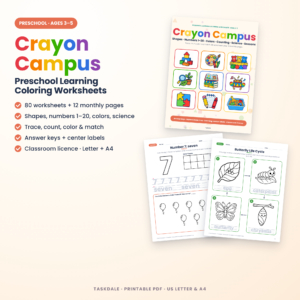
Crayon Campus Preschool Learning Coloring Worksheets
Price: $4.99 | Best for: families covering all preschool basics
Eighty one-skill worksheets on shapes, numbers 1 to 20, counting, colors, matching and simple science, plus 12 seasonal pages. Color-word pages pair neatly with letter work, since children trace words like “red” and “blue”. Answer keys and a skills checklist help you track progress, in 96-page US Letter and A4 PDFs.
Frequently asked questions
Where can I get free alphabet coloring pages A to Z?
Free coloring websites, teacher-sharing sites and sample pages from paid sets all have some. Or draw your own using the picture list in this guide.
Should alphabet pages show uppercase and lowercase?
Yes, ideally both on the same page. It helps children see them as a pair from the start.
What order should I teach the alphabet in?
A to Z works fine. Many parents start with the letters in their child’s name, then fill in the rest.
How many letters a week should a preschooler learn?
One letter a week is a gentle, steady pace. Some children enjoy two. Follow their interest.
What age are alphabet coloring pages for?
Big letter pages suit ages 2 to 4. Pages with pictures, sounds and tracing suit ages 3 to 6.
Can I print alphabet pages for my class?
Your own drawings, yes. For other pages, check the terms. Letter Parade and Roar to Z allow one teacher to print for their own class.
Your next step
Pick the first letter of your child’s name and draw it tonight using the picture table above. Color it together tomorrow and start a folder for your ABC book. If you would rather print all 26 in one go, Letter Parade has them ready.