A two-year-old will not color a lion carefully. They will grab the orange crayon, scrub at the mane for forty seconds, roar, and move on. That is a perfect coloring session. The best animal coloring books for toddlers are built for exactly that: one big animal, thick lines, and nothing fiddly to get wrong.
This guide is for parents, grandparents and childminders with a child between about 2 and 4. You will find the animal themes that hold a toddler’s attention, what a good toddler page looks like, and small games that sneak in early skills like naming colors, counting and holding a crayon properly. There are three printable books from Taskdale at the end of each section, if you want pages ready tonight.
Quick picks for little hands
| Product | Best for | Price | Link |
|---|---|---|---|
| Little Explorers Preschool Coloring Book | Ages 2 to 5, animals plus vehicles and early learning | $3.49 | View |
| Farm Animals Coloring Book | Barnyard fans who love animal sounds | $3.49 | View |
| Ocean Life Coloring Book | Bath-time and beach lovers | $3.49 | View |
What a toddler really learns from coloring an animal
Coloring at this age is not about a neat picture. It is hand practice with a reward attached. Every time a toddler wraps their fist around a crayon and drags it across the page, the small muscles in the hand and wrist get a workout. Six months later, that same child holds a crayon between thumb and fingers instead of in a fist. That shift is the start of writing.
Animals add something extra. Toddlers already care about them. A child who says “moo” twenty times a day will happily sit with a cow, and while they color you can talk. What does the cow say? Where does she live? Is she big or little? A single page becomes a short conversation, and conversation is how vocabulary grows.
There are quieter wins too. Sitting still for five minutes is a skill. So is finishing something and handing it to a grown-up with pride. Watch a three-year-old run to show you a purple duck and you will see what that small finish means to them.
Skills you can expect to see
- Grip and control. From whole-arm scribbles at 2 to small circles and stabs at 3.
- Color names. “Red” and “blue” first, then the trickier ones like purple and gray.
- Animal names and sounds. Easy to practice because the animal is right there.
- Simple counting. Three ducks, two piglets, one whale.
- Attention span. A few minutes longer each month, if the pages are easy enough.
How to spot a page that suits a two-year-old
Most coloring pages are drawn for older kids, and toddlers can tell. Too many small shapes and they give up fast. Here is what to look for before you print anything.
Thick outlines. A heavy black line gives a wobbly crayon something to bump against. Thin lines vanish under the first scribble.
One animal, big in the middle. A single puppy filling most of the page beats a busy park scene with ten tiny details. Toddlers color the biggest shape first and often stop there. Let the biggest shape be the animal.
Open spaces, not patterns. Leaves, scales and fur textures look lovely to adults. To a toddler, they are a wall of tiny boxes. Plain, smooth body shapes are better.
Something to talk about. A duck with ducklings, a bear holding a ball. A little action gives you a question to ask.
That is why the Little Explorers book is a strong first buy for this age group. It was drawn for small hands, with wide shapes that a fat crayon can fill.
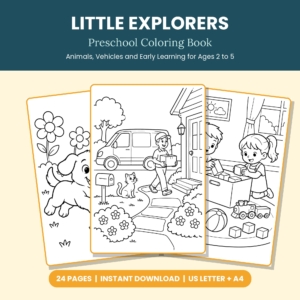
Little Explorers Preschool Coloring Book
Price: $3.49 | Best for: toddlers and preschoolers ages 2 to 5
24 simple pages split into three themes: Friendly Animals (a garden puppy, bunny picnic, sea turtle, duck family parade), Busy Vehicles, and Early Learning pages with counting ducks, shapes and big-and-small animals. You get US Letter and A4 PDFs plus every page as a separate PNG. Start with the Duck Family Parade page and count the ducks together.
If you want a wider spread of animal sets once your child is a bit older, our roundup of safari, farm, ocean and woodland coloring pages covers the next step up.
Easy animal themes that hold a toddler’s attention
Some themes simply work better at this age. They link to things a toddler already knows from books, songs and trips out.
Farm animals
The farm is the classic toddler theme for good reason. Cows, pigs, sheep, hens and horses are big, rounded, and each comes with a sound. Sing “Old MacDonald” while you color and you have a full music lesson on top. A farm page is also a lovely follow-up to a petting zoo visit. Color the goat you fed on Saturday and the memory sticks.
Ocean animals
Whales, turtles, fish and octopuses are simple shapes with lots of open space inside. They also make blue and green feel exciting rather than boring. Many toddlers will happily color a fish in every color they own, and that is fine. Real reef fish come in rainbow shades anyway.
Pets and garden friends
Puppies, kittens, bunnies and ducks are animals a child sees every week. They are the easiest to name, and the easiest to connect to real life. “That’s like Grandma’s cat” is a whole conversation.
Big wild animals
Elephants, lions and bears are thrilling for a three-year-old. Keep them friendly and simple. A smiling elephant by a pond works. A detailed lion hunting in long grass does not.
For farm-mad kids, a dedicated barnyard book gives you a full month of animal sounds.
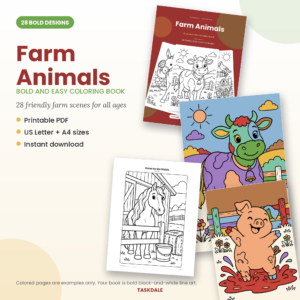
Farm Animals Coloring Book
Price: $3.49 | Best for: toddlers who love barnyard animals
28 bold, easy pages with thick outlines: a cow in a meadow, a pig in a puddle, fluffy sheep, a hen with eggs, a goat on a fence and a rooster at sunrise. It comes as US Letter and A4 PDFs, so it prints at home without resizing. Pick the pig in a puddle first. Brown crayon, lots of mud, very happy toddler.
Five little games for any animal page
You do not need a lesson plan. One page and a few questions turn coloring into learning without the child noticing. Try one game per session, not all five.
- What does it say? Before the first stroke, ask for the animal’s sound. Then ask again halfway through. Toddlers love being asked something they know.
- Pick two colors. Hold up two crayons and say the names. “Red or yellow for the hen?” Choosing between two is easier than facing a whole box, and it repeats color words naturally.
- Count the friends. On a page with three ducklings, touch each one and count out loud. Then color them one at a time, counting again.
- Big and little. Find the biggest animal on the page and the smallest. Color the big one first.
- Where does it live? Fish live in water, so draw some wavy blue lines. Cows live in fields, so scribble green grass. Now the child is adding to the picture, not just filling it.
An ocean book is great for game five, because water is the easiest background a toddler can make. Big blue scribbles count.
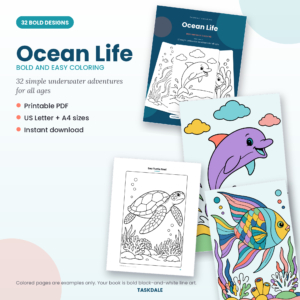
Ocean Life Coloring Book
Price: $3.49 | Best for: little ones who love sea animals
32 bold, easy underwater pages with a friendly dolphin, a sea turtle, a smiling octopus, a humpback whale and a curious seahorse. Each design sits on its own page, with US Letter and A4 PDFs and a Word user guide. For a toddler, print the whale or the dolphin first. They are the biggest, simplest shapes in the book.
Crayons, paper and printing for small hands
The right tools make a bigger difference than the right pages. A two-year-old with a thin pencil will be frustrated in a minute.
Crayons and markers
Chunky or egg-shaped crayons suit ages 2 and up because they fit a fist. Triangular crayons help nudge fingers into a better grip and do not roll off the table. Washable markers give bright color with almost no pressure, which suits kids who press lightly. Skip fine-tip pens and colored pencils until closer to 4.
Paper
Ordinary printer paper is fine for crayons. If you use markers, a heavier sheet stops bleed, and a spare page underneath protects the table. Print on the side you want and tape the corners down. Paper that slides around is the most common reason a toddler gives up.
Printing
Print at 100 percent, not “fit to page”, so the lines stay thick. Print one or two pages at a time instead of the whole book. A stack of 28 pages on the table looks like homework, even to a toddler. One page looks like play.
And keep spares. A printable book means a torn cow is not a tragedy. You just print another.
A ten-minute routine toddlers will actually repeat
Toddlers like the same thing at the same time. Here is a simple routine that works after lunch or before bath.
- Minute 1: Let the child choose between two printed pages. Just two.
- Minute 2: Name the animal together and make its sound.
- Minutes 3 to 8: Color side by side. You take your own copy of the same page.
- Minute 9: Ask one question. “What color is the turtle?”
- Minute 10: Write their name and the date, then tape it up.
That last step is the one kids remember. A fridge door covered in scribbly pigs is a small gallery, and a child who sees it every morning wants to add to it. Some families keep a folder per month, so by the end of the year you can flip through and watch the scribbles turn into shapes. It is genuinely moving to see.
If ten minutes is too long, stop at five. End while the child still wants more, and tomorrow they will ask for the crayons themselves.
Common mistakes that put toddlers off coloring
Most of these come from love. They still backfire.
Correcting the colors. A blue cow is a fine cow. If you say “cows are brown”, a toddler hears “you did it wrong.” Ask about their choice instead. “A blue cow! Is she cold?”
Asking them to stay in the lines. Inside-the-lines control comes later, usually around 4 or 5. Before that, the line is a rough guide.
Too many crayons. A box of 64 is overwhelming. Put out four or five. You can swap them each day.
Pages that are too detailed. Adult and older-kid books are lovely, but they are not for this age. If your toddler only colors one corner and walks away, the page is probably too busy.
Sessions that run too long. A 2-year-old’s attention for a sitting task is short. Two minutes of real focus is a good day.
When an animal coloring book is not the right pick
Animal books suit most toddlers, but not all of them, and not all the time.
A child under about 18 months will mostly chew the crayon. That is normal. Wait a few months and try again with one big crayon and a blank sheet before you bring out pages.
Some toddlers simply care more about trucks, diggers or trains. Follow the interest. Little Explorers has a full vehicles section for that reason, so one book can cover both moods.
And if your child is closer to 5 and asking for more detail, they may be ready for scenes with backgrounds and smaller parts. Bold and easy books still work at that age, but you might find they finish them in minutes and want something to chew on.
Frequently asked questions
What age can a toddler start using a coloring book?
Most children can start scribbling with a chunky crayon somewhere around 15 to 18 months. Simple animal pages with thick lines usually make sense from about age 2.
Are printable coloring pages better than store-bought books for toddlers?
For this age, printables have one big advantage: you can reprint a favorite page as often as you like. Toddlers love repeating the same animal, and a torn page is easy to replace.
What animals are easiest for toddlers to color?
Rounded, simple animals like whales, ducks, pigs, turtles and cows. They have big open body shapes and no fiddly fur or feather patterns.
How long should a toddler coloring session last?
Anything from two to ten minutes is normal. Stop when interest fades rather than pushing to finish the page.
Should I teach my toddler to color inside the lines?
Not yet. Let them scribble freely. Control comes with practice and age, and pressure tends to make kids avoid coloring altogether.
Your next step
Tonight, print one page with a single big animal, put out four chunky crayons, and color it beside your child for five minutes. Then tape it to the fridge. If you want a stack of toddler-ready pages that also cover counting and shapes, start with the Little Explorers Preschool Coloring Book.
For more simple ideas at this age, our preschool coloring pages guide explains how to move from big shapes to the next level.