Managing your own money comes down to five jobs: know what comes in, decide where it goes, pay the bills on time, put some aside, and chip away at what you owe. That is the whole list. Everything else, from apps to envelopes to color-coded binders, is just a way of doing those five jobs with less effort.
This guide is for anyone who never got a proper lesson in personal money management basics. Maybe you left home, got a paycheck and figured it out as you went. Maybe you have a partner, two kids and a car loan, and the system you used at 22 has stopped working. Either way, you will get a clear order of steps, a worked example with real numbers, a weekly routine that takes about 20 minutes, and a short list of tools if you want help.
No lectures. No shame about the past. Just the basics, laid out so you can start this week.
Quick picks: tools for getting your money in order
| Product | Best for | Price | Link |
|---|---|---|---|
| Offline Budget App | A private, all-in-one budget on your own computer | $12.99 | View |
| Rooted & Rich Money Mindset Workbook | Beginners who want lessons plus budget worksheets | $17.99 | View |
| Money Mindset Workbook | Understanding why you spend the way you do | $6.49 | View |
| Financial Anxiety Workbook | People who avoid bills and bank statements | $17.99 | View |
What personal money management actually covers
People often think money management means budgeting. Budgeting is one piece. The full picture has five parts, and they work best in this order.
- Income. What arrives, from where, and on which dates.
- A spending plan. Where each dollar is meant to go before the month begins.
- Bills. The fixed costs that leave on their own schedule, whether you are ready or not.
- Savings. A cushion for emergencies, plus money set aside for costs you know are coming.
- Debt. A plan to pay balances down instead of just keeping them alive.
Why that order? Because you cannot plan spending until you know your income, and you cannot save with any confidence until the bills are covered. Skip ahead and things wobble. A person who opens a high-interest savings account before they know when rent leaves their checking account will end up pulling that money back out on the 2nd of the month. It happens all the time.
Investing, retirement accounts and insurance all matter too. They sit on top of these five. Get the foundation steady first and those bigger decisions become much easier to think about.
Step one: know exactly what comes in, and when
Write down every source of money that reaches you in a normal month. Salary, side gigs, child support, a regular transfer from a partner, benefits. Next to each one, write the amount after tax and the date it lands.
The dates matter more than most people expect. Someone paid $1,900 on the 1st and $1,900 on the 15th has the same monthly income as someone paid $3,800 on the 28th. Their months feel completely different. The first person has to split rent, car and phone across two paychecks. The second has a long, thin stretch at the end of every month.
If your income changes month to month
Freelancers, servers, nurses on shifts and anyone on commission should look back at the last six months and find the lowest month. Plan your basics around that number. Anything above it is a bonus that goes to savings or debt once it has actually arrived. It feels cautious, and it is. That is the point. A lean month stops being a crisis when your plan already expected it.
Step two: give your money a plan before the month starts
A spending plan is just a list of categories with an amount next to each. Housing, groceries, transport, phone, childcare, fun money, savings, debt payments. The total of the categories should match your income. When it does, every dollar has a job, and you stop wondering where the money went.
This approach is called zero-based budgeting, and our guide on giving every dollar a job walks through it in more detail. The short version: income minus planned spending should equal zero. Not because you spend it all, but because savings and extra debt payments count as jobs too.
A worked example
Take Dana, who brings home $3,600 a month. Her plan looks like this: rent $1,250, groceries $420, car payment and insurance $390, gas $140, phone and internet $120, utilities $160, kid activities $90, eating out $120, personal spending $150, savings $400, extra on her credit card $260, and a $100 buffer. Add it up and it lands on exactly $3,600.
Does she hit every number? No. Groceries ran $455 last month. But she moved $35 from eating out and still finished the month with the savings transfer done. That small win is what keeps people going. The plan bends instead of breaking.
You can do this on paper, in a spreadsheet or in an app. If you would rather not hand your bank login to a company, a tool that runs on your own machine is worth a look.
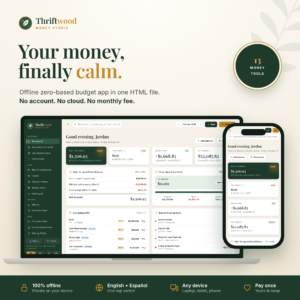
Offline Budget App
Price: $12.99 | Best for: private budgeting without bank logins
Thriftwood Money Studio is a single HTML file that opens in your browser and keeps every number on your own device. It is built for zero-based budgeting, with a live To assign counter, bill reminders, a paycheck planner, savings goals, a debt payoff calculator and bank CSV import. Start by entering your accounts and next month’s income, then assign each dollar until the counter hits zero.
Step three: bills, buffers and the costs you forget
Bills are the part of personal money management that punishes you fastest. Miss a due date and you pay a late fee, sometimes a hit to your credit report too. So list every bill with its due date and amount, then sort the list by date.
Now look at that list next to your paydays. If your car payment is due on the 3rd and you get paid on the 5th, ask the lender to move the date. Many will, and it costs nothing but a phone call. One five-minute call can save you a $35 late fee every few months.
Sinking funds for the yearly stuff
The costs that wreck budgets are rarely the monthly ones. It is the $600 car insurance renewal in March, the $180 for school photos and field trips in September, the holiday gifts in December. These are not emergencies. You knew they were coming.
The fix is a sinking fund. Add up your yearly costs, divide by 12 and set that amount aside each month. If your irregular costs total $2,400 a year, that is $200 a month. When the insurance bill arrives, the money is already sitting there. The relief of paying a big bill without touching your credit card is hard to describe until you feel it.
Keep these papers and due dates somewhere you can find them. A simple home management binder with a bills page and a yearly calendar works well for families who like paper.
Step four: savings and debt, side by side
People ask which comes first, saving or paying off debt. The practical answer is a bit of both, in a set order.
- A starter emergency fund. Aim for $500 to $1,000 in a separate account. This covers a flat tire or a vet visit without new debt.
- Minimum payments on everything. Always. Late payments cost more than any plan saves.
- Extra money to one debt at a time. Pick either the smallest balance (quick wins) or the highest interest rate (less interest paid overall). Both work. Choose the one you will stick with.
- A fuller emergency fund. Once high-interest debt is gone, build toward three months of basic costs.
Here is how it plays out. Marcus has three cards: $480, $1,900 and $4,200. He pays the minimums on all three and throws an extra $200 at the $480 card. It is gone in about two months. Then the $200 plus that card’s old minimum rolls onto the $1,900 balance. Each payoff speeds up the next one. He crossed off the second card ten months later, and he still talks about the day he cut it up.
Automate what you can. A savings transfer set for the day after payday happens whether you remember it or not. Same with debt payments. The less you have to decide each month, the more often the right thing happens.
The habits and feelings behind the numbers
You can know all four steps above and still not do them. Most people who struggle with money are not short on information. They are tired, or anxious, or they learned some odd rules about money as kids and never questioned them.
Maybe your parents never talked about money, so checking your balance feels like peeking at something forbidden. Maybe you grew up with very little, and now you spend the moment money arrives because some part of you expects it to vanish. Those patterns are common. They are also changeable, slowly, with some honest reflection.
A workbook gives that reflection a shape. You answer questions, spot your patterns on paper and turn them into one small change at a time. If you want lessons on budgeting and saving mixed in with that mindset work, this is a gentle starting point.

Rooted & Rich Money Mindset Workbook
Price: $17.99 | Best for: beginners who feel stuck about money
Rooted & Rich is an 83-page fillable and printable PDF in US Letter and A4, with an Ink-Saver edition for home printing. It has nine short lessons, 34 guided worksheets and nine bonus tools covering money beliefs, spending psychology, goals and a budget that fits your life. Read the first lesson, then fill in one worksheet this week rather than trying to finish the whole thing.
When money makes you anxious: start smaller
Some people cannot even get to step one. Opening the banking app makes their chest tight. There is a stack of unopened envelopes on the counter. If that sounds like you, you are not lazy and you are not bad with money. Avoidance is a very normal reaction to stress.
The trick is to make the first task tiny. Not “do a budget.” Just “open one envelope today.” Tomorrow, write down one balance. The day after, list three bills. Small, boring steps lower the fear, and after about a week the big task has shrunk to something you can face.
Two more things help. First, separate facts from fears on paper. “I owe $2,300 on the card” is a fact. “I will never get out of this” is a fear. Writing them in two columns shows you which one you can actually do something about. Second, pick a set time. Ten minutes on Sunday morning with a coffee is far easier than an open-ended promise to “look at my finances soon.”
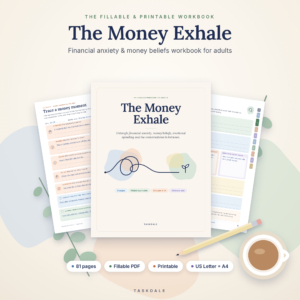
Financial Anxiety Workbook
Price: $17.99 | Best for: anyone who avoids looking at money
The Money Exhale is an 81-page fillable and printable PDF in US Letter and A4, with a Word user guide. Its eight parts cover facts versus worries, money beliefs, emotional spending, opening avoided mail and preparing for money conversations with partners and family. Begin with the starting snapshot and money weather check-in in part one, which take about 15 minutes.
A 20-minute weekly money routine
Monthly budgeting is good. Weekly check-ins are what make it work. Pick the same day each week. Sunday evening and Friday lunch are popular. Then run this list.
- Check balances (3 minutes). Checking, savings, credit cards. Just look.
- Log or review spending (7 minutes). Match transactions to categories. Note anything surprising.
- Look at the next 14 days of bills (3 minutes). Is the money there for each one?
- Adjust one category (3 minutes). Groceries ran high? Pull from eating out. Done.
- One small win (4 minutes). Move $20 to savings, pay $25 extra on a card, cancel one unused subscription.
That last step matters more than it looks. Ending each check-in with something you did, rather than something you worried about, changes how you feel about the whole habit. After two months of this, most people find they actually look forward to it. Odd, but true.
If you like seeing everything on one screen, our guide to running your money from a personal finance dashboard shows how to set one up so the weekly check takes even less time.
Common mistakes that knock beginners off track
- Making the budget too tight. A plan with $0 for fun lasts about three weeks. Give yourself some personal spending, even $50.
- Forgetting irregular costs. Haircuts, gifts, annual subscriptions. If it happens every year, it belongs in the plan.
- Tracking without deciding. Logging every coffee is useless if the numbers never change a choice. Tracking is there to inform the plan.
- Quitting after one bad month. Everyone overspends sometimes. Adjust next month’s numbers and carry on.
- Using too many tools. Three apps, a notebook and a spreadsheet means nothing is up to date. Pick one main place.
- Keeping a partner out of it. If you share bills, share the plan. A 15-minute monthly money date beats months of quiet resentment.
Who should start with mindset work instead of a spreadsheet
A spreadsheet is the right first tool for someone who just needs structure. They know they should budget; they have just never set one up. Give them categories and a total and they are off.
It is the wrong first tool for someone who has started five budgets and dropped them all within a month. For that person, the numbers are not the problem. Something underneath keeps pulling them off course, and another template will meet the same fate.
If you recognize yourself in that second group, spend two or three weeks on the why before the how. Work out where your money rules came from and what you reach for when stress hits.
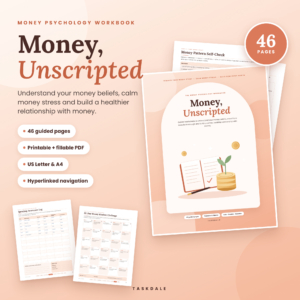
Money Mindset Workbook
Price: $6.49 | Best for: repeat budget quitters and couples
Money, Unscripted is a 46-page money psychology workbook, fillable or printable, in US Letter and A4. It covers money scripts, the scarcity loop, emotional spending and couples money talks. You begin with a Money Mindset Check-In that scores ten statements out of 100, then score them again at the end to see the change.
Frequently asked questions
What are the basics of personal money management?
Five jobs: track your income and paydays, make a spending plan before the month starts, pay bills on time, build savings for emergencies and known costs, and pay down debt on a set plan. Do them in that order.
How much of my income should I save?
Start with whatever you can do every month without pulling it back out. Even $25 a paycheck builds the habit. Many people work toward 10 to 20 percent of take-home pay over time, once debt and bills are steady.
Should I pay off debt or build an emergency fund first?
Build a small starter fund of $500 to $1,000 first, while paying minimums on every debt. Then put extra money toward debt. Without that cushion, the next surprise expense lands right back on a credit card.
What is the easiest way to start budgeting with no experience?
List your monthly take-home pay, then list your fixed bills. Subtract. What is left is what you have for groceries, gas, fun and savings. Split it across those categories and check in once a week.
How often should I check my bank account?
Once a week is enough for most people, during a short set routine. Daily checking can feed anxiety. Monthly checking lets problems grow for too long.
Your next step
Tonight, write down your take-home pay and the dates it arrives, then list every bill with its due date beside it. That one page is the foundation for everything else in this guide. When you are ready to turn it into a full monthly plan with bill reminders and a debt payoff tracker, set it up in the Offline Budget App and run your first weekly check-in this Sunday.