Most anime colouring goes wrong before the first stroke. Someone picks a nice pink for the hair, a nice blue for the eyes, a nice red for the jacket, and the finished page looks flat and slightly off. The problem is not the colours. It is the palette. Anime colouring book colour palettes work when every part of the character has a planned light, base and shadow tone, and those tones agree with each other.
This guide is for teens and adults who love anime-style art and want their pages to look like the cover of a light novel, not a muddy fridge drawing. You will learn the four-tone palette method, how to shade hair, eyes, skin and outfits step by step, and how to test a palette before you commit. Three printable Taskdale books are featured for practice, including one built around coded palettes and shading guides.
Quick picks for palette practice
| Product | Best for | Price | Link |
|---|---|---|---|
| Ink and Glint Manga Coloring Book | Coded palettes plus hair, eye and skin shading guides | $4.99 | View |
| Lumen and Lead Stained Glass Coloring Book | Practising light-to-dark colour runs with markers | $4.49 | View |
| Swish and Shade Digital Coloring Pages | Testing palettes on a tablet before using paper | $4.99 | View |
The four-tone method behind every good anime palette
Anime art looks clean because it uses very few tones per area, and each one has a job. For every part of a character (hair, skin, eyes, each piece of clothing), plan four:
- Light: the highlight, where light hits hardest. Often close to white.
- Base: the main colour you see first. This fills most of the area.
- Shadow: a darker, slightly cooler or warmer version of the base. It goes under fringes, inside folds, beneath the chin.
- Deep: the darkest accent, used sparingly. The very edge of a fold, the pupil, the line where hair meets neck.
Four tones. That is it. When you have them written down before you start, every decision on the page becomes easy. You are never staring at a box of 72 pencils wondering which brown to pick.
Why shadows should shift hue
This is the trick most beginners miss. A shadow is not just the base colour with black added. Black makes colours dull and muddy. Instead, nudge the shadow towards a neighbouring hue. Pink hair gets a shadow that leans purple. Yellow hair gets an ochre or orange-brown shadow. Light skin gets a shadow that leans warm pink or peach. The page stays bright and alive, even in the dark areas.
Pick a light source first
Before any colour, decide where the light comes from. Top left is the classic choice. Draw a tiny sun in the corner of the page if it helps. Every shadow then falls on the opposite side, and every highlight faces the sun. One light source is the single biggest step from “coloured in” to “looks finished”.
Building a palette you can trust
Professional colourists rarely invent a palette on the page. They test it first. Here is a simple way to do the same at the kitchen table.
- Make a swatch card. Take a scrap of the same paper you will colour on. Draw four small circles for each area: hair, skin, eyes, top, bottom.
- Fill each row light to deep. Check that the four steps look like a smooth staircase, not a jump from pale to very dark.
- Lay the rows side by side. Does the hair shadow clash with the jacket base? Does the skin look grey next to a bright outfit? Swap one pencil and test again.
- Write the names down. Pencil and marker names, or numbers. Next time you colour the same character, you can repeat the look exactly.
It takes ten minutes. It saves an hour of fixing. And there is a real thrill when the swatches click and you can see the finished character in five rows of circles.
A book that gives you tested palettes with named roles takes away most of the guesswork while you learn.
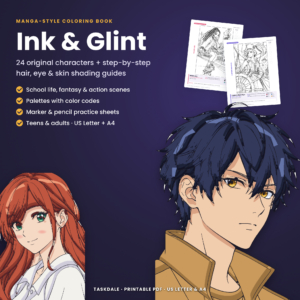
Ink and Glint Manga Coloring Book
Price: $4.99 | Best for: teens and adults learning anime shading
Twenty-four original anime-style characters in school-life, fantasy and action scenes, each with a profile, a suggested four-colour palette and a shading tip. Six step-by-step guides cover light and shadow, long hair, dark hair with cool highlights, sparkly eyes, sharp eyes and skin tones. There are 42 coded palettes in all, including 12 skin tones and 16 hair palettes, with light, base, shadow and deep roles. Start with the skin tone guide, then colour one character using its suggested palette.
If you are shopping for a teenager who is not sure anime is “their thing” yet, our list of colouring pages for teens that don’t feel babyish has a few other styles to compare.
How to shade anime hair
Hair is where anime style really shows. It is drawn in large clumps, not single strands, and you shade the clumps.
Step by step
- Base first. Fill all the hair with your base colour in smooth, even strokes that follow the direction the hair falls.
- Shadow under clumps. Where one clump sits on top of another, add shadow just underneath. Also shade under the fringe, behind the ears and at the back of the head away from the light.
- Deep in the darkest gaps. A thin line of the deep tone where hair parts or tucks behind the neck.
- Highlight band. Anime hair often has a shine band across the crown, a curved ring of lighter colour. Leave it as bare paper, or add your light tone in short zigzag strokes that follow the curve of the head.
Palette ideas for hair
- Black hair: do not use pure black as the base. Use a very dark navy or charcoal, with a cool blue-grey highlight. Pure black has nowhere to go.
- Blonde: pale lemon light, warm yellow base, ochre shadow, a touch of brown for deep.
- Brown: cream light, caramel base, chestnut shadow, dark chocolate deep.
- Pink: almost-white light, candy pink base, raspberry or mauve shadow, plum deep.
- Silver or white: leave lots of bare paper, use pale lilac or blue-grey for shadows. It looks magical.
How to colour expressive anime eyes
Eyes carry the emotion of the whole page, so give them the most care. They are small, so use sharp pencils or fine marker tips.
- Light base across the iris. Start with the lightest iris colour everywhere.
- Darken the top third. The upper eyelid casts a shadow, so the top of the iris is darker. Blend it down into the base.
- Add the pupil. Use the deep tone, not pure black, unless the design calls for it.
- Glow at the bottom. A lighter, brighter tone near the lower edge makes the eye look lit from within.
- Keep the catchlights white. Those small white ovals are what make anime eyes sparkle. Never colour over them. If you do, a white gel pen will bring them back.
Fun fact for palette planning: eye colour is a great place for contrast. A character with warm orange hair looks striking with teal or green eyes, because the two colours sit opposite each other on the colour wheel.
Skin tones that look warm, not grey
Skin is the area where muddy shading shows most. Keep the shadows warm. For light skin, use a pale peach base with a soft pink or coral shadow. For medium skin, try a golden tan base with a warm terracotta shadow. For deep skin, use a rich brown base, a deeper red-brown shadow and a cool highlight with a slight blue or lilac hint on the cheekbones and nose. Each tone looks rich and alive.
Where do the shadows go? Under the fringe across the forehead. Beneath the chin onto the neck. Inside the ear. A small curve under the lower lip. Then add a whisper of blush across the cheeks and the tip of the nose. That blush is very anime and very charming.
Outfit palettes: uniforms, armour and streetwear
Clothes are where you can tell a story with colour. A school uniform says one thing. Battle armour says another.
School uniforms
Navy blazer, white shirt, a pop of red at the tie or bow. Shade white shirts with pale blue-grey, never beige, or they look dirty. Navy shadows can lean towards deep indigo.
Fantasy robes and mage outfits
Rich jewel tones work best: emerald, sapphire, amethyst, with gold trim. Shade gold with ochre and a touch of brown, and leave tiny white specks for shine.
Action and sci-fi gear
Greys and blacks with one neon accent. Charcoal jacket, silver panels, bright cyan or magenta lights. The neon only works if it is the brightest thing on the page, so keep everything around it muted.
Folds and creases
Fabric folds are Y shapes and long curves. Put shadow inside each fold and the deep tone right at the bottom of the crease. Elbows, knees and waistbands all bunch up and need shadow.
One useful habit is practising a run of four tones on simple closed shapes before you try them on a character. Big, framed panes are perfect for that.
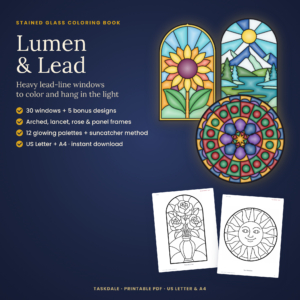
Lumen and Lead Stained Glass Coloring Book
Price: $4.49 | Best for: marker users practising colour runs
Thirty-five window designs with heavy lead lines and large panes, in arched, gothic, rose and panel frames. It includes 12 named palettes that show which colours glow side by side, and you colour each pane light to dark. It prints on US Letter and A4. Use one window as a palette rehearsal: colour every pane in the same four-tone run you plan to use on an outfit.
Cel shading or soft shading?
Anime uses two main styles, and you can use either on paper.
Cel shading has hard edges. The shadow is a clear shape with a crisp border. It looks like a TV frame. Alcohol markers are perfect, because they lay down flat, even colour. Lay the base, let it dry, then add the shadow shape on top.
Soft shading blends gently from light to dark. It looks more like a painted illustration. Coloured pencils are easiest here. Use light pressure and build layers, blending each tone into the next.
Many colourists mix them: cel shading for hair and clothes, soft shading for skin and eyes. Try both on one character and see which you enjoy. There is no wrong choice.
For more on choosing pens and the right paper to print on, see our guide to the best markers for adult colouring books.
Test palettes on a screen first
If you have a tablet, you can try three or four palettes on the same line art in minutes, with an undo button. Then you pick the winner and colour it on paper. It saves pencils and stops you committing to a palette you end up disliking.
Apps like Procreate and Ibis Paint let you colour a transparent line art layer and change colours freely. Even a simple, non-anime page is good practice for the four-tone method, because you can drop in light, base, shadow and deep and see the effect immediately.

Swish and Shade Digital Coloring Pages
Price: $4.99 | Best for: tablet users testing colour ideas
Sixty digital colouring pages as transparent PNGs plus a hyperlinked PDF for GoodNotes, Notability and Xodo, made for Procreate and Ibis Paint. It is designed for kids, with toddler, kids, detailed and phone travel sets, so it suits a younger sibling too. For palette practice, use the detailed set to try the same four tones in three arrangements before you pick up your pencils.
Fixing common palette problems
The page looks muddy. You probably used black or brown for every shadow. Swap to hue-shifted shadows: purple-ish under pink, blue-ish under white, orange-ish under yellow.
The character looks flat. Not enough contrast between base and shadow. Push the shadow one step darker, and make sure your highlights are truly light.
Too many colours fight. Count them. If the outfit alone has six different hues, pull it back to two plus a small accent.
The face looks grey. The skin shadow is too cool. Warm it up with peach, coral or a red-brown.
Eyes look dead. The catchlights were coloured over. Add them back with a white gel pen.
Every one of these is easy to fix next time, and fixing it once teaches you more than any tutorial.
Frequently asked questions
How many colours do I need for anime colouring?
Four tones per area is enough: light, base, shadow and deep. A full character might use 15 to 20 pencils or markers in total.
Should I use alcohol markers or coloured pencils for anime pages?
Markers suit crisp cel shading, and pencils suit soft blended shading. Many people use markers for flat base colour and pencils for details.
How do you colour black anime hair?
Use a very dark navy or charcoal as the base instead of pure black, and add cool blue-grey highlights. That leaves room for shine.
Where do highlights go on anime eyes?
Keep the white catchlights clear, usually one large and one small oval in the upper part of the iris. Brighten the lower part of the iris for glow.
Can beginners follow an anime colour palette?
Yes. Using a ready-made palette with named roles is the easiest way to learn, because you only have to follow the light, base, shadow and deep order.
Your next step
Before your next page, make a five-row swatch card for hair, skin, eyes, top and bottom, and pick your light source. Then colour one character with that plan. For tested palettes and step-by-step shading guides on original characters, try the Ink and Glint Manga Coloring Book.