Colouring in for children looks like a simple way to fill a wet afternoon. It is that. It is also quiet practice for nearly every skill a child needs before they can write their name: how to hold a crayon, how to steer it, how to stop at a line, how to sit with one task for ten minutes. The trick is giving each child pages that match where their hands and attention are right now.
This guide is for parents, grandparents, childminders and nursery or primary teachers. You will find an age-by-age guide to what children can do and which pages suit them, the skills colouring builds and how to nudge each one along, signs a page is too hard or too easy, and simple ways to turn colouring into early learning without it feeling like school. We also share three printable Taskdale sets that cover toddlers, preschoolers and older children.
Quick picks for children’s colouring by age
| Product | Best for | Price | Link |
|---|---|---|---|
| Little Explorers Preschool Coloring Book | Ages 2 to 5, big shapes and first themes | $3.49 | View |
| Crayon Campus Preschool Learning Coloring Worksheets | Ages 3 to 5, shapes, numbers and colours | $4.99 | View |
| Thankful Feathers Turkey Coloring Pages | Mixed ages, harvest scenes with writing prompts | $3.49 | View |
What colouring in actually builds
Colouring is rarely listed as a lesson, but it quietly trains a lot. Here are the main skills, in plain words.
- Grip. Holding a crayon well is the first step towards holding a pencil to write.
- Hand control. Moving the crayon where you mean it to go, and stopping when you want to.
- Hand-eye coordination. Watching the line while the hand moves.
- Using two hands together. One hand colours while the other holds the paper still. Young children often forget the helper hand at first.
- Colour knowledge. Naming colours, sorting them, choosing them on purpose.
- Attention. Staying with one task from start to finish, a little longer each time.
- Making choices. Which colour, which part first, what to add.
- Talking. Children chat about what they are colouring, which builds vocabulary.
- Calm. For many children, colouring is a settling, steady activity after a busy day.
None of that needs a worksheet or a test. It happens on its own when the page fits the child.
Age by age: what to expect and what to print
Every child is different, so treat these as rough guides. A careful three-year-old and a busy five-year-old can sit in the same place.
Ages 1 to 2
Most children hold a crayon in a fist and scribble with big arm movements. That is exactly right. Give them very large paper, or a page with one huge shape, and chunky crayons that are hard to snap. The goal is making marks and enjoying it. Ten minutes is a long session.
Ages 2 to 3
Scribbles start to land on the shape more often. Some children begin to name what they are colouring. Pages should have one big, simple object with very thick outlines: a ball, a duck, a car. Expect colour all over the page and praise the effort.
Ages 3 to 4
The grip often moves from a fist towards the fingers. Children start choosing colours on purpose and may try to stay inside the lines, at least some of the time. Pages can have one character and one simple prop, and a few shapes to fill.
Ages 4 to 5
This is the Reception year in England, when many children are getting ready to write. Grip often settles into a finger hold. They can colour smaller areas, follow a one-line instruction such as “colour the triangles blue”, and enjoy pages that mix colouring with tracing.
Ages 5 to 7
Children in Years 1 and 2 can handle simple scenes with several characters and small details. Many start shading in one direction and pressing harder or softer on purpose. Pages with a short line to read or a word to write fit well here.
Ages 7 to 11
Older children enjoy detail, patterns, humour and realistic pictures. Coloured pencils and fine felt tips come into their own. Colouring becomes a calm hobby rather than a skills exercise, and many enjoy pages with a short journal prompt.
First pages for toddlers and preschoolers
The first pages a child colours should be friendly, bold and impossible to get wrong. Thick outlines catch wandering crayons, and familiar subjects like animals and vehicles give children something to talk about while they work.
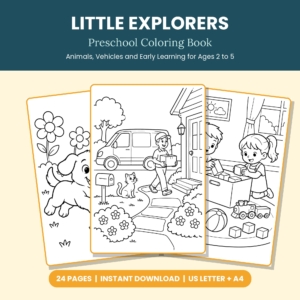
Little Explorers Preschool Coloring Book
Price: $3.49 | Best for: first pages for ages 2 to 5
This book has 24 simple pages with thick outlines and open spaces, in three themes: friendly animals such as a curious kitten and a bunny picnic, busy vehicles such as a digger and a fire engine, and early learning pages for counting ducks, shapes, feelings and big and small. You get US Letter and A4 PDFs plus every page as a PNG, so print the A4 Digger at Work page for a vehicle fan and talk about the colours as you go.
The early learning pages are a gentle bridge. A page called Big and Small Animals invites a chat about size. Feelings Balloons opens a conversation about happy, sad and cross, without anyone sitting a child down for a talk.
Building grip and control
Grip changes a lot between ages two and six, and colouring is one of the easiest ways to support it. A few simple tricks help.
- Short crayons. Break a crayon in half. A short stub is hard to hold in a fist, so little fingers naturally move towards a pinch grip.
- Chunky or triangular crayons. Easier to hold for small hands than thin pencils.
- A sloped surface. Taping the page to a large ring binder turned sideways, or to an easel, encourages a good wrist position.
- The helper hand. Gently remind children to hold the paper with their other hand. “One hand colours, one hand helps.”
- Small areas, then big areas. Colouring tiny shapes builds finger control. Colouring big areas builds arm and shoulder strength. Children need both.
Avoid correcting grip constantly. A light reminder now and then works better than turning every colouring session into a lesson.
Colouring that teaches shapes, numbers and colours
From around three, many children love pages with a small job attached. “Colour every circle red.” “Colour three apples.” The job gives them a reason to slow down and look, and that focus is a skill in itself.
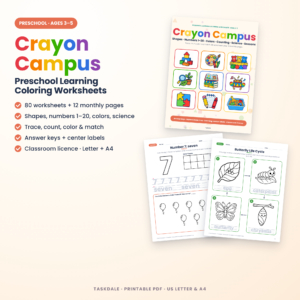
Crayon Campus Preschool Learning Coloring Worksheets
Price: $4.99 | Best for: early learning for ages 3 to 5
This set has 80 colouring worksheets in seven sections: shapes, numbers 1 to 20, counting and maths, colours, matching and science, plus 12 seasonal pages. Each page has one simple task, a one-line instruction to read aloud, big bold artwork and a name and date line. There are answer keys, a skills checklist and learning-centre labels, so start with the circle page and the number 1 page and add one new page a day.
The skills checklist is handy for parents and teachers alike. You can see at a glance which shapes and numbers a child has met, without testing them. For more pages that suit this age, our guide to preschool colouring pages with big shapes and easy wins has further ideas.
Signs a page is too hard or too easy
Children tell you very clearly whether a page fits. You just have to watch.
Too hard
- Scribbling over the whole page in frustration.
- Giving up after one small corner.
- Asking you to do it, or pushing the page away.
- Tears, especially from children who worry about getting it “wrong”.
Too easy
- Finishing in a minute and wandering off.
- Colouring the whole thing one colour just to be done.
- Saying it is for babies.
When a page misses, swap it without fuss. Thicker lines and fewer shapes for a struggling child. More detail, a story or a challenge for a bored one. Our guide on choosing age-appropriate character colouring books goes further into reading these signals.
Turning colouring into talking
Colouring is a lovely time for conversation, because children are relaxed and their hands are busy. Questions feel less like questions.
- Name the colours together. “You picked a dark blue. What else is dark blue?”
- Talk about the picture. “Where is the bunny going? What is in the basket?”
- Count things. “How many wheels have you coloured?”
- Describe, do not judge. “You coloured the sky in stripes” opens a chat. “That’s lovely” ends one.
For children learning English as an additional language, colouring is a calm, low-pressure way to practise colour and object words.
Colouring with older children: writing and reflection
Children of seven and up often enjoy a page that pairs colouring with a short writing prompt. It is a gentle way to practise handwriting and to think about feelings, and it suits seasonal times like harvest festival, which many UK primary schools celebrate each autumn.
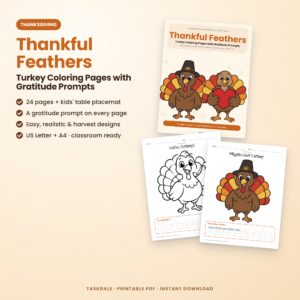
Thankful Feathers Turkey Coloring Pages
Price: $3.49 | Best for: mixed ages and harvest time
This set has 24 colouring pages that each pair a turkey or harvest picture with a short gratitude prompt and writing lines. There are 12 easy cartoon pages with handwriting lines for early writers, 6 realistic turkey pages and 6 detailed harvest scenes for older children and adults, plus a gratitude tree, word search, maze and place cards. It prints on US Letter or A4, so give younger children the easy pages and older ones the harvest scenes.
The mix of levels in one set is useful for a mixed-age family or a small class. Everyone works on the same theme, at their own level, and the finished pages make a lovely display together.
A simple weekly colouring routine
Little and often works far better than one long session at the weekend. A loose routine also means colouring happens on busy weeks, not only when someone remembers.
| Day | Focus | Example page |
|---|---|---|
| Monday | Big shapes and free choice | An animal or vehicle page |
| Tuesday | Colours | Colour everything on the page in reds and oranges |
| Wednesday | Shapes or numbers | Colour every circle, or colour three apples |
| Thursday | Small areas | A page with patterns or little details |
| Friday | Talk and show | Child picks a favourite and tells the family about it |
Ten minutes after breakfast or before tea is plenty. By the end of a month you will notice steadier lines, more deliberate colour choices and, often, a child who asks for “my colouring” before you suggest it.
Helping children who find colouring hard
Some children avoid colouring. It might be that their hands tire quickly, that they worry about mistakes, or that they simply prefer moving about. A few adjustments make it easier to enjoy.
- Left-handed children. Tilt the page slightly to the right and seat them on the left of a shared table, so elbows do not clash.
- Children who tire quickly. Offer chunky crayons that need less pressure, and keep pages small and bold.
- Worriers. Pages with no “right” colours, like patterns or silly characters, take the fear away.
- Movers. Tape a page to the wall and let them colour standing up. Many active children colour happily this way.
The aim is a child who enjoys it. Skill follows enjoyment, not the other way round.
Setting up a colouring space
A small, ready space means children colour more often, and more independently.
- A low table and chair where feet touch the floor.
- A pot of chunky crayons for little ones and a pot of coloured pencils for older children.
- A folder of printed pages at the right level for each child.
- A spot on the wall or fridge to display finished work straight away.
- A sharpener and a small bin for the shavings.
Children who can reach their own pages and crayons start colouring on their own. That independence is a skill too.
Printing tips for home and the classroom
- Use the A4 file in the UK. US Letter pages printed on A4 can crop or leave odd margins.
- Print at Actual size. Fit to page shrinks lines and makes shapes smaller for little hands.
- Use black and white or draft mode. Colouring pages do not need colour ink.
- Choose heavier paper for felt tips. 100 gsm paper stops ink soaking through to the table.
- Print in batches. One stack per week, sorted by child or by table group.
Common mistakes to avoid
- Pages too detailed for the age. Frustration is the fastest way to put a child off colouring.
- Correcting colours. Purple dogs and green suns are fine. The choice is the point.
- Insisting on staying inside the lines. Control comes with time and practice, not pressure.
- Sessions that run too long. Stop while they still want to carry on.
- Doing it for them. Colour your own page beside them instead.
Frequently asked questions
What age should children start colouring in?
Many children start making marks with chunky crayons from around 12 to 18 months. Expect scribbles at first, which is exactly right.
How does colouring help child development?
It builds grip, hand control, hand-eye coordination, colour knowledge and attention. It also gives children a calm activity and plenty to talk about.
When should a child colour inside the lines?
Most children start trying around three to four, and get steadier between four and six. Every child moves at their own pace.
Are crayons or pencils better for young children?
Chunky or short crayons suit toddlers and preschoolers. Coloured pencils and fine felt tips suit children from about five.
How long should a colouring session last?
Five to ten minutes for toddlers, ten to twenty for preschoolers, and as long as they like for older children.
What paper size should I use in the UK?
Use A4 pages, printed at actual size, on plain or 100 gsm paper.
Your next step
Watch your child colour one page this week and note which age stage they match. Then print a few pages at that level. For a toddler or preschooler, the Little Explorers Preschool Coloring Book is a gentle, bold place to start.