Naming a company feels like it should take an afternoon. Then three weeks later you are still scrolling a list of 60 options at midnight, and every name either sounds dull or is already taken. It is one of the most common places for a new business to stall.
This guide gives you a practical route through. First, where company names actually come from, with ten idea starters. Then the checks every name should pass before you register it or print a single sticker. Then the mistakes that push owners into an expensive rebrand a year or two in. A worked example shows the whole process from first brainstorm to final pick.
It is written for founders in the US naming a new company, a trading name or a shop. The checks mention US registries, but the thinking applies anywhere. All example names are invented.
Quick picks for naming a company
| Product | Best for | Price | Link |
|---|---|---|---|
| Spark & Shingle Business Name Workbook | Ideas, scoring, availability checks and feedback | $6.99 | View |
| Business Launch Planner | Name checker plus registration, permits and launch plan | $14.99 | View |
Start with a short naming brief
Before you write a single name, write five lines about the company. This is your brief. It stops you judging names on mood alone.
- What we do: “Residential landscaping and garden maintenance.”
- Who we serve: “Homeowners in the north suburbs, mostly families and retirees.”
- How we want to feel: three words, such as “reliable, friendly, tidy”.
- Where the name will live: truck doors, yard signs, a website, invoices.
- Where we might grow: “Possibly snow removal and hardscaping later.”
That last line matters more than people think. A name like “Lawn Kings Mowing” boxes you in the day you add patios. A brief written in ten minutes can save you a rebrand in year three.
Ten places good company names come from
Most strong names are not plucked from the air. They come from a source you can mine on purpose. Spend about ten minutes on each of these and write down everything, good or bad.
1. The customer’s words
Listen to how customers describe the result they want. A cleaning client might say “I just want to walk in and breathe”. That gives you “Fresh Breath Home Care” or “Easy Air Cleaning”. Customer language often makes the most natural names.
2. The tools of your trade
Every craft has objects: a trowel, a ladle, a compass, a spool. “Trowel & Thyme” for a garden designer. “Spool Street Alterations” for a seamstress.
3. Local landmarks
A river, ridge, old mill or street name tells people you are part of the community. “Millbrook Electric” sounds settled and trustworthy.
4. Your story
A grandparent’s nickname, the street you grew up on, the dog that sat in the van. Personal stories make names that are easy to explain and hard to copy.
5. Nature and animals
Birds, trees, weather and animals carry feelings. An owl suggests wisdom for a tutoring company. An oak suggests strength for a construction firm.
6. Words from another language
Carefully done, a short foreign word can be lovely. Check the meaning with a native speaker and make sure English speakers can say it.
7. Two words joined
“Brightpath”, “Stonewell”, “Hearthside”. Compound names often make good domains. Read the joined word slowly to check it does not form an unfortunate word in the middle.
8. Founder names
“Okafor & Daughters Roofing” or “Lena Brooks Design”. Great for trust-based services. Less great if you plan to sell the company one day.
9. A promise
Name the benefit: “On Time Movers”, “Clear View Windows”. Plain, but customers understand you instantly.
10. Invented words
Short coined words like “Vantly” or “Orvo”. Easy to secure online, but you will spend more effort teaching people what you do.
For more on making a name stick once you have options, our guide to business names that are easy to remember covers sound, rhythm and memory tests.
A workbook that gives you word banks and methods side by side makes these sprints quicker.
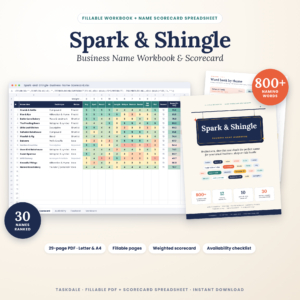
Spark & Shingle Business Name Workbook
Price: $6.99 | Best for: founders naming a new company
A 29-page fillable PDF workbook in US Letter and A4, plus an Excel and Google Sheets scorecard. It has 16 themed word banks, words by tone, prefixes and suffixes, and 12 naming techniques with fictional examples, then a 10-criterion shortlist scorecard and an availability checklist covering domains, handles, your state business entity search and USPTO search pointers. Fill in the brand foundations page first, then run one technique sprint per day for a week.
The checks every company name must pass
Once you have five or six favorites, run each through these checks. Do it before you tell anyone your new name, and long before you pay for a logo. Write the results in a simple table: name across the top, check down the side, a tick or cross in each box.
State business name search
If you are forming an LLC or corporation, your state usually will not register a name that is too close to an existing one. Most secretary of state websites have a free entity search. Try spelling variations too.
Trading name or DBA rules
If you trade under a name that is not your legal name, many states or counties ask you to file a DBA, sometimes called an assumed or fictitious name. Look up the rules for your area and note the fee.
Trademark search
Search the USPTO trademark database for your name and close variations, especially in your own field. A registered mark held by another landscaper is a serious problem even if your state accepted your LLC name. If you are unsure what you find, a trademark attorney can advise.
Domain name
Check whether the .com is available, or a sensible alternative. Many small businesses do fine with a short add-on like the town or trade. Avoid hyphens if you can, because people forget them.
Social handles
Check the two or three platforms you will actually use. Matching handles across them make you easier to find.
Search results
Search the name and look at the first page. Is it full of a large company, a scandal, or something you would not want to be confused with? Better to know now.
Meaning and sound check
Say it out loud to five people. Spell it to them over the phone. Check what it means in other languages your customers speak. Write the initials and see if they spell anything awkward.
Legal endings and how to show them
If you form an LLC or corporation, your legal name usually needs an ending such as LLC, Inc. or Corp. Your state sets the exact rules. That ending goes on contracts, invoices and official documents.
On signs, a website or a truck, many companies use just the trading name. “Millbrook Electric” on the van, “Millbrook Electric LLC” on the invoice. Just make sure your DBA or registration covers whatever version you use in public, and keep it consistent.
Some words are also restricted in company names in many states, such as “bank”, “insurance” or terms that suggest a licensed profession. If your favorite name includes a word like that, check your state’s rules before you get attached. It is a small search that can save a rejected filing and a wasted fee.
Common company naming mistakes
These are the mistakes that most often lead to awkward conversations, confused customers or a rebrand.
- Falling in love before checking. Owners order a logo, then discover the name is trademarked by a firm two states away.
- Naming too narrowly. “Downtown Dog Walks” is a problem once you add cat sitting in three suburbs.
- Clever spellings. “Kleen Kutz” saves no one time. Every phone call becomes a spelling lesson.
- Copying a big brand’s style. A name that sounds like a famous company invites confusion and possibly a legal letter.
- Ignoring how it sounds. Names that look fine written can be hard to say, or sound like something else when spoken quickly.
- Too long. If it will not fit on a yard sign in big letters, it is too long.
- Asking too many people. Twenty opinions produce a beige compromise. Ask five people who match your customers.
- Choosing by committee mood. Co-founders arguing in circles for weeks. Agree on scoring criteria first, then score.
- Forgetting the legal ending. Leaving LLC off a contract can cause confusion about who the client is dealing with.
- Waiting for perfect. No name is perfect. A clear, available, easy-to-say name beats a dream name you never settle on.
Scoring names fairly when co-founders disagree
Two founders with two favorites can stall for weeks. The way out is a scorecard agreed before anyone looks at names. Pick six to eight criteria, such as easy to say, easy to spell, fits what we do, room to grow, domain available, no trademark clash. Give each a weight. Then each founder scores every name privately.
Add the scores. The top two names usually become clear. Sometimes the winner is neither founder’s favorite, which is oddly freeing for both. It turns a personal tug of war into a shared decision.
A worked example: two founders, one name
Jess and Marco are starting a landscaping company north of the city. Their brief said: reliable, friendly, tidy, with room for hardscaping later.
Their brainstorm produced 55 names in two evenings. Their favorites: “Green Thumb Bros” (Marco), “Hearthside Gardens” (Jess), “Millbrook Outdoor”, “Fernleaf Landscapes” and “Tidy Yards Co”.
The checks thinned the list fast. “Green Thumb Bros” had several existing businesses nearby with similar names, and Jess is not a brother. “Tidy Yards Co” felt narrow once patios entered the plan. “Hearthside Gardens” made people think of a garden center.
That left “Millbrook Outdoor” and “Fernleaf Landscapes”. On the scorecard, Millbrook won on local feel and room to grow, Fernleaf on picture and sound. They asked six neighbors. Five remembered “Millbrook” the next day. The state search was clear, the domain was available with “outdoor” in it, and the trademark search found nothing close in their field.
They registered “Millbrook Outdoor LLC”. Marco admitted it was better than his pick. They celebrated with pizza on the tailgate.
After you choose: make it official in order
Once the name passes every check, move quickly so nobody else grabs it. A sensible order:
- Register the domain and social handles the same day.
- Form your LLC or corporation, or file your DBA.
- Open a business bank account in the company’s name.
- Consider a trademark application if the name is central to your plans. Ask a professional if unsure.
- Order simple branding: logo, business cards, invoice template.
Then get on with the actual business. Our guide to starting a business in your first 30 days picks up from here.
It helps to have the naming step sitting inside your full setup checklist, so nothing falls between the cracks.
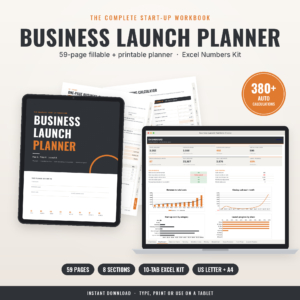
Business Launch Planner
Price: $14.99 | Best for: founders getting set up properly
A 59-page fillable and print-and-digital PDF planner in US Letter and A4, with a 10-tab Excel Numbers Kit. The Set Up section has a business name checker, brand basics, business structure and registration notes, and a tracker for licenses, permits and insurance. The Launch section adds a master start-up checklist and a 90-day action plan. Fill in the name checker for your top three names before you register anything.
Frequently asked questions
How do I check if a company name is already taken?
Search your state’s business entity database, the USPTO trademark database, domain registrars and the social platforms you plan to use. Also run a plain web search for the name in your area and field.
Can two companies have the same name?
Sometimes, in different states or very different industries. But a name that is close to another business in your field can cause confusion and trademark trouble, so it is usually best avoided.
Do I need a DBA if my company name is different from my legal name?
In many places, yes. Rules vary by state and county, so check your local requirements before you start trading under the new name.
Should my company name include LLC?
Your legal name usually must, depending on state rules. On signs and marketing you can often use the trading name alone, as long as it is properly registered.
How many name ideas should I come up with?
Aim for 40 to 60 rough ideas. That is usually enough to find five strong ones worth checking.
Can I change my company name later?
Yes, but it costs time and money: new filings, signs, website, accounts and customer confusion. A careful choice now saves that hassle, and if you do rebrand, tell customers early and keep the old name visible for a few months.
Your next step
Write your five-line naming brief tonight. Tomorrow, spend an hour on the ten idea sources and aim for 40 names. Then run your top five through the checks above. The Spark & Shingle Business Name Workbook has the word banks, scorecard and availability checklist ready to fill in.