A teacher diary is where the small promises of the day go so they stop living in your head. Photocopy 30 sheets for period 3. Ring Jayden’s dad back after school. Remind 8C about the trip money. Chase the missing permission slips before Friday. None of it is a lesson plan, and all of it matters by home time.
This guide is for teachers who want one dated book, paper or digital, that holds both the day’s lessons and the reminders around them. You will see what a good diary page looks like, how to handle reminders that are weeks away, a five-minute end-of-day habit, and four Taskdale planners that work as a teacher diary in different ways.
Quick picks for a teacher diary
| Product | Best for | Price | Link |
|---|---|---|---|
| Bright Days Teacher Planner | An undated printable diary in A5, A4 or Letter | $4.99 | View |
| Bell to Bell Printable Teacher Planner | A dated school-year diary with weekly spreads | $6.49 | View |
| Classroom Compass Teacher Planner | A laptop diary that lists what needs attention today | Original price was: $6.49.$4.99Current price is: $4.99. | View |
| Teacher’s Compass Lesson Plan Template Pack | Quick one-page lesson notes to slip in the diary | $2.49 | View |
Diary or planner: what is the difference?
A planner looks ahead. It is where you map out units, weeks and lessons. A diary lives in the day. It is dated, it is messy, and it holds whatever came up at 8.20am in the staffroom.
Most teachers need a bit of both, in one place. If lessons live in a planner and reminders live in a separate notebook, one of them gets left at home. Usually the one you need. So the best teacher diary combines a short lesson line for each period with plenty of room for everything else.
Think of it like this. The lesson plan tells you what to teach in period 2. The diary tells you that period 2 is also when the SENCo is popping in, that you need the mini whiteboards from the cupboard, and that Amira is back after a week off and needs the worksheet she missed.
What goes on a good diary page
A diary page for a full teaching day needs six areas. More than that and it gets cluttered. Fewer and things spill onto sticky notes.
- Lessons: one line per period or session. Class, room, focus.
- Duties and meetings: break duty, line meeting, after-school club.
- Copies and prep: what to print, set out or book before the lesson.
- Calls and messages: who to contact, about what.
- Reminders: anything with a deadline, such as reports, trip forms or data drops.
- Carry forward: what did not get done and moves to tomorrow.
That last box is the one most diaries lack, and it is the one that stops tasks vanishing. At 4pm you glance at the page, and anything unticked goes into the carry-forward box. Next morning it is the first thing you see.
Paper size: bag diary or desk diary?
Size changes how you use a diary more than layout does. An A5 diary fits in a bag and comes to every meeting, every duty and every corridor conversation. An A4 diary stays on the desk and holds more per page, but it rarely leaves the classroom.
Ask yourself where reminders arrive. If they arrive in the playground on duty or in a meeting in the hall, go A5 and keep it on you. If they arrive by email at your desk, A4 gives you room to write them out properly. Some teachers run both: an A5 diary that travels and an A4 lesson planner on the desk, with the diary emptied into the planner at the end of each day.
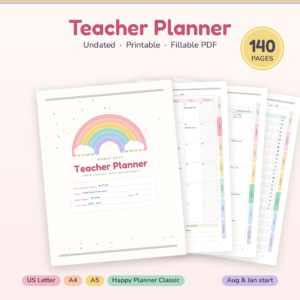
Bright Days Teacher Planner
Price: $4.99 | Best for: teachers who want a printable bag diary
A 140-page undated teacher planner in four sizes, including A5, A4 and US Letter, as both printable and fillable PDFs, with August or January start. It includes monthly calendars, horizontal and vertical weekly pages, a daily planner, weekly lesson planners by period or subject, a parent communication log, meeting notes, a daily to-do list and a brain dump page. Print the daily planner and weekly pages first and punch them for a ring binder.
A dated diary for the whole school year
Undated pages suit teachers who skip weeks or switch between formats. A dated diary suits those who like to open the book and find today already waiting. No dates to write in on a Sunday night, and the week ahead is always the next page.
Look for a weekly spread with a column per subject or period, plus boxes for to-dos, copies and prep, reminders and next week. That last box matters. When a colleague says “can you cover the Year 7 trip in three weeks?”, you flick forward and write it straight in. The reminder sits waiting on the right page instead of floating around in your head for 21 days.
Month dividers help too. A page at the start of each month with key dates, units and birthdays gives you a quick look at the month before the weekly pages start.
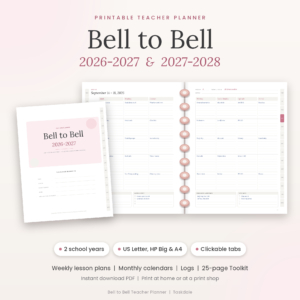
Bell to Bell Printable Teacher Planner
Price: $6.49 | Best for: teachers who like dated weekly spreads
A printable, clickable teacher planner for July 2026 to June 2027 and July 2027 to June 2028, in US Letter and A4 (181 pages each), plus a 25-page undated toolkit. Each week gets a Monday to Friday spread with seven planning columns, a to-do list, copies and prep, reminders and next week, and each month has a divider and a month-in-review page. The calendars have US holidays printed, so add your own term dates on the academic calendar page first.
Three kinds of reminders and where each one goes
Reminders are not all the same, and treating them the same is why they slip.
Today reminders
“Take the register to the office.” “Collect Year 10 books.” These go on today’s page, in the reminders box, and get ticked off by 3.30pm.
This week reminders
“Mark mock papers by Thursday.” “Email the trip letter.” These go on the weekly to-do list, so you see them every morning until they are done.
Future reminders
“Report comments due 14 March.” “Check in on Leo’s reading in four weeks.” These are the dangerous ones. Write them on the page of the day they are due, not today’s page. In a paper diary that means flicking forward. In a digital planner it means adding a date so it pops up on its own.
This is where a digital diary earns its keep. A dashboard that shows today’s lessons alongside anything overdue or due soon catches the future reminders you would otherwise forget you wrote.
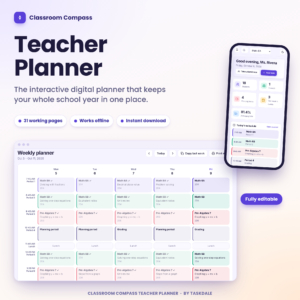
Classroom Compass Teacher Planner
Price: Original price was: $6.49.$4.99Current price is: $4.99. | Best for: teachers who work from a laptop all day
A single HTML file that opens in your browser and works offline, with no account. Its dashboard shows today’s schedule and a short list of things that need attention, alongside tasks, a calendar, notes, a parent contact log with conference scheduling and a weekly planner built from your bell times. Search across students, lessons, tasks and notes with Ctrl+K. Add this week’s tasks with due dates on day one, then check the dashboard each morning.
If marks and attendance are what you want reminders for, the guide to a teacher planner spreadsheet for lessons, grades and attendance shows how a spreadsheet flags missing work for you.
Short lesson notes in a diary
A diary is not the place for full lesson plans. One line per lesson is plenty: “8C: adding fractions, mini whiteboards, exit ticket.” If you need more, slip a one-page plan in behind the day and note “see plan” on the diary line.
When does a lesson need more than a line? An observed lesson, a cover lesson for someone else, or the first lesson of a new unit. For those, a quick plan with an objective, an I do, we do, you do flow and an exit ticket takes ten minutes and saves the lesson from drifting.
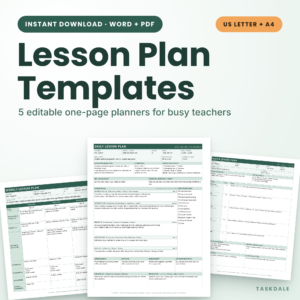
Teacher's Compass Lesson Plan Template Pack
Price: $2.49 | Best for: teachers who need a quick one-page plan
Five one-page templates in editable Word and printable PDF: a detailed daily plan, a quick daily plan built on I do, we do, you do with success criteria and an exit ticket, a weekly plan, a unit plan and a substitute teacher plan. Each comes in two colour styles and US Letter and A4. Print a small stack of the quick daily plan and keep it in the back of your diary for lessons that need more than a line.
For a closer look at choosing between Word and fillable PDF plans, see editable lesson plan template: Word or fillable PDF.
Set the diary up before the first day of term
Half an hour of setup in the last week of the holidays saves a lot of scribbling later. Work through these in order, with the school calendar open beside you.
- Term dates and closures. INSET days, half-term, bank holidays. Cross them out so you never plan a lesson for a day the school is shut.
- Known deadlines. Report windows, data drops, parents’ evenings, moderation. Write each on the week it lands and again two weeks before, as a warning.
- Your timetable. Copy it onto a reference page at the front, with rooms and duty days.
- Recurring reminders. If spelling tests go home every Friday or reading records are checked every Monday, note them on the first few weeks until the habit sticks.
- Key contacts. Office extension, site team, SENCo, your phase leader. One page, at the front.
A Year 3 teacher who does this in late August walks into September with the term’s pinch points already marked. The two-week warning for report comments alone is worth the effort, because nobody remembers report deadlines until a colleague mentions them in the staffroom.
The five-minute end-of-day habit
A diary only works if you close the loop each day. Five minutes before you leave, with the classroom quiet:
- Tick everything that got done. Enjoy that bit.
- Move anything unticked into the carry-forward box, or onto a later page if it can wait.
- Write tomorrow’s first job at the top of tomorrow’s page. Something small and certain, like “set out the science kit”.
- Glance at the rest of the week for anything that needs prep tonight.
That is all. It sounds too small to matter. But a teacher who does this every day walks in each morning knowing exactly what is waiting. No 7am panic, no “what was I meant to do?” It is one of the quiet wins of the job.
A diary that doubles as a record
Dated notes are useful long after the day has passed. When a parent asks in March about something from November, a diary entry like “12 Nov: rang Mum re homework, agreed weekly check” settles it in seconds.
Keep those notes short and factual. Date, who, what was said, what was agreed. Follow your school’s policy on what pupil information can be written down and where it must be kept, and store a diary with pupil names somewhere safe, not on the passenger seat of the car. Anything serious, such as a safeguarding concern, goes through your school’s system, not just the diary.
The same habit helps on days you are off sick. A diary with this week’s lessons, duties and reminders already written down makes handing over to a cover teacher much easier. This guide on what to put in a substitute teacher plan template covers the rest.
Common teacher diary mistakes
Writing reminders on today’s page when they are due next month
Today’s page gets turned over tonight. Put future reminders on the day they matter.
Leaving the diary in the classroom
If reminders arrive in meetings and on duty, the diary has to come with you. Size it so it does.
Turning it into a scrapbook
Stickers and colours are lovely if they help you find things. If they slow you down in a busy week, keep them for the monthly pages.
Never looking back
Once a half-term, flick through the last six weeks. Patterns jump out, like the same three pupils on every call list, or every Thursday overloaded.
Frequently asked questions
What should a teacher diary include?
A line for each lesson, duties and meetings, copies and prep, calls to make, dated reminders and a carry-forward box for unfinished tasks.
Is A5 or A4 better for a teacher diary?
A5 if you want to carry it to meetings and duties. A4 if it stays on your desk and you need more room per day.
Should a teacher diary be dated or undated?
Dated saves time and makes future reminders easy to place. Undated suits teachers who skip weeks or start mid-year.
Can I use a digital teacher diary instead of paper?
Yes. A digital planner is better for reminders weeks ahead and for searching old notes. Paper is quicker for jotting things down on the move.
How do I stop forgetting things as a teacher?
Write every reminder down the moment you hear it, on the page of the day it is due, and spend five minutes at the end of each day moving unfinished tasks forward.
Your next step
Tomorrow, carry one page with you all day and write down every small promise you make. By 3.30pm you will know exactly how much your diary needs to hold. If a printable A5 diary sounds right, print a week from the Bright Days Teacher Planner tonight and try it for five days.