A custom coloring book is one of the few branded items people keep. A child at a pizza place colors the mascot while waiting for dinner, takes the book home, and the logo sits on the kitchen table for a week. Compare that to a flyer, which lasts about as long as the walk to the bin.
This guide is for small business owners, marketers and community groups thinking about branded activity books. You will find ideas by type of business, what to put inside, how to brief an illustrator, how to print short runs without overspending, and the rights question that catches many first-timers. There is also a simple cost example and a checklist you can hand straight to a designer.
Quick picks and what each one is for
| Product | Best for | Price | Link |
|---|---|---|---|
| Marquee Me Personalized Name Coloring Pages | Testing name-banner ideas at home before you brief a designer | $4.99 | View |
| Kettle and Quilt Cozy Coloring Book | Libraries, clubs and care homes running their own activity groups | $6.99 | View |
| Sunrise Basket Easter Coloring and Activity Book | A Sunday school teacher’s own class or group | $4.99 | View |
| Porchlight Memories Large Print Coloring Book for Seniors | Activity sessions in senior living communities | $8.99 | View |
One honest note before we start: these printables are licensed for personal use or for your own class or activity group. They are great for in-house activities and for trying out ideas, but a branded book you hand to customers needs original artwork that your business owns or has licensed for commercial use. More on that below.
Why branded coloring books work
A coloring book earns attention slowly. A child might spend twenty minutes on one page, and a parent sees your name each time they glance over. Then the book goes home.
- It solves a real problem. Parents waiting with bored kids are grateful for anything that buys them ten calm minutes. That gratitude attaches to your business.
- It is low cost per piece. A short, simple booklet prints for a modest amount per copy, especially in black and white.
- It suits many industries. Restaurants, dentists, banks, vets, real estate agents, hotels, farms and charities all use them.
- It feels like a gift, not an ad. Done with a light touch, it reads as kindness first and branding second.
Ideas by type of business
Restaurants and cafes
A placemat-size activity sheet or an 8-page mini book with your mascot, a maze to the kitchen and a “design your own pizza” page. Hand it out with the menu so kids are busy before the food arrives.
Dentists and pediatric clinics
A brushing chart, a “find the healthy snacks” page and a friendly tooth character. It calms nerves in the waiting room and goes home as a reminder.
Real estate agents
A “My New Home” book for buyers’ children: draw your new bedroom, a moving-day checklist to color, a map of the neighborhood. Families remember the agent who thought of the kids.
Banks and credit unions
A savings-themed book with a piggy bank to color, coin counting and a goal tracker. Gentle money lessons for ages 5 to 9.
Vets and pet shops
Pet care pages: what a puppy needs, a cat’s daily routine, a “draw your pet” page. Perfect for families at a first vet visit.
Hotels, farms and attractions
A souvenir book of your place: the barn, the animals, the pool, the trail. Kids color it on the trip and keep it as a memory.
Charities and community groups
An awareness book on recycling, water safety or kindness, handed out at events and schools.
What to put inside a branded activity book
Mix activities so every child finds something they enjoy. A good 12-page book might look like this.
| Page | Content |
|---|---|
| Cover | Title, mascot, small logo, space for the child’s name |
| 2 | Welcome page from the mascot |
| 3 to 7 | Coloring pages of your place, products or theme |
| 8 | A maze or dot-to-dot |
| 9 | A word search with 8 to 10 theme words |
| 10 | A draw-your-own page |
| 11 | A simple fact or tip page in big print |
| Back cover | Logo, address, website and answers |
Keep the logo small inside. One mark in a corner of each page is plenty. Children and parents both tune out pages that feel like adverts.
Prototype the idea at home first
Before you spend money on an illustrator, test the concept at your own kitchen table. Print a few themed pages with name banners, staple them into a rough booklet and hand it to your own children or nieces and nephews. Watch which pages they choose first and which they skip.
A personal-use printable with fillable name banners is handy for this. You can see how a name on the cover changes a child’s interest, and how many pages a six-year-old really finishes. Then you brief the designer with real notes instead of guesses.
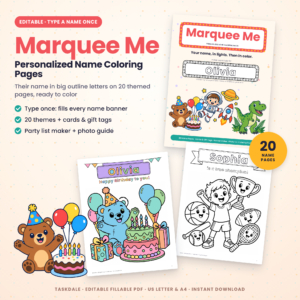
Marquee Me Personalized Name Coloring Pages
Price: $4.99 | Best for: business owners testing ideas at home
Type a name once and it appears in hollow outline letters on 20 themed kids’ pages, with seven banner styles, cards, gift tags, door hangers and an outline alphabet. It is licensed for personal use, so use it with your own family to test layouts, name banners and page counts, then commission original art for the branded version. Fillable PDF in US Letter and A4. Print three themes and see which one your kids pick.
The rights question: use art you own
This is the part people skip, and it matters. A book you hand to customers is a commercial use. The artwork inside must be something you own or have licensed for that use.
- Do not use film, TV, game or toy characters. Even a look-alike can cause trouble. Create your own mascot.
- Check clip art licenses. Many free images are for personal use only. Commercial licenses are often available, but read the terms.
- Personal-use printables are not for giveaways. Coloring books sold for home use, including Taskdale’s, cannot be copied and handed out as branded material.
- Get rights in writing from your illustrator. State that the business can print and give away unlimited copies, and use the art on its website and social media.
An original mascot is worth the effort. It becomes part of your brand, shows up on signs and stickers, and is entirely yours.
How to brief an illustrator
A clear brief saves rounds of changes. Send something like this.
- Audience: ages 4 to 8, with a few pages for 9 to 11.
- Page count and size: 12 pages, half letter, black line art only.
- Line weight: thick, bold outlines, no tiny detail on pages for young children.
- Mascot: a friendly original character, with three or four reference sketches if you have them.
- Page list: the table above, with your specific scenes.
- Brand touches: logo on cover and back, a small mark on inside pages, brand colors suggested on the cover only.
- Rights: full commercial rights for print and digital use.
- Files: print-ready PDF plus the original vector or high-resolution files.
Ask to see one finished page before the illustrator draws the rest. It is the cheapest moment to change direction.
Printing short runs without overspending
You do not need ten thousand copies. Start small and reorder.
- Black and white inside, color cover. This keeps costs down and makes sense anyway, because kids add the color.
- Saddle stitch binding. Two staples down a center fold. Cheap, flat, kid-friendly.
- Uncoated paper. Glossy paper repels crayon. Ask for uncoated or matte stock.
- Half letter or A5 size. Fits in a menu folder, a gift bag or a pocket.
- Get two quotes. A local printer and an online one often price short runs very differently.
A rough cost example
Here is an illustrative budget for a first run. Real prices vary by region, printer and illustrator.
| Item | Example |
|---|---|
| Original illustration, 12 pages | $600 |
| Printing 500 copies, B and W inside, color cover | $450 |
| Mini crayon packs, 500 | $150 |
| First run total | $1,200 |
In this example the first run works out to 2.40 per book. The second run drops to about 1.20, because the art is already paid for. That is why the artwork you own is the real asset.
In-house activities: a different use case
Not every business wants a branded giveaway. Libraries, care homes, community centers and clubs often just need calm, ready-to-print pages for their own weekly sessions. For that, a printable licensed for your own activity group is the simplest route, and no branding is needed.
Look for bold, easy pages that suit mixed abilities and print well on a standard office printer. For more on running sessions with older adults, see our guide to coloring books for seniors.
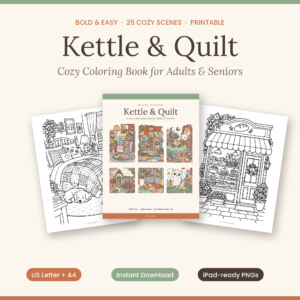
Kettle and Quilt Cozy Coloring Book
Price: $6.99 | Best for: libraries and clubs running weekly groups
Twenty-five cozy scenes with thick, clean outlines and large open spaces: sleepy cats in armchairs, a corner bakery, seaside cottages and a lantern-lit owl. Its terms allow printing for your own class or activity group, though not for resale or giveaways. US Letter and A4 PDFs, 300 dpi PNGs for tablets, a swatch page and six palettes. Print the swatch page and two scenes for your first session.
Churches, schools and youth groups
Faith groups and schools often want seasonal activity books, especially at Easter and Christmas. If you are a teacher or leader running your own class, a printable with a group license covers that. If the book will be handed out to the wider community with your organization’s name on it, the same rule applies as for any business: commission original art.
For a single Sunday school class or a classroom spring unit, a ready-made pack saves hours of design work and keeps the focus on the children.
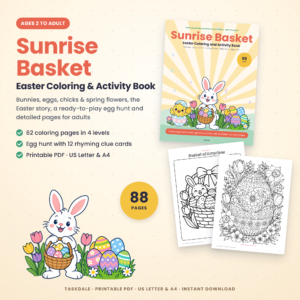
Sunrise Basket Easter Coloring and Activity Book
Price: $4.99 | Best for: one Sunday school teacher and class
Eighty-eight pages including thirty Easter coloring pages for kids, ten toddler pages, an optional Easter story section with KJV verses, four color by number pages, a maze, a word search and an egg hunt with clue cards. A Classroom and Sunday School Pack has Name and Date lines. One teacher may print it for one class or group. US Letter and A4 PDFs. Start with the Classroom Pack.
Safety and accessibility details
Anything you hand to a child carries your name, so small details count.
- Crayons labeled non-toxic. Check the packaging before you order in bulk.
- Age guidance on the back. A simple “Best for ages 4 to 9” helps parents choose.
- No small loose parts. Skip stickers or attachments for books aimed at toddlers.
- Readable text. Use a large, plain font for instructions so early readers can manage alone.
- A few easier pages. Include two or three big, simple pages so younger siblings and children with less steady hands can join in.
These cost almost nothing to get right, and they show families you thought about their kids, not just your logo.
Getting the books into hands
A box of books in a storeroom helps nobody. Plan where each copy goes.
- At the counter: a small stand with books and crayon packs, and a sign saying “Free for kids”.
- With the order: restaurants slip one into the kids’ menu folder.
- At events: a coloring table at a fair or open day draws families to your stand.
- In welcome packs: hotels, new patients and new home buyers.
- Through schools: charities and banks often partner with local schools for awareness weeks.
Add a simple way to see what works, such as a “Bring back your finished page for a sticker” offer. Finished pages pinned on a wall also make lovely, free decoration.
Mistakes businesses make with activity books
- Too much logo. Pages that look like ads get ignored.
- Tiny detail for young kids. Thin lines and small spaces frustrate the main audience.
- Glossy paper. Crayons slide off. Use uncoated stock.
- Using art you do not own. Characters and personal-use printables are not for giveaways.
- No crayons. A coloring book without anything to color with gets put aside.
- Printing too many at once. Start with a few hundred, learn, then reorder.
Frequently asked questions
How much does a custom branded coloring book cost?
It depends on illustration fees, page count and print run. Illustration is the biggest one-off cost; printing short, black and white runs is usually modest per copy.
Can I use printable coloring pages I bought for my business giveaways?
Only if the license allows commercial giveaways. Most home printables, including personal-use ones, do not. Commission original art for branded books.
What size should a branded activity book be?
Half letter or A5 is popular. It fits menus, gift bags and small hands, and prints cheaply.
How many pages should a kids’ activity book have?
Eight to twelve pages is enough for a waiting room or restaurant visit. Sixteen works for a souvenir book.
What activities should go in a branded coloring book?
Mostly coloring pages, plus a maze, a word search, a draw-your-own page and a simple fact page tied to your business.
Where should my logo go?
On the front and back covers, with at most a small mark on inside pages. Keep the inside about the child.
Your next step
This week, sketch a 12-page plan on one sheet of paper using the table above, and test a rough version with a couple of children you know. Then send the brief to an illustrator with commercial rights in writing. To try out name banners and page counts at home first, print a few pages from Marquee Me Personalized Name Coloring Pages with your own family. For ideas on what kids enjoy most, see our post on printable coloring books for kids.