Cute coloring books for kids are easy to find. Cute coloring books that make a child think are rarer. The difference is not the drawing style. It is whether the page leaves room for a choice: which color, which story, which tiny thing to add in the corner.
This guide is for parents, grandparents, childminders and teachers of children roughly 3 to 10. You will find the themes that tend to spark ideas, a handful of prompts that turn any page into a creative task, a simple weekly rhythm, and the way you talk about a finished page so a child wants to make the next one. We also share four printable books from Taskdale and what each one is good for.
Quick picks: cute printable books for kids
| Product | Best for | Price | Link |
|---|---|---|---|
| Marquee Me Personalized Name Coloring Pages | A child’s own name on 20 themes | $4.99 | View |
| Easy Mandala Coloring Book | Patterns, symmetry and calm | $3.49 | View |
| Ocean Life Coloring Book | Smiley sea animals with big shapes | $3.49 | View |
| Orbit Pals Printable Coloring Book | Silly space animals for story-makers | $3.99 | View |
What creativity looks like at the coloring table
Creativity in a five-year-old is not a masterpiece. It is small decisions. A blue cow because she likes blue. Polka dots on a turtle shell. A sun drawn in the corner that was not on the page. Each of those is a child trying an idea of her own.
A coloring page supports that when it gives a clear starting shape but leaves plenty open. The outline says “here is a whale”. Everything else, from the whale’s color to what it is thinking, is up to the child. That is a nice balance for kids who freeze in front of a blank sheet. They do not have to invent everything, just something.
So when you pick a cute book, look past how adorable the cover is. Ask a simpler question. Does this page leave room for my child to make a choice?
Themes that spark ideas
Some themes almost always lead to more drawing, more talking and more invented stories. These are the ones we see work again and again.
- Their own name. Nothing is more personal. Kids decorate their own name with a care they rarely give anything else.
- Silly animals. An octopus juggling planets invites a story. A plain octopus invites a shrug.
- Patterns and shapes. Mandalas and simple patterns ask the child to choose a color rule and follow it, or break it.
- The sea. Underwater pages can hold any color, any creature, any amount of bubbles.
- Everyday play. Blanket forts, tea parties, picnics. Children color what they recognize and then act it out.
Pages with their own name
Watch a six-year-old color her own name in big outline letters. She will try rainbow stripes on the M, stars on the A and her favorite color on the last letter, then ask for another copy to do it differently. A name page is creative practice disguised as pride.
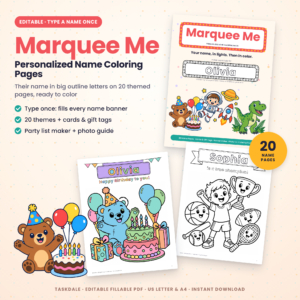
Marquee Me Personalized Name Coloring Pages
Price: $4.99 | Best for: kids who love seeing their name
You type a child’s name once in the fillable PDF and it appears in bold outline letters on 20 themed pages, such as dinosaurs, space, unicorns, trucks, ballet and beach days. There are also eight foldable cards, eight gift tags, an offline name banner maker and a guide for turning a family photo into a coloring page. It comes in US Letter and A4, so type the name, print the theme your child loves most and let them decorate every letter differently.
A creative stretch for older kids: ask them to give each letter of their name its own pattern, then explain why. “The J has stripes because it is fast.” You learn a lot about how a child thinks from a single page.
Patterns, symmetry and making your own rules
Mandalas look like grown-up coloring, but easy ones with bold outlines are a lovely fit for kids from about five. A mandala asks a child to make a plan. Will all the petals be the same color? Will they go around in a rainbow? Will the middle be dark or light?
That plan is a creative act. So is changing it halfway through. Children who are anxious about “doing it right” often settle with mandalas, because there is no correct answer and the pattern still looks good whatever they choose.
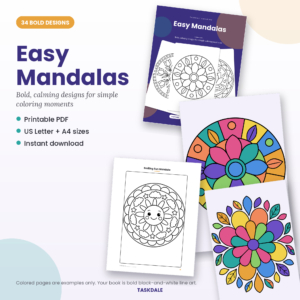
Easy Mandala Coloring Book
Price: $3.49 | Best for: kids who like patterns and calm
This book has 34 bold mandalas with big shapes and open spaces, including a smiling sun, a heart bloom, a starburst, a butterfly wings mandala and a cloud and raindrop design. It comes as US Letter and A4 PDFs, and every design has its own page so you can print just one. Start with the Smiling Sun Mandala and challenge your child to use only three colors.
Mandalas are also good for quiet time. Ten minutes on a sun mandala before bed is a calmer wind-down than a tablet, and the half-finished page is waiting tomorrow.
Creative prompts that work on any page
You do not need a special book for creativity. You need a prompt. Write these on slips of paper, put them in a jar, and let your child pull one before they start.
Color prompts
- Use only three colors on the whole page.
- Color everything the opposite of real life. Blue grass, green sky.
- Pick your two favorite colors and use them on every single shape.
- Color it as if it is nighttime.
Drawing prompts
- Add one thing that is not on the page.
- Give every character a hat.
- Draw what is happening just outside the edge of the page.
- Add a speech bubble. What is the animal saying?
Story prompts
- Give the main character a name, an age and a favorite food.
- What happened just before this picture? What happens next?
- Who is this character’s best friend, and where are they?
A jar of twenty prompts and a stack of pages can carry a whole school holiday. Kids love the lucky-dip feeling, and the prompt takes away the “I don’t know what to do” moment.
Ocean pages for curious kids
Sea animals are cute by nature, and the ocean is full of real wonders that start conversations. Did you know an octopus has three hearts? That one fact can turn a coloring page into ten questions and a library trip.
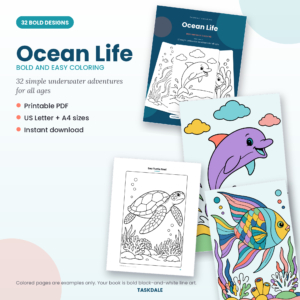
Ocean Life Coloring Book
Price: $3.49 | Best for: young sea animal fans
This book has 32 bold, easy underwater scenes, including a friendly dolphin, a smiling octopus, a curious seahorse, a humpback whale and a treasure chest. Thick outlines keep it friendly for younger kids. It comes as US Letter and A4 PDFs with a color test page, so try the prompt “color it as if it is nighttime” on the octopus page for a deep-sea twist.
Ocean pages also pair well with a simple science chat. Which animals breathe air? Which live in the deep, dark parts? Kids remember those answers far longer when they have just colored the animal.
Space pals for story-makers
Some children are natural storytellers. Hand them a page with a capybara in a moon bath and they will tell you its whole life story before the first crayon touches paper. Funny pages feed that.
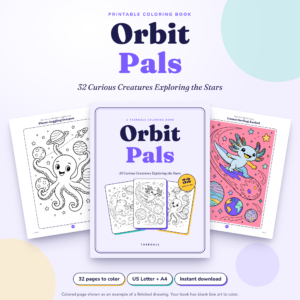
Orbit Pals Printable Coloring Book
Price: $3.99 | Best for: storytellers aged seven and up
Orbit Pals has 32 full-page drawings of animals who have taken over the galaxy, like an axolotl surfing a comet and an octopus juggling planets. You get US Letter and A4 PDFs, single-page PNGs for reprinting and a user guide. Pair a page with the speech-bubble prompt and you have a comic strip in the making.
Try making a mini comic. Print three pages, color them, and staple them together in order. Your child writes or tells the story that links them. A space comic made at seven is the kind of thing families keep in a drawer for decades. For more ideas that stretch coloring into something new, our guide to the reverse coloring book flips the usual idea: you get the color and draw the lines yourself.
Setting up a small creativity corner
Kids make more when making is easy. A corner where everything is ready, and reachable, turns “I’m bored” into “I’m busy” without you lifting a finger.
- A low shelf or a basket. Somewhere a four-year-old can reach without climbing.
- A folder of printed pages. Ten to fifteen, refreshed every Sunday. Mix themes so there is always something new.
- A small cup of crayons and a cup of pencils. Eight colors each is plenty.
- The prompt jar. Right next to the pages so it gets used.
- A display spot. A strip of washi tape on the wall or a string with pegs. Finished pages go up straight away.
The display spot is the part people skip, and it matters most. A child who sees her purple whale on the wall the same afternoon feels proud, and pride is what brings her back tomorrow. Rotate the display every week or two and keep the best pages in a big envelope with the date on the front.
How to talk about a finished page
What you say after the coloring matters as much as the page itself. “That’s beautiful” is kind, but it ends the conversation. Describing what you see opens it up.
- Name a choice. “You made the whale purple and the water orange. Tell me about that.”
- Ask about the story. “Where is this dolphin going?”
- Notice effort. “You spent a long time on those petals.”
- Skip the fixes. Never point out where they went outside the line.
Kids who feel their choices are interesting make more of them. That is the whole goal.
A simple weekly coloring rhythm
Creativity grows with a little routine. Not a strict schedule, just a loose shape to the week so coloring happens often enough to become a habit.
| Day | Idea |
|---|---|
| Monday | Name page, decorate each letter differently |
| Tuesday | Mandala with a three-color rule |
| Wednesday | Ocean page and one ocean fact |
| Thursday | Prompt jar, any page |
| Friday | Space page plus speech bubble |
| Weekend | Free choice, or make a mini comic |
Fifteen minutes a day is plenty. Some days your child will color for an hour. Other days they will do one corner and run off. Both count.
Choosing a book by age
Ages 3 to 4
Very thick outlines, one main shape per page. Their own name in big letters works well, as do bold sea animals. Creativity at this age is choosing colors, so offer a choice of four or five crayons.
Ages 5 to 7
Easy mandalas, simple scenes and name pages. Start using one prompt per page. Many kids at this age begin adding their own drawings to the page without being asked.
Ages 8 to 10
Funny, detailed pages like space animals. Comics, speech bubbles and story prompts. They may want finer pens and colored pencils. For a wider range of picks, see our guide to coloring pages for kids they’ll finish.
Common mistakes that shut creativity down
- Coloring the page for them. Sit beside them with your own page instead.
- Only realistic colors allowed. Pink elephants are fine.
- Pages that are too hard. Frustration kills ideas. Step down in detail if they keep giving up.
- Rushing to the next page. Ask about the finished one first.
- Too many supplies. Sixty markers can overwhelm. Start with eight.
Frequently asked questions
What age are cute coloring books for kids best for?
Most suit ages 3 to 10, with the level of detail matched to the child. Bold, simple pages for under-fives and funnier, busier pages from about seven.
Do coloring books help kids be more creative?
They can, when the page leaves room for choices. Add a prompt, like adding one thing that is not on the page, and coloring becomes a creative task.
What are good coloring themes for creative kids?
Their own name, silly animals, mandalas, the ocean and space. Themes that invite a story or a pattern work best.
Can I personalize a coloring page with my child’s name?
Yes. Marquee Me lets you type a name once and it appears on 20 themed pages in outline letters ready to color.
How long should a kids’ coloring session last?
Ten to twenty minutes is plenty for most children. Stop while they still want more.
Should I correct my child when they color outside the lines?
No. Control improves with practice on its own. Correcting it tends to make kids anxious and less willing to try.
Your next step
Write five creative prompts on scraps of paper tonight and drop them in a jar. Then print a page your child will love on sight, like their own name from Marquee Me, and let them pull the first prompt.