Daily planner pages for tasks, priorities and notes work best when each of those three things has its own job. Priorities are the two or three things that would make today a good day. Tasks are everything else you could do. Notes are the stuff that turns up while you work: a phone number, an idea, a thing your boss said in passing. Mix them in one long list and the important items drown.
This guide is for anyone whose to-do list has 23 items and somehow none of the right ones get done. You will learn a simple brain dump and sort method, see a worked example, pick up rules for carrying tasks forward without guilt, and get a five-minute evening routine that closes each page cleanly. Four printable Taskdale planners are matched to different ways of thinking along the way.
Quick picks: daily pages with room for all three
| Product | Best for | Price | Link |
|---|---|---|---|
| Petalpath Undated Daily Planner | A Today’s Focus line plus Top 4 priorities | $2.39 | View |
| Clear Day Daily Planner Printable | Long task lists and a priority matrix | Original price was: $2.99.$2.49Current price is: $2.49. | View |
| BrightDay Fillable Daily Planner | A notes page and a weekly review | $1.99 | View |
| Daily Rainbow Planner | One color per weekday | Original price was: $1.99.$1.49Current price is: $1.49. | View |
Three jobs, one page
It helps to be clear about the difference before you pick up a pen.
Priorities
A priority is something that matters more than the rest today. Finishing the grant application due Friday. Calling the school about your son’s reading. Getting the invoice out so you are paid this month. If you did only these and nothing else, the day would still count.
Tasks
Tasks are the rest of the list. Buy printer ink. Reply to Maria. Book the car service. They need doing at some point, but not all today, and not before the priorities.
Notes
Notes are what comes in while you are busy. A client mentions they will be away in March. A new idea for the shop window. The plumber’s arrival window. Notes are not tasks yet. They are raw material you sort later.
A good daily page gives each of these its own box. Your eye goes to priorities first, tasks second, and notes stay out of the way until you need them.
Start with a brain dump, then sort
Most people write their to-do list in the order things pop into their head. That puts “buy milk” above “finish report” purely because milk came to mind first. A brain dump fixes that by separating capture from choosing.
- Dump. On scrap paper or a notes area, write every single thing on your mind for two to three minutes. Do not sort. Do not judge.
- Circle the priorities. Ask: which three would make the biggest difference if done today? Circle them. Only three.
- Pick the tasks. From what is left, choose the ones that truly need doing today or that fit in short gaps. Copy them onto the task list.
- Park the rest. Everything else goes on a later list, a future page or a weekly list. It is not forgotten. It is just not today.
Worked example: a freelance writer’s Monday
Her dump had 17 items: finish the bakery article, send two invoices, reply to four emails, research a pitch, update her portfolio, buy a birthday gift, call the bank, book a haircut, renew the domain, edit Saturday’s photos, water plants, tidy the desk, read a contract, plan meals, chase a late payment, back up files and walk the dog.
After sorting:
- Priorities: finish the bakery article (due Tuesday), send both invoices, read the contract before Wednesday’s call.
- Tasks today: reply to the two urgent emails, chase the late payment, renew the domain (expires Thursday), walk the dog, plan meals.
- Parked: portfolio, pitch research, photos, haircut, gift (birthday is in 12 days), backup, tidy desk, call the bank.
Seventeen became eight. And the three priorities were done by 2 p.m., which felt wonderful. The parked items went onto Wednesday and Thursday pages, where they had room.
If you like the idea of task lists built around getting things done, our guide to the daily task planner for getting things done goes deeper into sorting by context.
How to choose your priorities
Choosing three is harder than it sounds, because everything feels important at 8 a.m. These questions help.
- What has a deadline in the next 48 hours? Those usually win.
- What unblocks someone else? Sending the brief your designer is waiting on matters more than tidying your own files.
- What will I regret not doing tonight? A quick gut check that cuts through.
- What moves a bigger goal forward? One priority a day for a long-term goal adds up fast.
Some people do best with a single “focus” line above the priorities: the one outcome that defines the day. “Get the article to the editor” or “Get the house ready for Mom’s visit”. Everything else serves that line.
A fourth priority slot is handy for days with one small but urgent item, like a form that must go in by 5. Just do not let the fourth slot become a habit of overloading.
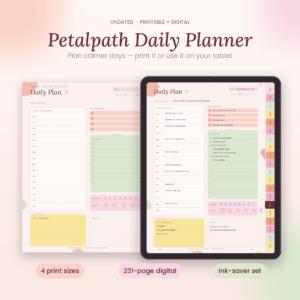
Petalpath Undated Daily Planner
Price: $2.39 | Best for: people who like a single daily focus
An undated printable and digital set whose Daily Plan page holds a Today’s Focus line, four Top Priorities, a to-do checklist, a 6 a.m. to 9 p.m. hourly schedule, water and mood trackers, a For Tomorrow box and a dot-grid notes area. There are 13 more layouts for weeks, months, habits, goals, meals and budgets. Print in four sizes or use the hyperlinked version on a tablet. Fill the Today’s Focus line before anything else.
A task list that does not overflow
A task list grows like weeds. The fix is a few firm rules.
Cap the lines
If your page has 13 task lines, that is your limit. When it fills, new items go on a later page. The cap forces small decisions all day long, and those small decisions are exactly what keeps the list honest.
Add rough times
Write a quick estimate beside each task: 5m, 20m, 1h. Add them up. If your tasks total six hours and you have three free hours after meetings, something has to move. Better to see that at 8 a.m. than at 4 p.m.
Batch the small ones
Five-minute tasks, like replying to texts or paying a bill, are better done together in one 30-minute slot. Mark them with a small dot and clear them in a batch after lunch.
Use a matrix on heavy days
On a day with too many competing tasks, a simple four-box grid helps. Urgent and important, important but not urgent, urgent but not important, neither. Anything in the last box gets crossed off without guilt.
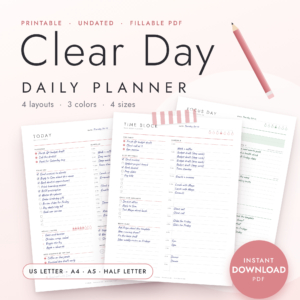
Clear Day Daily Planner Printable
Price: Original price was: $2.99.$2.49Current price is: $2.49. | Best for: long lists and busy workdays
Four undated layouts in three colors and four sizes, printable or fillable. The Daily Planner page has three priorities, a 13-line to-do list with tick boxes, an hourly schedule and a line for tomorrow. The Focus Day page adds the one big thing, a four-box priority matrix, focus rounds and a brain dump. Print the Focus Day page for your busiest day this week.
A notes area that does not turn into clutter
The notes box is where good ideas and important details either get saved or get lost. The difference is processing.
What belongs in notes
- Information you need later: numbers, dates, names, codes
- Ideas that pop up while you are doing something else
- Things people tell you: “Sam’s off next Friday”, “the venue needs numbers by the 20th”
- New tasks that arrive mid-day, before you decide where they go
Process notes before bed
Each evening, read the notes box once. For every line, decide: is this a task (move it to a future page), a date (add it to the calendar), information to keep (copy to a reference page) or nothing (cross it out). Three minutes. Now the notes box is empty for tomorrow and nothing has slipped through.
A separate notes page at the end of each week catches the longer stuff: meeting jottings, a gift ideas list, the name of that podcast someone mentioned.
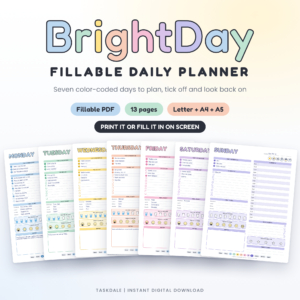
BrightDay Fillable Daily Planner
Price: $1.99 | Best for: weekly planners who review on Fridays
A 13-page undated set with a Start Here page, a Week at a Glance spread, seven daily pages in seven colors with top 3 priorities above an hourly schedule, a habit tracker for up to 12 habits, a weekly review with star ratings and a lined notes page. Type into it or print it on US Letter, A4 or A5. Use the notes page as your weekly catch-all for anything that will not fit on a daily page.
Using color to separate days and categories
Color is not just decoration. It is a quick sorting tool for your eyes. Two ways to use it:
- Color by day. Each weekday page in its own shade. You find Thursday by color alone, and parked tasks are easy to spot when you flip forward.
- Color by category. Highlight work tasks in blue, home in green, errands in yellow. A glance tells you if Tuesday is all work and no home, which is useful when you are planning the week.
A parent planning school week pages might color-code each child’s tasks. Pink for Ella’s science project, orange for Leo’s football kit. No reading needed to see whose stuff is due.
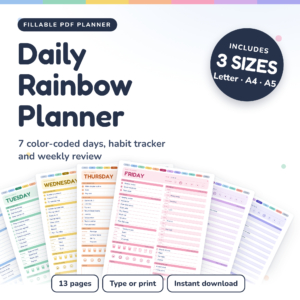
Daily Rainbow Planner
Price: Original price was: $1.99.$1.49Current price is: $1.49. | Best for: visual thinkers and color coders
An undated 7-day planner where each day from Monday to Sunday has its own color and the same layout: top 3 priorities, an eight-box to-do list, an hourly schedule from 5 a.m. to midnight, a meal diary and habit tick boxes, with a weekly overview and review. Fillable PDF in Letter, A4 and A5. Print a full week and use matching highlighters for categories.
For more color ideas and softer layouts, our round-up of cute daily planner picks compares pastel pages with rainbow days.
The five-minute evening shutdown
Closing each page properly is what makes the next one easy. Do this before you put the planner away.
- Tick what got done. Notice the priorities first. Let yourself feel good about them.
- Move unfinished tasks. Copy each one to a specific future day, or cross it out if it no longer matters.
- Process the notes box. Task, date, keep or bin.
- Write tomorrow’s top three in the For Tomorrow box or on tomorrow’s page.
- Close the planner. Literally. The workday is over.
The carry-over rule
If a task has been moved three days in a row, stop. Ask why. Maybe it is too big and needs breaking down. Maybe it is not really important. Maybe you are avoiding it. Either break it into a smaller first step, schedule it as a priority, or drop it. Carrying the same item for two weeks quietly drains your confidence.
Common mistakes with daily pages
- Too many priorities. Six priorities is a task list in disguise.
- No time estimates. Lists always look shorter than they are.
- Notes left unprocessed. They pile up and you stop trusting the page.
- Planning in the morning rush. The night before is calmer and clearer.
- Rewriting the whole list daily. Only move what is unfinished. Do not recopy the week’s backlog every morning.
Daily pages are not for everyone. If your work is mostly reactive, say a support desk or a busy reception, you may get more from a simple shift checklist. But if you choose what to work on most days, a page that separates priorities, tasks and notes is one of the cheapest ways to feel in charge of your time.
Frequently asked questions
How many priorities should I have each day?
Three is a good default. Some people prefer one main focus plus two or three supporting priorities. More than four usually means the list needs another sort.
What is the difference between a priority and a task?
A priority is something that would make today count if it were the only thing done. A task is useful but can wait or be done in a gap.
What should I write in the notes section of a daily planner?
Information you will need later, ideas, things people tell you and new tasks that arrive during the day. Process it each evening.
What do I do with tasks I did not finish?
Move each one to a specific future day or cross it out. If a task moves three days running, break it down or drop it.
Is a printable or digital daily planner better for to-do lists?
Printable pages are quick to scan and satisfying to tick. Digital pages are easier to carry and edit. Many fillable PDFs let you do both.
Your next step
Tonight, do a three-minute brain dump, circle three priorities for tomorrow and park the rest. Write them on a fresh page with a notes box at the bottom. If you want a page that puts a single focus above your priorities, start with the Petalpath Undated Daily Planner.