The best learning time with a preschooler often does not look like learning at all. It looks like a child coloring a big letter B, saying “buh, buh, bear” under their breath, and then tracing the word twice because they want to. Educational coloring books work because the coloring is the hook and the skill rides along quietly.
This guide is for parents, homeschoolers and early years teachers looking for educational coloring books that make learning letters, numbers, and science fun. You will learn what separates a real learning book from a themed one, how to use each type, a simple weekly plan, and four printable books from Taskdale that cover letters, numbers, early science and real-world facts.
Quick picks: learning coloring books
| Product | Best for | Price | Link |
|---|---|---|---|
| Crayon Campus Preschool Learning Coloring Worksheets | Shapes, numbers, colors and science, ages 3 to 5 | $4.99 | View |
| Letter Parade Alphabet Coloring Book A to Z | Letters, sounds and tracing | $3.99 | View |
| Hop to Ten Color by Number for Kids | Numbers 1 to 10 and first sums | $4.49 | View |
| Roar to Z Dinosaur Coloring Book A to Z | Dinosaur fans who love facts | $4.49 | View |
What makes a coloring book educational
Plenty of books call themselves educational because they have animals in them. That is a stretch. A page earns the word when it asks the child to do one small thinking job alongside the coloring: count something, match something, say a sound, trace a shape or answer a question.
Look for these signs when you flick through a preview:
- One skill per page. A page about the number 7 should be about 7, not 7 plus three shapes plus a maze.
- A simple instruction you can read aloud. “Color 4 apples” beats a paragraph of text.
- Tracing or writing space. Handwriting lines with a start dot help small hands form letters and numerals properly.
- A way to check. Answer keys or finished examples save you guessing.
- Big, clear artwork. If the picture is too fussy, the skill gets lost.
A themed book is still lovely for quiet time. But if you want a four-year-old to know their numbers by summer, pick the book that asks them to count.
Letters: connecting shape, name and sound
Children learn letters fastest when four things line up at once: what the letter looks like, what it is called, the sound it makes and a word that starts with that sound. A good alphabet page puts all four on one sheet. The child colors a big A, colors an apple, hears “a, a, apple” and traces the letter underneath.
Uppercase and lowercase on the same page matters too. Many children learn capitals first from signs and toys, then get confused when they see “b” in a picture book. Seeing B and b side by side, every time, clears that up gently.
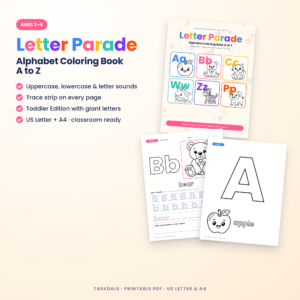
Letter Parade Alphabet Coloring Book A to Z
Price: $3.99 | Best for: ages 2 to 6, letter of the week
One page per letter with a big uppercase and lowercase letter to color, a picture from apple to zebra, the word, and three trace rows on handwriting lines. A separate Toddler Edition gives each letter an extra-large page for ages 2 to 4. It includes letter match and letter hunt pages, an alphabet chart, US Letter and A4 PDFs, and a one-teacher classroom license.
How to run a letter page
- Say the letter name and its sound together. “This is M. It says mmm.”
- Color the big letter while you both repeat the sound.
- Color the picture. Ask what else starts with mmm. Mum? Milk? Moon?
- Trace the letter on the lines, starting at the dot.
Ten minutes. One letter. That is plenty for a four-year-old, and it is small enough that you will actually keep it up.
Numbers: counting that feels like a game
Number sense is more than reciting 1 to 10. A child needs to know that “5” means five things, that 5 comes after 4, and that five apples and five cars are the same amount. Coloring helps because the child has to physically count and color each object, which locks in one-to-one counting.
Color by number is a sneaky favorite here. A child finds a 3 on the picture, looks at the key, finds the crayon for 3 and colors the space. They are reading numerals over and over without noticing, and a cheerful picture appears at the end as the reward.
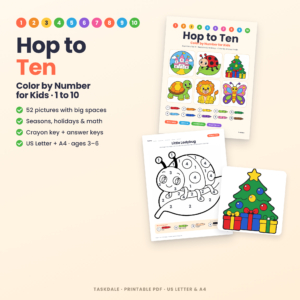
Hop to Ten Color by Number for Kids
Price: $4.49 | Best for: preschool to first grade number practice
Fifty-two pictures using only the numbers 1 to 10, ordered from 1 to 5, then 6 to 10, then mixed, plus seasonal pages and color-by-answer sums within 10. Every picture has a full-color finished version at the back for checking. It comes as US Letter and A4 PDFs with a Word guide, and one teacher may print copies for their own class.
Number activities to add
- Number of the day: pick one number and hunt for it on three different pages.
- Ten frames: color boxes in a ten frame to match the number, then count the empty ones.
- Which has more? Color two groups and point to the bigger one.
For more ideas on number pages at this age, our guide to planning a themed preschool week shows how to build a number or letter into every day without it feeling repetitive.
Shapes and colors: the skills people forget
Letters and numbers get all the attention. Shapes and color names quietly matter just as much. A child who can tell a circle from an oval is practicing the same careful looking they will need to tell “b” from “d”. A child who can name purple and brown is building vocabulary they will use every single day.
Shape pages work best with a big dashed outline to trace, then a “find every circle” row where the child colors only the matching shapes. That second step is where the thinking happens. They have to look, compare and decide. Color-word pages do something similar: color the crayon red, trace the word “red”, then color four things that are usually red, like a strawberry, a fire truck, an apple and a ladybug.
Easy shape and color games
- Shape walk: after coloring a triangle page, find three triangles in the house. A roof on a toy, a slice of toast cut corner to corner, a road sign in a book.
- Color sort: tip out the crayon box and sort it into warm and cool colors before you start.
- Mystery picture: color-by-shape pages, where every triangle is green and every circle is yellow, reveal a hidden picture at the end.
These are small, quick wins. A three-year-old who shouts “Diamond!” at a kite in the park has learned something real, and you will both feel it.
Science: weather, plants and life cycles
Science for three- to five-year-olds is mostly noticing. What is the weather today? What does a plant need? What comes out of a frog egg? A coloring page gives that noticing a shape. The child colors a tadpole, then a froglet, then a frog, and the order of the life cycle sticks because they made each stage themselves.
Good early science pages keep it simple: four steps in a life cycle, three things a plant needs, a sorting page for land, water and sky animals. Pair each page with something real. Color the plant page, then water a bean on the windowsill. Color the weather page, then look outside.
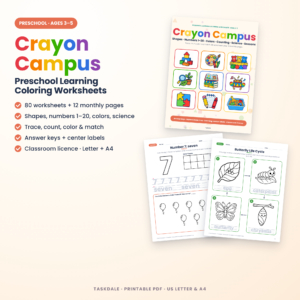
Crayon Campus Preschool Learning Coloring Worksheets
Price: $4.99 | Best for: ages 3 to 5, home or classroom
Eighty worksheets across shapes, numbers 1 to 20, counting, colors, matching and simple science (weather, plant parts, four life cycles, animal homes), plus 12 seasonal pages. It includes answer keys, a skills checklist, a certificate and printable learning-center labels. You get 96-page US Letter and A4 PDFs, and a classroom license for one teacher.
The skills checklist is handy for parents too. Tick a box when your child can name a triangle or count to 12 without help. Seeing a full row of ticks by the end of a term gives everyone a quiet sense of pride.
Real facts for curious kids
Some children are not interested in “learning pages” at all. They are interested in dinosaurs. Or horses. Or sharks. For these kids, the trick is to bring the learning inside the thing they already love.
A fact-based coloring book does exactly that. The child colors a Stegosaurus, and while they color, you read three facts aloud: when it lived, how big it was, one fun detail. Then they try to say the name. A five-year-old who can pronounce “Pachycephalosaurus” is a very proud five-year-old.
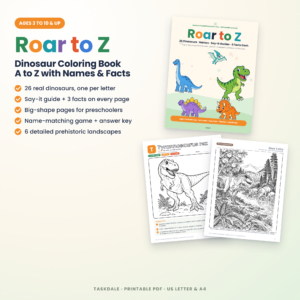
Roar to Z Dinosaur Coloring Book
Price: $4.49 | Best for: dinosaur fans aged 3 to 10
An alphabet of 26 real dinosaurs and prehistoric reptiles, each with its name to color, a say-it pronunciation guide, what the name means and three kid-friendly facts. It also has a big-shape section for preschoolers, a name-matching game and six detailed landscapes for older kids. Licensed for personal use and one teacher’s own class.
This doubles as letter practice, since every dinosaur sits under a letter. A for Ankylosaurus. Z for Zuniceratops. Learning letters through dinosaurs works brilliantly for kids who roll their eyes at “apple”.
A simple weekly learning plan
You do not need a full curriculum. Fifteen to twenty minutes a day, four days a week, covers a lot of ground for a preschooler. Here is a plan a parent can run at the kitchen table:
| Day | Focus | Example page |
|---|---|---|
| Monday | Letter of the week | Big letter with a picture and tracing |
| Tuesday | Number of the week | Count and color, plus a ten frame |
| Wednesday | Science | Weather watch or a life cycle |
| Thursday | Fun review | Color by number or a fact page |
| Friday | Off, or free coloring | Whatever they pick |
Over 26 weeks you cover the whole alphabet and numbers well past 20. That is a real head start before kindergarten, done in short, happy sessions.
Using learning pages at home, in homeschool or in class
At home
Keep it light. Leave a learning page and a pot of crayons on the table after breakfast and see if your child wanders over. Many will. If they do not, try again after nap time. Pressure is the fastest way to make a child dislike worksheets.
In a homeschool
Use a learning page as the warm-up before a hands-on activity. Color the life cycle of a butterfly, then read a picture book about caterpillars. Color the number 8 page, then count 8 spoons into a bowl. The page sets up the idea and the activity makes it real.
In a preschool classroom
Learning pages make easy morning work while children arrive, and a calm activity for early finishers. A teacher with 18 four-year-olds can put the same counting page at one table, a letter page at another, and let children rotate. Name lines at the top make collecting work simple, and an answer key means a classroom helper can check pages too.
Common mistakes with learning pages
Correcting every line
If a child colors the sky green, let it go. The skill on the page is counting or the letter sound, not realism. Constant correction turns a fun activity into a test, and children notice.
Too many pages at once
Three worksheets back to back is a lot for a four-year-old. One learning page and one free page is a better mix. Stop while they still want more.
Skipping the talk
The talking is where most of the learning happens. “How many ducks? Let’s count together.” Silent coloring is relaxing, but a short chat doubles the value of the page.
Ignoring the license
If you teach, check whether a book includes a classroom license before you print copies for your class. The four books above cover one teacher’s own class. Many general coloring books are household-only.
Science pages work well for older children too. Our article on science coloring worksheets covers pages for school-age kids, from the water cycle to body systems.
Frequently asked questions
What age are educational coloring books for?
Most early learning books suit ages 3 to 6. Toddler editions with giant letters work from about age 2, and fact-based books like dinosaur or animal sets keep kids up to 10 interested.
Do coloring books help kids learn letters?
They can, when each page pairs the letter shape with its sound, a picture and tracing. Short daily practice builds recognition without pressure.
Is color by number good for preschoolers?
Yes, if it uses small numbers and big spaces. Books that stick to 1 to 10 are a good fit for ages 3 to 6.
How long should a learning coloring session last?
About 10 to 20 minutes for preschoolers. Stop while they are still enjoying it so they look forward to the next one.
Are printable learning books better than store-bought ones?
Each has a place. Printables let you reprint a page when it gets torn or when a child needs more practice on one letter, and you can print just the pages you need for this week.
Can teachers print these for a whole class?
The four books in this guide include a license for one teacher’s own class. Each extra teacher needs their own copy.
Your next step
Pick one letter and one number your child does not know yet. Print a page for each tonight and try them over breakfast tomorrow. If that goes well, the Crayon Campus worksheets give you a ready-made term of short, happy lessons.