Felt coloring pages for preschool are two things at once. A child colors a printed shape, a grown-up helps cut it out, and the finished piece gets a felt backing so it sticks to a felt board. A red circle becomes a sun. A colored puppy becomes the star of a story. The coloring is only the start.
This guide is for parents, preschool teachers and childminders who want that kind of hands-on activity without buying a pricey felt kit. You will get a simple way to make the pieces, a list of shapes and characters that work best, play ideas for the board, and printable sets on Taskdale that give you clean, bold outlines to start from.
One heads-up before we begin. Some shops sell fuzzy “velvet” or felt-flocked posters that kids color with markers. Those are lovely, but they are a different product. Here we are making our own felt pieces from paper pages, which costs less and lets your child choose what goes on the board.
Quick picks for cut-and-color felt pieces
| Product | Best for | Price | Link |
|---|---|---|---|
| Crayon Campus Preschool Learning Coloring Worksheets | Shapes, colors and counting pieces | $4.99 | View |
| Little Explorers Preschool Coloring Book | Animal and vehicle characters | $3.49 | View |
| Starmane Meadow Unicorn Coloring Book | Chunky unicorns for story play | $4.49 | View |
| Tap Tap Treehouse Digital Quiet Book | Felt-style play on a tablet | $5.99 | View |
What makes a page good for felt pieces
Not every coloring page survives the scissors. A busy scene with ten tiny flowers and a fence turns into confetti. The pages that work have one big subject, a thick outline and plenty of space around the edge.
Look for three things before you print:
- One shape or character per page. A single bold circle, a single tractor, a single bunny. You want something a 4-year-old can recognize from across the room once it is on the board.
- Outlines at least a few millimeters thick. Thick lines give you a cutting guide. They also hide small wobbles when an adult cuts around the edge.
- No thin bits sticking out. Skinny tails, whiskers and antennae snap off after a week of play. Round, chunky shapes last much longer.
If you want a wider look at what suits small hands, our guide to preschool coloring pages in PDF covers line weight, page size and how much detail a 3-year-old can handle.
How to make felt-backed coloring pieces, step by step
You need very little. Most of it is already in a craft drawer.
What to gather
- Printed coloring pages on card stock (around 65 lb or 176 gsm is a good weight)
- Crayons or washable markers
- Scissors for you, safety scissors for your child
- A few sheets of craft felt, any color
- A glue stick or white craft glue
- Optional: clear packing tape or a laminator
The steps
- Print on card stock. Plain paper curls once glue touches it. Card stays flat.
- Color first, cut second. Let your child color the whole page while it is still a rectangle. It is much easier to hold.
- Cut a loose outline. Leave a thin white border, about the width of a pencil line, around the shape. That border protects the colored edge.
- Glue onto felt. Spread glue over the back of the shape and press it onto a felt sheet. Put a heavy book on top for 20 minutes.
- Trim the felt. Once dry, cut the felt to match the paper shape.
- Seal if you like. A layer of clear tape on the front stops crayon wax smudging onto other pieces.
A batch of eight pieces takes about 30 minutes, including drying time. That is one nap or one long cartoon. The first time a child presses their own colored star onto the board and it sticks, you will see the pride on their face. It is worth the glue on the table.
Shape pieces that teach while they play
Shapes are the best place to start. They are easy to cut, easy to name, and they turn into dozens of games. A set of circles, squares, triangles and rectangles in four colors gives you 16 pieces and a whole week of play.
Here is a small worked example. Print the circle page twice, the triangle page twice and the square page once. Your child colors two circles red, two triangles green and the square blue. After cutting, you have five pieces. Now build a house: square for the walls, triangle for the roof, a circle for the sun. Then pull it apart and ask, “Which shape has three sides?” That is shape practice, color naming and counting in one ten-minute game.
Worksheet-style pages are handy here because they already put the shape front and center, with the word printed nearby. You can cut the big shape out and keep the rest of the page as a tracing sheet.
Crayon Campus Preschool Learning Coloring Worksheets
Price: $4.99 | Best for: preschool teachers and homeschool families
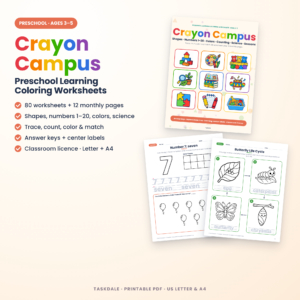
Crayon Campus has 80 learning worksheets plus 12 monthly seasonal pages, with a 12-page Shapes section that gives each shape (circle, square, triangle, star, heart and more) a big dashed outline to color and trace. It comes as US Letter and A4 PDFs, with answer keys, a skills checklist and a classroom licence for one teacher. Start by printing the circle, square and triangle pages on card stock and cutting out the big shapes for your first felt set.
Once your child knows the basic shapes, add the number pages. A colored number 5 on the felt board, next to five small felt circles, makes counting something they can touch.
Character pieces for felt board stories
Shapes teach. Characters tell stories. And preschoolers adore a story they get to move with their own hands.
Pick three or four characters that can share a scene. A puppy, a duck, a fire engine and a tractor are plenty. Your child colors each one, you cut them out, and the board becomes a farm, a road or a park. Ask “Where is the puppy going?” and let them run with it. You might hear a 15-minute saga about a duck who drives a tow truck. Good. That is language practice in disguise.
Characters that cut well
- Animals sitting or standing side-on, with round bodies
- Vehicles with simple boxy outlines, like dump trucks and diggers
- Friendly faces with big eyes that read clearly from a distance
Characters to skip
- Anything with long thin legs, like a giraffe or a spider
- Scenes where the character overlaps a background
- Very small characters inside a bigger picture
A book with separate animal and vehicle pages makes life easy, because each character already sits on its own page with room to cut.
Little Explorers Preschool Coloring Book
Price: $3.49 | Best for: ages 2 to 5 who love animals
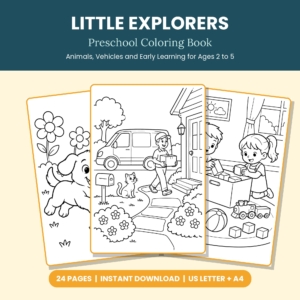
Little Explorers has 24 pages with thick outlines in three themes: Friendly Animals, Busy Vehicles and Early Learning. You get US Letter and A4 PDFs plus every page as a separate 300 DPI PNG, which is handy for printing just the tractor or just the sea turtle. The files cover personal, family and classroom use. Begin with the Busy Vehicles pages, since trucks and diggers have the chunkiest shapes to cut.
For a unicorn fan, the Little Hooves section of Starmane Meadow has 14 chunky preschool unicorns with extra-thick outlines. A unicorn on a cloud plus a rainbow piece makes a sweet little scene for bedtime stories.
Felt board games to play with the finished pieces
Once you have ten or so pieces, the board earns its keep. These games need no extra prep.
- What is missing? Put four pieces on the board. Your child closes their eyes while you take one away. They guess which piece vanished. Start with three pieces for a 3-year-old.
- Color sort. Make two zones on the board with a strip of yarn. Red pieces on one side, blue on the other.
- Build a picture. Ask for a snowman made of circles, or a train made of squares.
- Story starter. You place one character and say one sentence. Your child adds a piece and the next sentence. Take turns until the story ends, usually in something ridiculous.
- Count and match. Put up a number and ask your child to add that many pieces underneath it.
Rotate the pieces every week or two. Keep the rest in a zip bag or an envelope taped to the back of the board. Fresh pieces feel new again, and nothing gets lost under the sofa.
Making a felt board that costs almost nothing
You do not need a shop-bought board. A large piece of felt does the job if it has something firm behind it.
The cheapest version uses a cardboard box flap. Cut a rectangle about 12 by 16 inches, glue a matching sheet of felt over it, and fold the edges round the back. Done in ten minutes. For a sturdier board, wrap felt around a cheap canvas or a thin cork board and staple it at the back.
For car trips, try a small travel version. Glue felt inside a folder or a pencil case lid. A 5-year-old can play with six pieces on their lap for a whole 40-minute drive, and the pieces tuck back inside when you arrive. Dark felt, like navy or dark green, makes colored pieces pop. White felt looks pretty but shows every crayon smudge by Thursday.
Common mistakes with paper and felt pieces
Most problems come from rushing. Here are the ones that catch people out.
- Using printer paper. Thin paper wrinkles under glue and tears after a few days of play. Card stock is worth it.
- Too much glue. Puddles soak through and leave wet patches on the front. A glue stick, rubbed edge to edge, is enough.
- Cutting too close. Trimming right on the black line leaves jagged edges. Leave that thin white border.
- Markers on plain paper. Washable markers bleed on thin sheets. On card stock they look bright and stay put.
- Making every piece at once. A preschooler will color five pages happily and then rebel. Make a few pieces at a time and add to the set over a month.
- Doing the coloring for them. It is tempting to fix a scribbly cow. Leave it. A purple cow they made is worth ten tidy cows you made.
When you have no felt, glue or time: a tablet option
Some days the craft drawer is empty, or you are sitting in a doctor’s waiting room with a fidgety toddler. Felt pieces are no help there. They fall on the floor, roll under chairs and get stepped on.
That is where a digital quiet book fills the gap. It gives the same tap-and-move feel as a felt board, with nothing to drop. It is not a replacement for real cutting and gluing, which builds hand strength, but it is a calm backup for travel and restaurants.
Tap Tap Treehouse Digital Quiet Book
Price: $5.99 | Best for: toddlers on trips and in waiting rooms
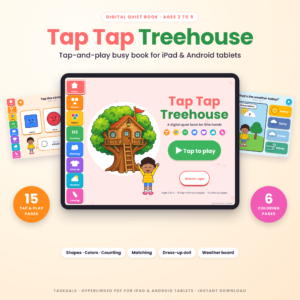
Tap Tap Treehouse is a hyperlinked PDF for iPad and Android tablets with 15 tap-and-play activities (shapes, colors, counting, matching, a weather board and a dress-up doll called Pip) plus 6 coloring pages you color on screen with a finger or stylus. It works offline in apps like GoodNotes, Notability and Xodo, and includes a parent guide. Load it on your tablet at home, open the picture menu once with your child, and save it for the next long wait.
Many families use both. Felt pieces at the kitchen table, the tablet book in the handbag. For more screen-free ideas for the youngest kids, see our list of free coloring sheets for toddlers.
A simple weekly routine for preschool felt play
Little and often works better than one big craft day. Here is a rhythm that fits around a normal week.
- Monday: Color two new pages. Shapes or one new character.
- Tuesday: Cut and glue them onto felt. Leave them under a book overnight.
- Wednesday: Trim the felt and add the new pieces to the board.
- Thursday: Play one game, like color sort or what is missing.
- Friday: Story time with all the characters. Let your child lead.
In a classroom, this splits nicely across a theme week. If you plan by theme already, our preschool lesson plan template guide shows how to slot an activity like this into each day. Keep licences in mind, too. A set sold for one family or one teacher’s class should not be copied for a whole school.
Frequently asked questions
What are felt coloring pages?
The phrase covers two things. Some are fuzzy, flocked posters you color with markers. Others are printed coloring pages that kids color, cut out and back with felt so the pieces stick to a felt board. This guide covers the second kind.
What age is right for cut-and-color felt pieces?
Children from about age 3 can color the pieces and help press them onto felt. Most 4- and 5-year-olds can cut simple shapes with safety scissors. An adult should do the final trimming for younger kids.
Do paper pieces stick to a felt board?
Bare paper does not stick well. A felt backing grips the board. If you have no felt, a strip of sandpaper or the rough side of hook-and-loop tape on the back also works.
What paper should I print felt board pieces on?
Card stock around 65 lb (176 gsm) is ideal. It stays flat under glue and survives weeks of play. Plain paper is fine for practice pages you do not plan to cut.
Can I laminate the pieces instead of using felt?
Yes, but laminated pieces slide off a felt board. Laminate them and add a small piece of felt or hook-and-loop tape on the back to make them grip.
How many pieces should a preschool felt set have?
Start with 8 to 12. That is enough for games and stories without overwhelming a small child. Add a few more every week.
Your next step
Print three shape pages on card stock tonight, a circle, a square and a triangle, and let your child color them after breakfast tomorrow. Back them with felt, stick them on a cardboard board and build a house together. When you want more shapes, numbers and seasonal pages ready to cut, the Crayon Campus preschool worksheets give you a year of pieces to make.