A four-year-old and a ten-year-old can sit at the same table with the same pack of crayons and want completely different pages. Give the little one a detailed jungle scene and you get tears. Give the older one a giant smiling sun and you get an eye roll. Matching the page to the age is the whole trick.
This guide sorts free coloring pages for kids by age, from preschool through the end of elementary school. For each stage you will see what a good page looks like, what kids that age enjoy, and one simple activity to try. Then we cover where free pages actually come from, how to spot a good one in ten seconds, and when a low-cost printable set saves you time.
It is written for parents, grandparents, babysitters and anyone who has typed “coloring pages” into a search bar at 7 am on a snow day.
Quick picks: printable sets for different ages
| Product | Best for | Price | Link |
|---|---|---|---|
| Farm Animals Coloring Book | Ages 3 to 6, big bold barnyard scenes | $3.49 | View |
| Ocean Life Coloring Book | Ages 4 to 8, sea animals with simple shapes | $3.49 | View |
| Orbit Pals Printable Coloring Book | Ages 7 and up, funny space animals | $3.99 | View |
| Thankful Feathers Turkey Coloring Pages | Mixed ages in November | $3.49 | View |
Where good free coloring pages come from
Free pages are easy to find and easy to regret. Here are the sources worth your time, and what each is best for.
- Libraries. Many children’s desks keep seasonal sheets on hand. They are usually clean, age-appropriate and printed already. Just ask.
- Your child’s school. Teachers often send extra pages home or will tell you where they found a favorite.
- Museum, zoo and park websites. Many have kids’ activity pages about animals, plants and history. Good for curious kids who like real facts.
- Coloring websites. Huge variety, quick to print. Expect ads, single pages and mixed quality. Our guide to finding good printable coloring pages explains how to tell the good ones apart.
- Free samples from designers. A page or two from a paid book, shared to show the style. Often the best-drawn free pages around.
- Your own drawing. A circle, two ears and whiskers is a cat. Small kids think you are a genius.
Free pages are perfect for a one-off: a rainy hour, a waiting room, a quick filler before dinner. They fall short when you need lots of pages in one theme, pages for several ages at once, or something you can reprint without hunting for it again.
Check any page in ten seconds
Before you hit print, run this quick test. It works for any age.
- Squint at it. If the page turns into a gray blur, it is too detailed for anyone under seven.
- Find the smallest space. Could your child’s crayon tip fit inside it? If not, skip it for now.
- Zoom in on a line. Smooth and dark means a clean print. Jagged and fuzzy means a blurry print.
- Look at the size. The picture should fill most of the page. A tiny drawing in a sea of white is hard work.
- Ask: would my kid choose this? Theme beats everything. A dinosaur fan will color a so-so dinosaur over a beautiful flower.
Ages 3 to 4: preschool pages
Preschoolers are still building hand strength. Most hold a crayon in their fist and color with big arm movements. The page needs to meet them there.
What to look for
- One main subject per page, like a cow, a duck or a fire truck.
- Very thick outlines that act like walls.
- Big, open shapes with lots of white space.
- Familiar things from their own world.
Try this
Color and chat. Ask what sound the animal makes, how many legs it has, what color it should be. Five minutes of coloring becomes five minutes of talking, and both count. For more on this stage, our guide to preschool coloring pages covers big shapes and easy wins in more detail.
Farm animals are a classic at this age, because every child knows a cow says moo.
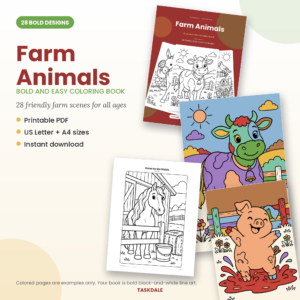
Farm Animals Coloring Book
Price: $3.49 | Best for: preschoolers and early learners
This printable book has 28 bold, friendly farm scenes, such as a cow in a meadow, a pig in a puddle and a duck family at the pond, drawn with thick outlines and large shapes. It comes as US Letter and A4 PDFs with every design on its own page, and you can reprint favorites for personal use. Print the pig page first and ask your child what color mud should be.
Ages 5 to 6: kindergarten pages
Around five, children start trying to stay inside the lines, and they care about getting colors right. They also start to notice small details and want to add their own.
What to look for
- A main subject plus one or two extras, like a fish with bubbles or a turtle on a rock.
- Medium-thick lines and mostly large spaces, with a few smaller ones.
- Pages with a word or label they can color or trace.
- Simple counting or matching, like three starfish to color.
Try this
Color by your own key. Write “1 = blue, 2 = green” at the top of a plain page and number a few shapes. You have just made a free color by number, and a five-year-old will feel very grown up following it.
Sea animals hit the sweet spot at this age: bright, friendly and full of simple shapes. Our page on ocean coloring pages for kids and adults has more ideas for an underwater theme.
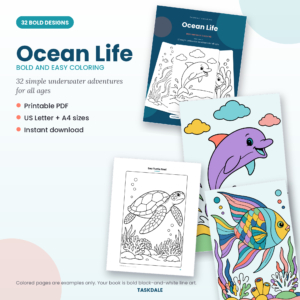
Ocean Life Coloring Book
Price: $3.49 | Best for: kindergarten and early elementary
Ocean Life has 32 bold, easy underwater scenes, including a friendly dolphin, a sea turtle on the reef, a smiling octopus and a curious seahorse. Thick outlines and large shapes mean fewer tiny spaces, and you get both US Letter and A4 PDFs. Print a few for a beach or aquarium day, and let kids pick a rainbow reef or real ocean blues.
Ages 7 to 8: early elementary pages
By second and third grade, kids want pages that are fun, funny or a bit surprising. Their hands are steadier, and they can handle small details if the page gives them a big shape to start with.
What to look for
- Characters with personality and a bit of humor.
- A mix of large shapes and small details like stars, spots or patterns.
- A scene or background they can add to.
- Themes they are learning about: space, oceans, dinosaurs, weather.
Try this
Name it and tell its story. Before coloring, ask your child to name the character and say what it is doing. A rabbit called Comet who is late for a moon party gets colored with far more care than “a rabbit”. Write the name at the top.
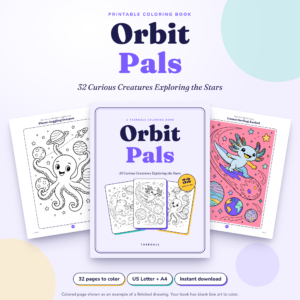
Orbit Pals Printable Coloring Book
Price: $3.99 | Best for: kids from about 7 who love space
Orbit Pals has 32 full-page drawings of animals loose in outer space, like an axolotl surfing a comet and a capybara soaking in a moon bath, each with a short caption. You get US Letter and A4 PDFs, a single-page PNG pack and an illustrated user guide. Younger siblings can color the big animal while older kids take on every star and crater.
One more idea for this age: tie the page to whatever they are learning at school. If the class is studying planets, a space page at home lets them show off what they know while they color.
Ages 9 to 11: upper elementary pages
This is the age where many kids drift away from coloring because the pages feel babyish. Win them back with more detail, more realism and more choice.
What to look for
- Finer lines and more detail, such as realistic animals or patterns.
- Mandalas and geometric designs for calm, focused coloring.
- Funny or slightly weird subjects that feel grown up.
- Pages tied to real interests, like sports, music or nature facts.
Try this
Give real tools. A set of colored pencils and a proper sharpener says “this is a hobby”, not “this is for little kids”. Show them how to shade one side of a shape darker for a 3D effect. That one trick hooks a lot of ten-year-olds.
Coloring for mixed ages at one table
Many families have kids at two or three stages at once. Here is how to keep everyone happy without printing four different worlds.
- Same theme, different pages. Choose one topic, like fall, and print an easy page for the four-year-old and a detailed one for the nine-year-old.
- Same page, different jobs. The little one colors the big shapes. The older one adds patterns inside them. It becomes a team picture.
- Add a writing prompt for older kids. A line like “Something I am thankful for is…” gives the older child a bit more to do.
Seasonal sets with pages at several levels make this especially easy in the busy weeks before a holiday.
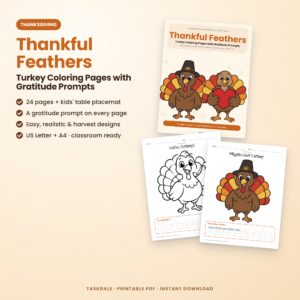
Thankful Feathers Turkey Coloring Pages
Price: $3.49 | Best for: families with kids at different ages
Thankful Feathers has 24 Thanksgiving pages at three levels: 12 easy cartoon turkeys for preschoolers, 6 realistic wild turkeys and 6 detailed harvest scenes for older kids. Each page pairs the picture with a short gratitude prompt and writing lines, and the set adds a kids’ table placemat and puzzles. Print one easy and one realistic page and let siblings color side by side.
A simple weekly coloring rhythm
Coloring works best as a small, steady habit rather than a rescue when everyone is bored. Here is a light rhythm that suits most homes with kids from three to eleven.
| When | What | Why it works |
|---|---|---|
| Monday after school | One page each while snacks are out | A calm landing after a busy day |
| Wednesday evening | Theme night, everyone colors the same topic | Siblings compare, nobody competes |
| Saturday morning | Kids choose and print their own pages | Choice builds excitement |
| Sunday | Pick one finished page for the fridge | Kids see their work valued |
Twenty minutes, three times a week. That is it. A seven-year-old who colors like this through one school term will have a stack of 30 or more finished pages, and you will notice their lines get steadier and their color choices get bolder. That small pride is worth more than any single beautiful page.
Keep the setup simple: one basket with paper, crayons and pencils, kept somewhere kids can reach without asking.
Make free pages go further
A few small tricks stretch every page you print.
- Use a sheet protector and dry-erase markers. Slide a page into a clear sleeve and it becomes reusable. Wipe and color again. Great for toddlers who color for two minutes at a time.
- Keep a coloring folder. Print a handful when you find good ones and store them in a folder by the door. You will thank yourself on the next sick day.
- Print two copies of favorites. One to color now, one to try a new color scheme later.
- Use the back. Once the front is colored, the back is a blank page for drawing their own picture.
- Make a book. Staple a week of finished pages together with a cover. Kids love having their own book to show off.
When a printable set is worth it
Free pages are great. A printable set pays off when you find yourself searching every weekend. One download gives you 25 or 30 pages in one theme, at one consistent quality, in your paper size, ready to reprint any time. No ads, no hunting, no wondering if the next page will print fuzzy.
Think about your actual week. If coloring is a once-a-month thing, free pages will do. If it is part of most afternoons, a few well-chosen sets that suit each child’s age will save you time and frustration.
Frequently asked questions
What coloring pages are best for a 3-year-old?
Pages with one big, familiar subject, very thick outlines and lots of open space. Farm animals, vehicles and simple shapes work well. Keep sessions short and let them color with chunky crayons.
Where can I get free coloring pages for kids?
Try your local library, your child’s teacher, museum and zoo websites, coloring websites and free samples from designers. You can also draw simple pages yourself with a thick marker.
What age can kids color detailed pages?
Many kids handle more detail from about seven or eight, especially if there is a big main shape to start with. Fully detailed pages usually suit ages nine and up.
How do I know if a free coloring page will print well?
Zoom in on the screen. If the lines stay smooth and dark, it will print cleanly. If they look jagged or gray, the print will be blurry. Print at 100% and in best quality.
Can I reuse coloring pages?
Yes. Slide a page into a clear sheet protector and use dry-erase markers, then wipe it clean. With printable books, you can also reprint a favorite page as often as you like for personal use.
Your next step
Write down each child’s age and one thing they love right now. Then print two pages for each child tonight, one easy and one a step harder, and see which one they finish. For a preschooler, a bold barnyard page from the Farm Animals Coloring Book is a happy place to start.