To choose a coloring book for mixed-media craft supplies, look first at the paper, then the lines, then the design. The paper has to be heavy enough for wet media and printed on one side only. The black lines must not run when water or alcohol touches them. And the design needs open spaces big enough for paint, collage or texture to show. Most bound coloring books fail at least one of these. Printable books let you solve all three, because you choose the paper and the printer.
This guide is for crafters who like to mix watercolor with colored pencil, add gel pen sparkle over markers, glue paper scraps into a page, or try paint pens on a design. It is also for parents and teachers planning a messy art afternoon. You will get a checklist for judging any book, a medium-by-medium guide, printing tips for heavier papers, and a few project ideas to get started.
Quick picks for mixed-media pages
| Product | Best for | Price | Link |
|---|---|---|---|
| Easy Mandala Coloring Book | Watercolor, gel pens and layered media on bold rings | $3.49 | View |
| Snug Hours Cozy Coloring Book | Print or digital, with transparent line-art PNGs | $5.99 | View |
| Pretend Play Coloring Book | Kids’ collage and craft-scrap projects | $2.99 | View |
| Friendship Fun Coloring Book | Big scenes for stickers, fabric and paper scraps | $2.99 | View |
The four-point checklist
Run any coloring book, printed or printable, through these four questions before you open the paint.
1. Is the paper heavy enough?
Thin paper buckles under water, pills under scrubbing and lets alcohol ink straight through. For anything wet, you want at least 65 lb cardstock, and for real watercolor washes, a mixed-media or watercolor paper. Most mass-market coloring books use paper in the 50 to 70 gsm range, which is fine for pencils and little else.
2. Are pages single-sided?
Double-sided books mean every wet layer threatens the design on the back. Single-sided pages, or loose printables you print one per sheet, remove that worry entirely.
3. Will the lines stay put?
This is the hidden trap. Some printed lines dissolve when wet. Water-soluble ink in an inkjet print can bleed gray into a watercolor wash. Laser toner can smear under alcohol markers. A good mixed-media page has stable lines, or you choose a combination of printer and medium that keeps them stable.
4. Are the spaces open enough?
Mixed media needs room. A brush, a collage scrap or a stamp cannot fit into a 2 mm gap. Look for bold outlines and medium to large spaces, with some areas that are almost empty, ready for texture.
Why printables win for mixed media
With a bound book, the paper is chosen for you. With a printable, you decide. That single difference makes printables the easiest route to mixed-media coloring.
- Pick the paper per project. Copy paper for pencil tests, cardstock for markers, mixed-media paper for watercolor.
- Print the same design several times. Try watercolor on one copy and alcohol markers on another, then compare.
- No wasted pages. A failed experiment costs one sheet, not a page out of a book you love.
- Frame-ready size. Letter and A4 sheets fit standard frames, so a finished mixed-media piece goes straight on the wall.
Licences still apply, of course. Most printable coloring books are for personal use, so reprint for your own projects rather than for a whole class unless the listing includes a classroom licence.
Choosing pages by medium
| Medium | Paper to print on | Design to choose | Watch out for |
|---|---|---|---|
| Watercolor or watercolor pencils | Mixed-media paper or heavy cardstock | Bold lines, large open areas | Inkjet lines bleeding when wet |
| Alcohol markers | Smooth cardstock, 80 lb or more | Medium to large shapes | Bleed-through, toner smudging |
| Gel pens and paint pens | Smooth cardstock | Patterns, borders, highlights | Smearing before ink dries |
| Colored pencil over paint | Mixed-media paper with some tooth | Any, once paint is dry | Pencil skating on glossy paint |
| Collage and paper scraps | 65 lb cardstock or heavier | Large simple shapes and backgrounds | Glue wrinkling thin paper |
| Glitter, stickers, washi tape | Cardstock | Open backgrounds, frames | Too much detail under tape |
Watercolor: the most demanding medium
Watercolor is where most coloring pages fall apart. Water makes paper swell, and swelling paper buckles into hills and valleys that trap pools of paint.
Choose bold, simple designs with big areas for washes. Mandalas are ideal, because each ring can take a wash of its own and the next ring can be painted once the first is dry. Thick outlines also help hide the soft edge watercolor leaves at the boundary of a shape.
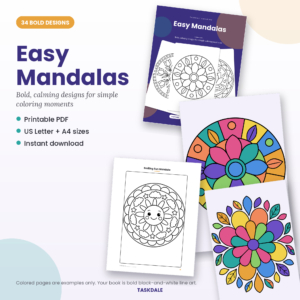
Easy Mandala Coloring Book
Price: $3.49 | Best for: watercolor and gel pen experiments
Easy Mandala holds 34 bold mandalas with thick outlines and generous open spaces, including sun, cloud and raindrop, leaf and butterfly designs. Every design is its own page in US Letter and A4, so you can print one mandala on mixed-media paper for watercolor and another on cardstock for markers. Paint the outer ring first and let it dry before working inward.
Keeping lines from running
- Laser printers fuse toner that does not dissolve in water. If you have one, use it for watercolor pages.
- Inkjet printers vary. Pigment-based black ink is usually water-resistant once dry. Dye-based ink often bleeds. Test by printing a page, letting it dry for an hour, and brushing water across one line.
- Heat-set trick: Some crafters run a warm iron over the back of an inkjet page, with a cloth between, to help the ink set. Test this on a spare page first.
- Go over key lines. If lines still bleed, trace the main outlines with a waterproof pigment fineliner before painting.
Printing on heavier paper
Many home printers accept cardstock up to about 80 lb cover through a rear or manual feed tray. Thicker watercolor paper, such as 140 lb, usually will not feed at all. A good middle ground is mixed-media paper cut to Letter or A4 that sits within your printer’s weight limit. Check your printer manual for the heaviest paper it supports.
To limit buckling, tape the edges of the page to a board with masking tape before painting, and leave it taped until fully dry. Peel the tape slowly at a low angle.
For more on painting pages, see our guide to water coloring book pages.
Markers, gel pens and paint pens
Dry-ish media are easier than watercolor but still need the right page.
Alcohol markers soak through almost everything. Use smooth, heavy cardstock and always slip a scrap sheet underneath. If you laser-print, color up to the line rather than over it, because alcohol can lift toner.
Gel pens sit on top of the paper. They shine on dark backgrounds and over finished marker work. Smooth cardstock keeps lines crisp, and you need to let each area dry before your hand passes over it.
Paint pens are opaque and bold. They are ideal for adding white highlights, metallic details or patterns on top of other media. Choose designs with borders and frames, where a pattern of dots or stripes looks right at home.
Digital files open another door. A page that also comes as a transparent PNG can be printed for traditional media or colored on a tablet, then printed and finished by hand with gel pens or paint pens.
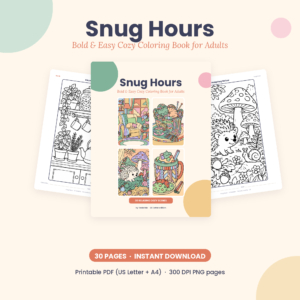
Snug Hours Cozy Coloring Book
Price: $5.99 | Best for: crafters mixing print and digital
Snug Hours has 30 bold cozy scenes in US Letter and A4 PDFs, plus 30 white-background PNGs and 30 transparent line-art PNGs at 300 DPI for apps with layers. A user guide covers print settings and paper tips, and the PDF includes a color test page and palette ideas. Print the rainy window seat on cardstock and add raindrops with a white paint pen after the markers dry.
Collage and mixed scraps
Collage turns a coloring page into a craft project. Fabric scraps for clothes, tissue paper for skies, magazine cutouts for windows, washi tape for borders. Kids especially love it, because it feels like building rather than coloring.
Choose pages with big, simple shapes and recognizable objects. A dress, a kite, a tablecloth, a sofa: each is a ready-made template for a scrap of real material. Print on 65 lb cardstock or heavier so glue does not wrinkle the page. A glue stick is easier than liquid glue for little hands and causes less buckling.
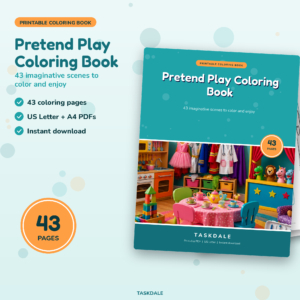
Pretend Play Coloring Book
Price: $2.99 | Best for: kids' collage and craft afternoons
Pretend Play has 43 detailed scenes built around jobs and make-believe, from a toy kitchen chef and a tea party table to a pirate ship captain, a supermarket shopper and an ice cream parlor. Each page shows one large picture with lots of props, which makes great collage targets. Print the tea party table on cardstock and let your child glue fabric scraps onto the tablecloth.
Scenes of friends playing work well for this too. Patterned clothing and flower borders are perfect for stickers and small paper shapes, and big sky areas take tissue paper beautifully.
Project ideas to try this week
- Watercolor and pencil mandala. Paint soft washes in each ring, let dry, then add pencil shading and gel pen dots.
- Marker scene with paint pen highlights. Color a cozy scene with markers and add white paint pen for steam, snow or light reflections.
- Collage kids’ scene. Glue fabric and paper scraps onto clothing and furniture, then color the rest with crayons.
- Junk journal page. Color a small design, cut it out and add it to a journal spread with tape and stamps. Our guide to printing and binding junk journal kits covers the paper side.
- Coffee-stained vintage page. Brush cooled coffee over a printed page on cardstock, dry it flat, then color with pencils for an old-paper feel.
Mistakes that ruin mixed-media pages
- Using a bound book for watercolor. The paper buckles and paint soaks into the next page. Use loose sheets.
- Not testing the lines. Always brush water or swipe an alcohol marker across one line on a spare print before starting.
- Going too wet too soon. Let each wet layer dry fully before the next one. A hair dryer on low speeds it up.
- Choosing dense, tiny designs. Mixed media needs room. Save intricate pages for fine pens.
- Forgetting the order. Wet media first, dry media last. Paint, then pencil, then gel pen.
Drying, flattening and displaying finished pieces
Mixed-media pages need a little care after the last brushstroke. Wet layers keep drying for hours, and a page that looks flat at bedtime can curl by morning.
- Dry flat. Leave the page taped to its board, or lay it on a clean towel, until it is dry to the touch on both sides. Overnight is safest for watercolor.
- Flatten under weight. Once dry, place it between two sheets of clean paper and stack a few heavy books on top for a day. Most gentle buckling relaxes this way.
- Protect the surface. Pages with pencil or pastel layers can smudge. A light spray of fixative, used outdoors, helps. Gel pen and paint pen work only needs to be fully dry.
- Frame or sleeve it. A Letter or A4 page fits standard frames and clear sheet protectors. Collage pages with raised scraps do better in a deep box frame, so the glass does not press on them.
A finished mixed-media page has a real handmade feel, with texture you can see and almost touch. It deserves a spot on the wall, not a drawer.
Frequently asked questions
Can you use watercolor in a coloring book?
Only if the paper is heavy enough and printed on one side. Most bound coloring books use thin paper that buckles. Printing a design on mixed-media paper or heavy cardstock works much better.
What paper should I print coloring pages on for mixed media?
Heavy cardstock of 65 lb to 110 lb for markers, gel pens and collage. Mixed-media paper within your printer’s weight limit for watercolor. Check your printer manual for the maximum weight.
Will printed coloring page lines run with watercolor?
Laser-printed lines usually stay put. Inkjet lines depend on the ink: pigment black tends to hold, dye black may bleed. Test on a spare print first.
What coloring books are good for collage with kids?
Books with big, simple objects such as clothes, furniture and skies. Print them on cardstock so glue does not wrinkle the paper.
In what order should I layer mixed media on a coloring page?
Wet media first, such as watercolor or ink washes. Then markers once dry. Then colored pencil, and finally gel pens or paint pens for highlights.
How do I flatten a coloring page that buckled from watercolor?
Let it dry fully, then press it between clean sheets of paper under a stack of heavy books for a day. Taping the page to a board before painting stops most buckling in the first place.
Your next step
Print two copies of one design from the Easy Mandala Coloring Book: one on cardstock, one on mixed-media paper. Brush water over a single line on each to test the ink, then paint the outer ring on the sheet that passes. Finish the center with pencil and a few gel pen dots.