A free fishing log printable is the simplest way to stop forgetting what worked. Every angler has had the day where the fish bit on one lure, at one spot, under one set of conditions, and then could not remember the details a month later. A fishing log fixes that. Below you can download three free trip log pages and a five-knot guide, and then learn how to keep a log that actually helps you catch more fish.

Free Fishing Log Printable: 3 Trip Pages + 5-Knot Guide
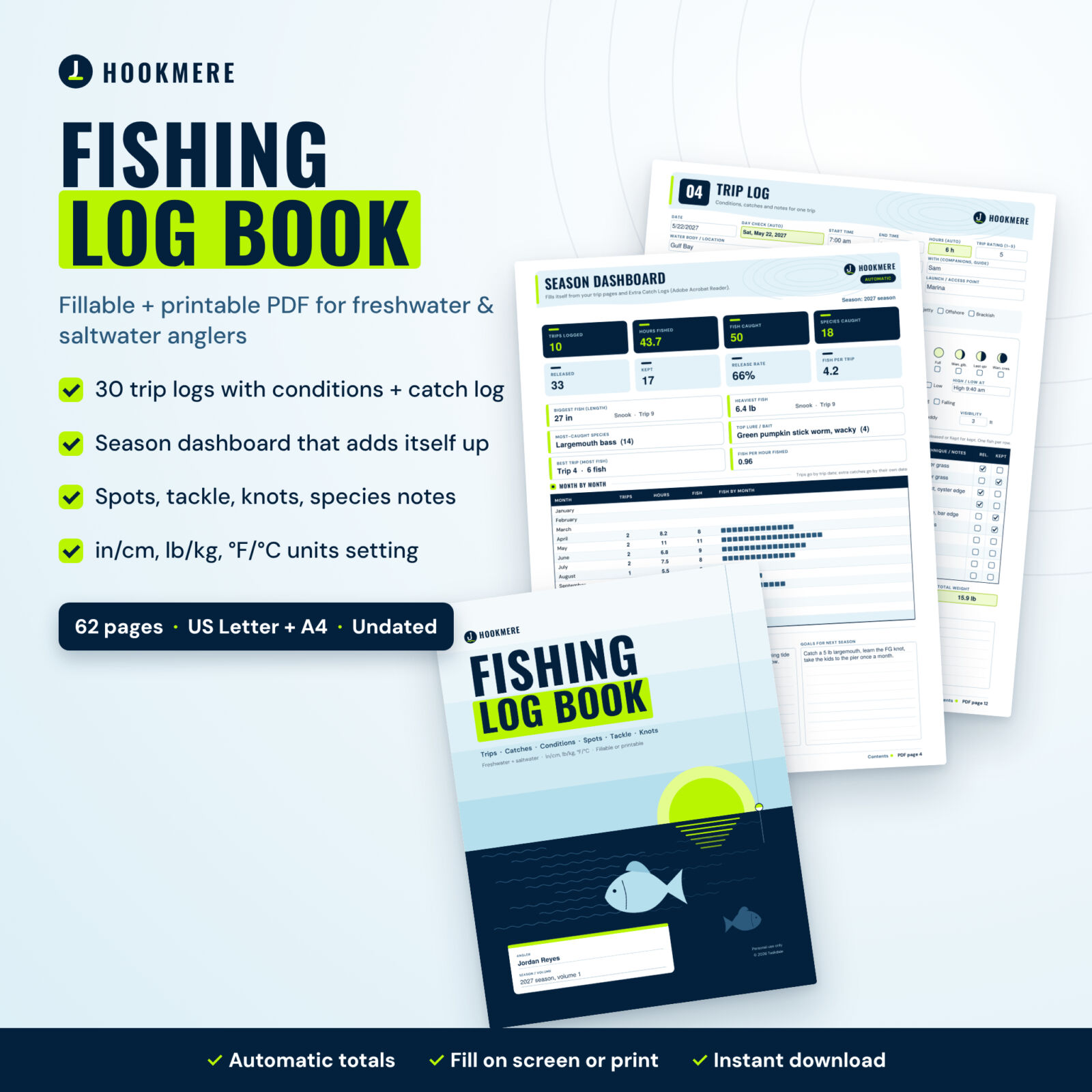
A 7-page fillable and printable PDF with 3 full trip log pages (conditions, moon, tide and a 10-fish catch log with automatic totals), a units setting and the first 5 knots from the Hookmere knot reference.
Want everything unlocked?
The free file is a sample. The full version has every page, tab and feature, plus the user guide.
See the full versionThe download is free. You enter your email address to get the file, and free downloads are limited to 3 per day.
What is in the free fishing log printable
The free file is a 7-page PDF from the Hookmere Fishing Log Book. You can fill it in on a computer or tablet, or print it and write by hand.
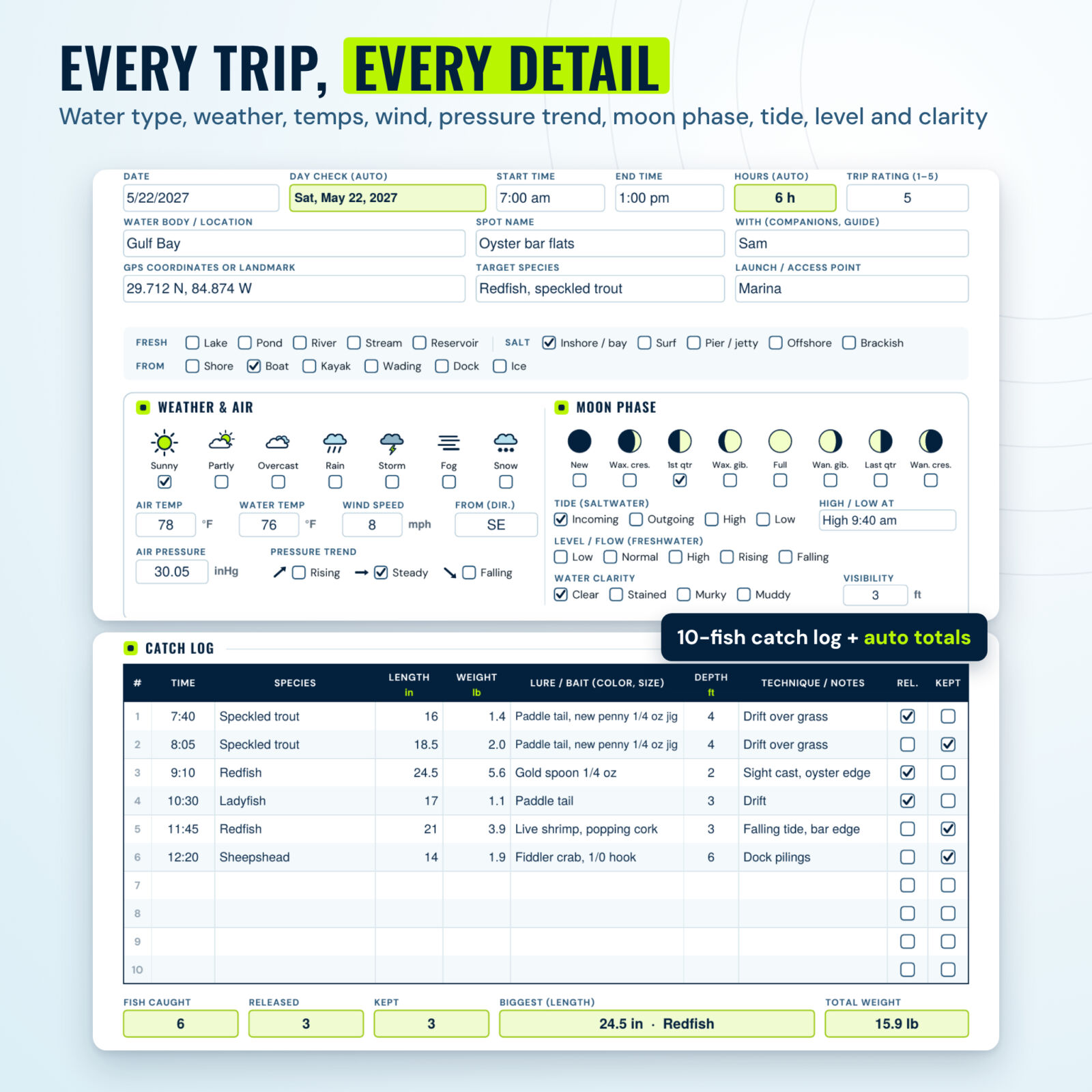
- 3 full trip log pages with date, times, water type, weather, air and water temperature, wind, pressure trend, moon phase, tide, level, clarity and notes
- A 10-fish catch log on every trip, with automatic fish count, released and kept tally, biggest fish and total weight
- 5 knots, step by step: Improved Clinch, Palomar, Uni, Snell and Non-Slip Loop
- A units setting for in or cm, lb or kg and °F or °C
If you want a whole season of pages, a dashboard and spot maps, the full Hookmere fishing log book has 62 pages and everything below.
Why keep a fishing log?
Memory is selective. You remember the big fish and forget the conditions that put it there. A log turns single trips into patterns you can use:
- Find your best times. After a few months you can see which months, times of day and tides gave you fish.
- Learn which lures really work. Your top lure is often not the one you think it is.
- Read the water faster. Clarity, water temperature and level tell you a lot once you have notes to compare.
- Save money on tackle. A tackle inventory stops you buying the same hooks three times.
- Keep the memories. First fish, personal bests and trips with friends are worth writing down.
What to record on every fishing trip
Keep it quick. Fill in the conditions when you arrive and add catches as you go. These are the fields that matter most:
Where and when
Write the date, start and end time, the water body and the exact spot. Add GPS coordinates or a landmark so you can find the spot again. Note who you fished with and the species you were targeting.
Weather and air
Record the sky (sunny, cloudy, rain, fog), the air temperature, and the wind speed and direction. Wind direction means where the wind is blowing from. Add the air pressure from a weather app and whether it is rising, steady or falling.
Water conditions
- Water temperature: one of the most useful numbers to track over a season.
- Clarity: clear, stained, murky or muddy. For a number, lower a light-colored lure and note the depth where it disappears.
- Tide (saltwater): incoming or outgoing, plus the high and low times from a tide table.
- Level and flow (freshwater): low, normal or high, and whether it is rising or falling.
- Moon phase: around the new and full moon, tides have a larger range; around the quarter moons the range is smaller.
Every fish
One line per fish: time, species, length, weight, lure or bait (with color and size), depth, technique, and whether you released or kept it. Measure the way your local rules require, and type lengths and weights as plain numbers so totals add up.
What worked and what to try next time
Two sentences are enough: “Bass on the outside weed edge, wacky worm, slow fall. Try the point when the wind picks up.” These notes are what you will read before your next trip.
How to use your fishing log to catch more fish
- Log every trip, even the slow ones. A blank day under certain conditions is just as useful as a great one.
- Use the same spelling for species and lures, so you can compare them easily.
- Review before you go. Look up trips to the same water in the same month and with similar wind and pressure.
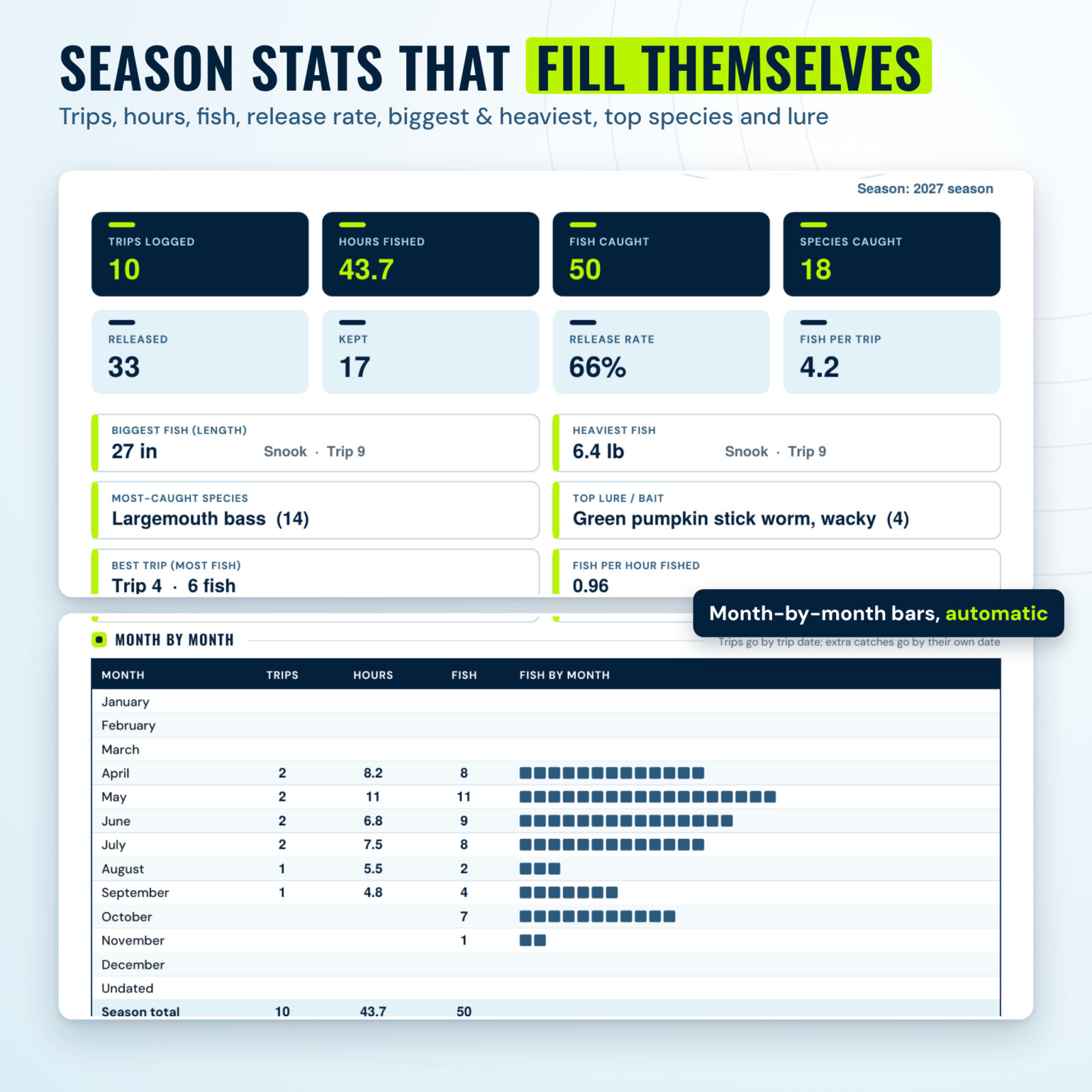
- Total it up each month. Count trips, hours and fish. The Hookmere Season Dashboard does this for you automatically.
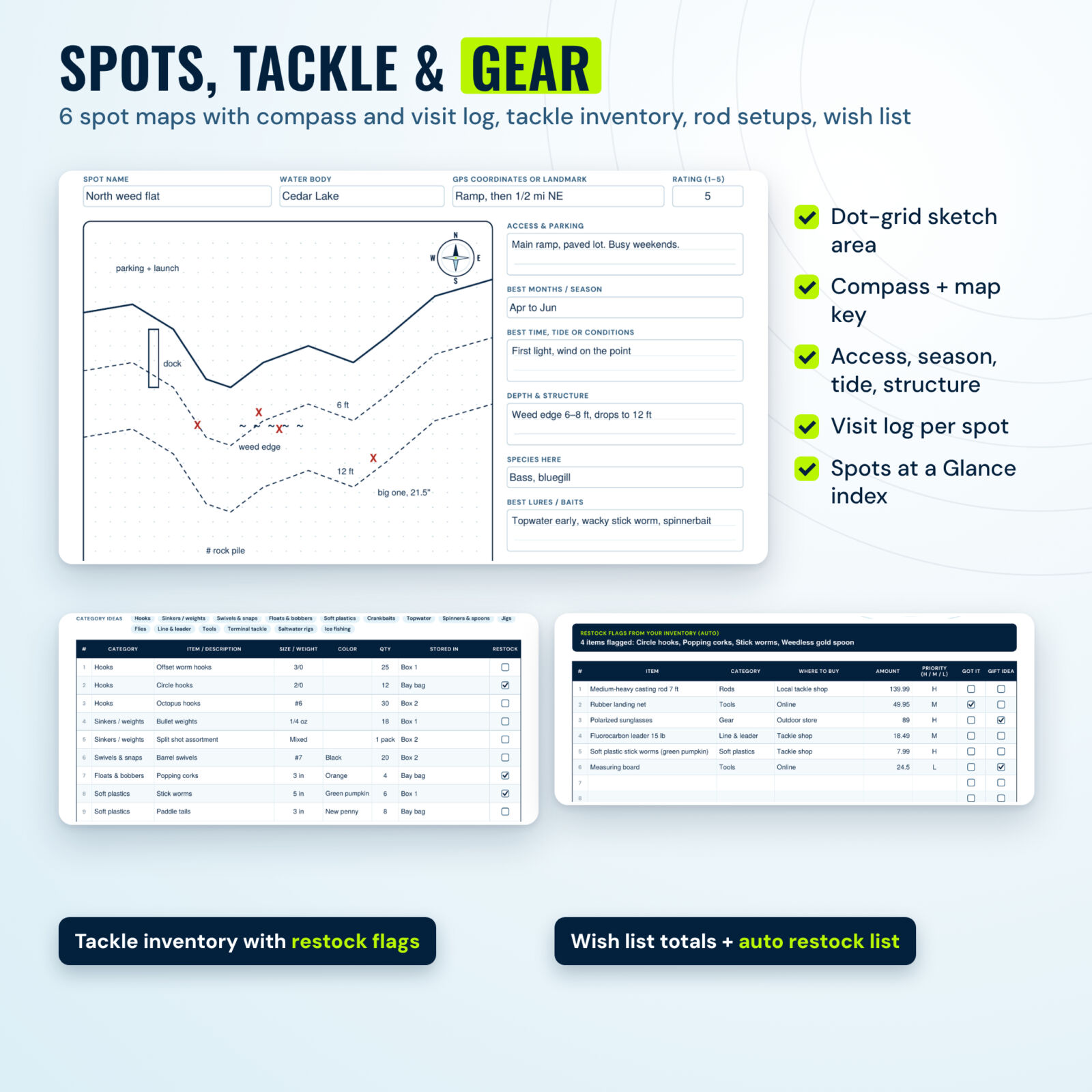
- Map your spots. A quick sketch with depth lines, weed edges and an X where fish bit beats any memory.
Paper or fillable: which fishing journal is better?
Paper is fast, works in the rain with a pencil, and never needs charging. A fillable PDF on a tablet or computer does the math for you and keeps everything searchable. The good news is you do not have to choose. The free pages and the full book both print cleanly and both work as fillable PDFs in the free Adobe Acrobat Reader. Many anglers jot notes on paper at the water and type them in at home.
Freshwater and saltwater in one log
Most fishing log printables are built for one kind of water. Hookmere covers both on the same page: lake, pond, river, stream and reservoir, or inshore, surf, pier, offshore and brackish. Saltwater anglers get tide fields and freshwater anglers get level and flow. If you split time between a bass lake and the coast, it all goes in the same fishing log book.
Fishing log ideas for different kinds of anglers
- Bass anglers: note the cover type (weeds, docks, wood, rock), the depth and the retrieve speed for every fish. Patterns by water temperature show up quickly.
- Trout and fly anglers: record river level, clarity and the fly pattern and size. A rising or falling river often explains a good or bad day.
- Inshore saltwater anglers: write the tide direction and the time to the next high or low. Matching tide stage to each catch is the fastest way to plan the next trip.
- Kayak and family anglers: use the float plan and checklist every time, and keep a page of first fish and funny moments.
Know before you go
Every state and province sets its own fishing rules, and they change often. Before each trip, check the current official regulations from your fish and wildlife agency, including licenses, seasons, size limits and bag limits. The full log book includes a page to note the rules that apply to you, plus a license page and a trip prep checklist with a float plan.
Get the full Hookmere Fishing Log Book
- 30 trip logs plus 4 extra catch logs for a whole season
- Season Dashboard and Trip Index that fill themselves
- 6 spot maps, tackle inventory, rod setups and a wish list with totals
- 12 species cards with season tallies, personal bests and a bucket list
- 10-knot reference, conditions guide, conversion charts and a float plan
- US Letter and A4 files plus a full user guide
$9.99, instant download.
Download your free fishing log printable
Grab the three free trip pages and the knot guide below, take them on your next trip, and see how much more you remember. When you are ready for a full season, the complete Hookmere log book picks up right where the free pages stop.
Fishing log FAQ
Is the free fishing log really free?
Yes. Enter your email to download the PDF. It is for personal use.
Can I print the free fishing log more than once?
Yes, print the trip pages as often as you like for your own fishing.
Does it work in metric?
Yes. Choose cm, kg and °C on the Start Here page and the unit labels change.
What is the difference between the free and full version?
The free file has 3 trip pages and 5 knots. The full version has 62 pages, a season dashboard, spot maps, tackle pages, species notes and 10 knots.