A learning center only works if children can run it without you. That is the whole point: you sit with a small reading group while four other tables hum along on their own. Coloring sheets are one of the few activities a room of four- and five-year-olds can do independently, quietly and with something real to show at the end.
This guide is for preschool, pre-K and kindergarten teachers, plus homeschool co-op leaders, looking for free printable coloring sheets for classroom learning centers. You will find honest advice on where free classroom-safe sheets come from, how to set up literacy, math and science centers around coloring, a rotation plan for a class of twenty, and four Taskdale sets that include a classroom license for one teacher, for when you want a full, organized bank of pages.
Quick picks for center-ready sets
| Product | Best for | Price | Link |
|---|---|---|---|
| Crayon Campus Preschool Learning Coloring Worksheets | 80 center pages plus center labels | $4.99 | View |
| Letter Parade Alphabet Coloring Book A to Z | Literacy center, letter of the week | $3.99 | View |
| Hop to Ten Color by Number for Kids | Math center, numbers 1 to 10 | $4.49 | View |
| Roar to Z Dinosaur Coloring Book A to Z | Theme or science center | $4.49 | View |
Why coloring sheets suit learning centers
Most center activities need some adult help to get going. Coloring sheets do not. A child sits down, sees a big letter M and a picture of a moon, and knows what to do. That independence is gold when you are working with six children at the reading table and need the other fourteen settled.
Coloring sheets also handle mixed ability well. At the same math table, one child colors five apples carefully and another colors twenty. Both are working at their level. Nobody is stuck waiting, and nobody is bored.
And they leave evidence. A finished sheet with a name at the top tells you, at a glance, who can count to ten, who traced the letter correctly and who needs another go. That makes them handy for quick, informal assessment without a formal test.
There is a calming effect too. A noisy room after outdoor play often settles within a few minutes once crayons come out. Teachers who run centers straight after recess often put coloring at two of the four tables for exactly that reason.
Where to find free sheets you can use in class
Free is great, but classroom use adds one important question: are you allowed to copy this for a group? Many free pages are for personal or home use only. Copying them for twenty children may break the terms, even if nobody would ever know. Teachers set the example, so it is worth checking.
Good free sources for classroom use
- Pages you make yourself. A big bubble letter, a ten frame or a shape hunt drawn with a marker belongs to you. Copy as many as you like.
- Your school or district resource bank. Many schools keep shared folders of worksheets that staff can use freely.
- Free pages that say “classroom use permitted”. Some educators share free pages with clear classroom permission. Look for that line before printing.
- Free samples from paid sets. Check the sample’s terms. Some allow classroom use for the sample page.
When free gets expensive in time
Hunting for 26 matching alphabet pages, 20 number pages and a dozen science pages that all look consistent and allow class use can eat a whole weekend. That is the moment a low-cost set with a one-teacher classroom license starts to make sense. You pay once, get a consistent bank of pages and print for your own class all year.
Setting up a coloring center from scratch
A good center is mostly about containers and clear signs. Children need to know where things live and where finished work goes.
- One tub per center. A clear plastic tub with this week’s sheets, crayons and pencils.
- A sign at child height. A big picture label (a book for Library, numbers for Math) so non-readers know where they are.
- A “finished” tray. Children drop completed sheets here, name side up.
- Two levels of sheet. An easier stack and a harder stack, marked with a green or red dot in the corner. Children pick.
- A visual instruction card. Three pictures: color, count, put in tray.
Labels sound like a small thing, but they save a surprising amount of time in October when the novelty has worn off and children wander. A set that comes with ready-made center signs is a real shortcut.
Teaching the routine in week one
Spend the first week teaching the system, not the content. Day one, model one center while the class watches. Day two, the whole class does the same center at once. Day three, two centers. By Friday, all four are running. It feels slow, but a class that knows the routine will run centers smoothly for the rest of the year, and you will get your small group time back.
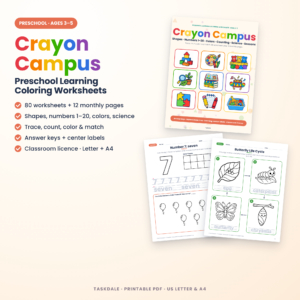
Crayon Campus Preschool Learning Coloring Worksheets
Price: $4.99 | Best for: preschool and pre-K teachers
Eighty one-skill worksheets across shapes, numbers 1 to 20, counting, colors, matching and simple science, plus 12 monthly seasonal pages, answer keys and a skills checklist. It also includes a separate set of learning-center labels: 16 large center signs, 2 blank signs and 16 small bin labels for areas like Math, Science, Writing and Library. A one-teacher classroom license is included.
Literacy center sheets
A literacy center built on coloring should focus on letters and sounds. Keep it to one letter a week so the whole class meets the same letter together, and children who visit on Friday get the same practice as those who visit on Monday.
What to put in the literacy tub
- The letter of the week page: big letter to color, a picture and trace rows
- A letter hunt page: color every M you can find
- An uppercase and lowercase match page for early finishers
- Blank paper and a prompt: “Draw something that starts with M”
That is four tasks at four levels in one tub. A child who finishes the letter page in eight minutes moves to the hunt. A child who takes the full fifteen minutes still finishes the main task and feels good.
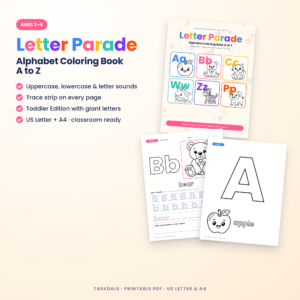
Letter Parade Alphabet Coloring Book A to Z
Price: $3.99 | Best for: literacy centers and letter of the week
Twenty-six letter pages with a big uppercase and lowercase letter, a picture for the sound, the word and three trace rows, plus a Name line at the top for collecting work. Extras include letter match pages, letter hunts (B, M and S) and an alphabet chart. A Toddler Edition suits younger or less confident children, and one teacher may print unlimited copies for their own class.
Math center sheets
Math centers work well with color by number because the rules are simple and self-checking. A child who colors the wrong space sees it right away when the picture looks odd. That built-in feedback means less help from you.
What to put in the math tub
- Color by number pages at two levels: 1 to 5 and 1 to 10
- A count and color page tied to this week’s number
- Ten frame pages with counters to place before coloring
- For kindergarten, color-by-answer pages with simple sums
Put a finished example of each picture in a sheet protector in the tub. Children check their own work against it before dropping it in the tray. That small habit builds independence quickly.
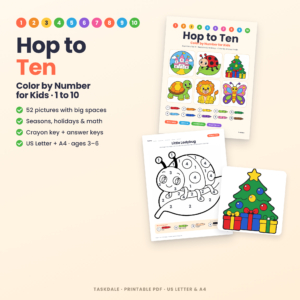
Hop to Ten Color by Number for Kids
Price: $4.49 | Best for: math centers, pre-K to first grade
Fifty-two pictures using only numbers 1 to 10, sorted from 1 to 5, then 6 to 10, then mixed, then seasonal pages and color-by-answer addition and take-away. Full-color finished pictures sit at the back for self-checking. It is designed for morning work, math centers and early finishers, and includes a one-teacher classroom license.
Science and theme center sheets
A theme center ties into whatever unit you are teaching: weather, plants, animals, dinosaurs. Coloring sheets here should carry a bit of real information, so children come away knowing something new.
Dinosaurs are a gift for this. Many four- and five-year-olds already know more dinosaur names than adults do, and they love to show it. A page with a dinosaur, its name, a “say it” guide and three short facts gives them something to color and something to tell their friends at snack time.
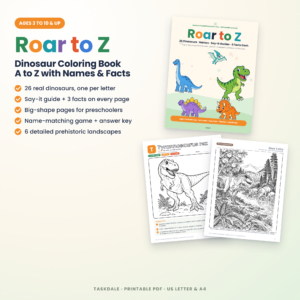
Roar to Z Dinosaur Coloring Book
Price: $4.49 | Best for: dinosaur or fossil units, ages 3 to 8
Twenty-six real dinosaurs and prehistoric reptiles from A to Z, each with a say-it guide and three facts, plus eight big-shape pages for younger children, a name-matching game, a word search, a maze and a timeline. The terms cover personal use and one teacher’s own classroom, homeschool group or tutoring group. It doubles as an alphabet resource.
For weather or plant units, simple science sheets work the same way: a life cycle to color in order, plant parts to label with color, or a weather chart to fill in each morning.
Pair each theme sheet with a real object in the tub when you can: a plastic dinosaur, a pinecone, a seed packet, a toy umbrella. Children color more carefully when they can pick up the thing they are drawing and look at it from every side.
A rotation plan for a class of twenty
Four centers, five children each, fifteen minutes per rotation. Here is a simple plan for a one-hour center block.
| Rotation | Group A | Group B | Group C | Group D |
|---|---|---|---|---|
| 1 | Teacher table | Literacy coloring | Math coloring | Theme coloring |
| 2 | Theme coloring | Teacher table | Literacy coloring | Math coloring |
| 3 | Math coloring | Theme coloring | Teacher table | Literacy coloring |
| 4 | Literacy coloring | Math coloring | Theme coloring | Teacher table |
Use a chime or a song to signal each switch. By the third week, most classes move between centers in under a minute. For planning the rest of your week around centers, a solid teacher planner keeps rotations, groups and notes in one place.
Early finishers, sub days and quick checks
Early finishers
Keep a “done early” folder in each tub with a few extra sheets. A child who finishes can choose one without asking you. That one habit removes a lot of interruptions from your small group time.
Substitute days
Coloring centers are perfect for sub plans. The routine is familiar, the sheets explain themselves and the children know where things go. Leave the rotation chart and a note on which letter and number are this week’s focus. Our guide on what to put in a substitute teacher plan has a fuller checklist.
Quick checks
At the end of the week, flip through the finished tray. Sort sheets into “got it” and “needs another go”. It takes five minutes and tells you who to pull for extra help next week. A skills checklist on a clipboard makes it even faster.
Mistakes that slow centers down
- Sheets that need reading. If the instructions are three lines long, children will queue at your table to ask. Use picture instructions or one short line.
- Too many crayons. A full box of 64 leads to arguing and sorting. Eight colors per tub is plenty.
- No name line. Unnamed sheets pile up and become useless for checking. Choose sheets with a name line or stamp names on first.
- Changing everything every week. Keep the tubs and routine the same and swap only the sheets. Children learn the system faster.
- Ignoring the license. Check before you copy. It takes a minute and keeps you on the right side of the creator.
- Running out of sheets mid-week. Print 25 percent more than you think you need. Torn or scribbled sheets happen, and a spare stack saves a dash to the copier.
Frequently asked questions
Can I use free coloring pages in my classroom?
Only if the terms allow it. Pages you make yourself are always fine. Many free online pages are for home use, so check before copying for a class.
What is a good coloring activity for a literacy center?
A letter of the week page with a picture, the letter sound and tracing rows, plus a letter hunt page for early finishers.
How long should a coloring center rotation be?
About 12 to 15 minutes for preschool and pre-K, and up to 20 minutes for kindergarten.
How do I stop children rushing through center sheets?
Offer two levels, add a “done early” folder and check finished work against a model. Children slow down when they know someone will look.
Do these sets allow a whole school to use them?
No. The sets in this guide include a license for one teacher’s own class. Each additional teacher needs their own copy.
What crayons work best for a coloring center?
Chunky crayons for ages 3 to 4, regular crayons and colored pencils for 5 and up. Washable markers are fun but dry out fast if lids go missing, so keep them for special days.
Your next step
This weekend, set up one tub for one center, with a picture sign, two levels of sheet and a finished tray. Run it for a week before adding the next. When you are ready for the full set of pages and center labels, start with Crayon Campus.