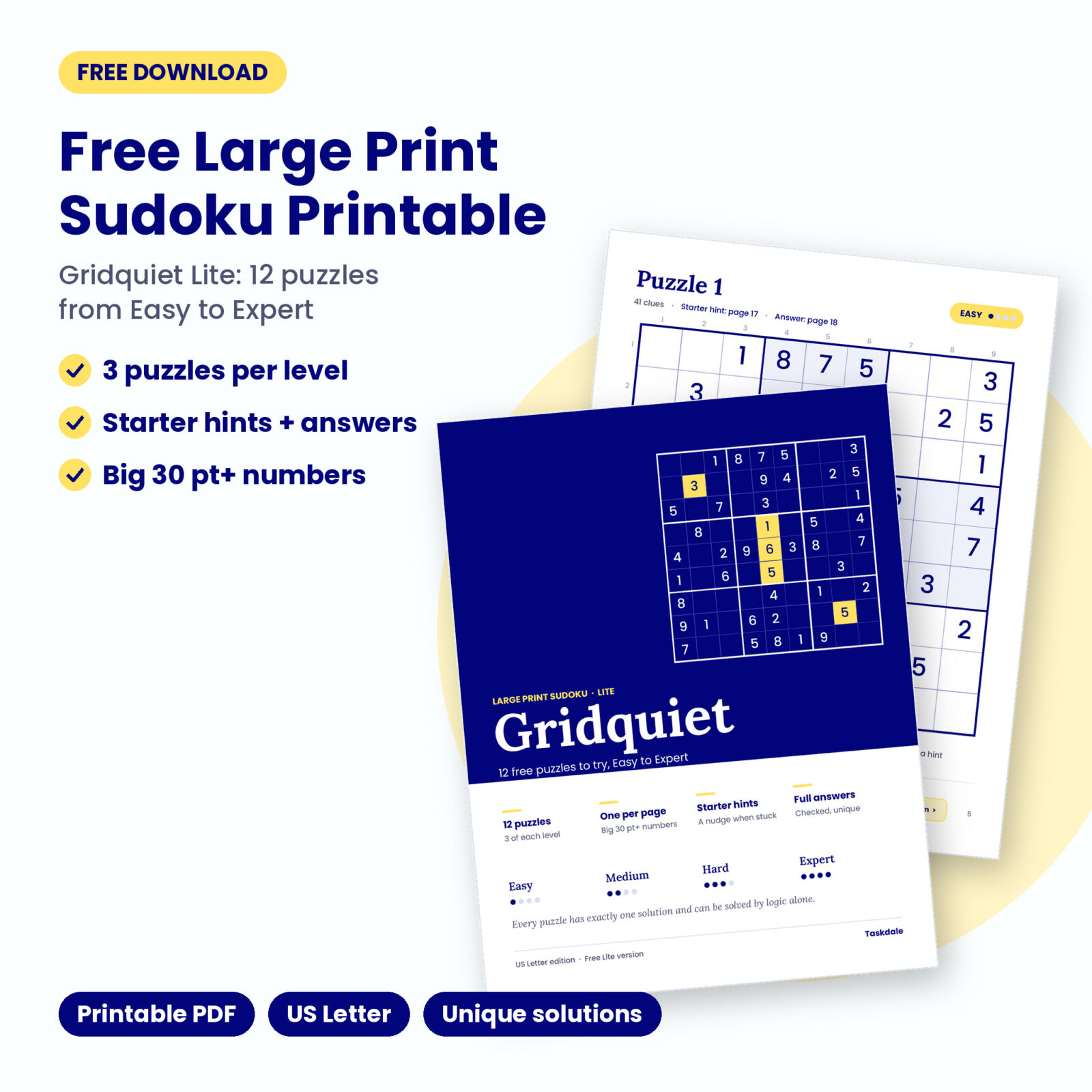
Looking for free printable large print sudoku puzzles that you can actually read? Below you can download Gridquiet Lite, a free PDF with 12 large print sudoku puzzles from Easy to Expert, one per page, with starter hints and full answers. Then read on for a friendly guide to solving, printing and choosing the right level.

Gridquiet Lite: Free Printable Large Print Sudoku Puzzles
Get 12 large print sudoku puzzles from Easy to Expert, one per page, with starter hints and full answers. Enter your email and the PDF is yours.

Want everything unlocked?
The free file is a sample. The full version has every page, tab and feature, plus the user guide.
See the full versionThe download is free. You just enter your email address so we can send you the file, and free downloads are limited to 3 per day.
What Is in the Free Large Print Sudoku PDF
Gridquiet Lite is a 22-page sample of our full large print sudoku book. It is small, but it is not a teaser with half the pages missing. Everything you need to solve is in there:
- 12 puzzles, three from each level: Easy, Medium, Hard and Expert
- One puzzle per page, with clue numbers over 30 pt and lightly shaded boxes
- A starter hint for every puzzle, so you are never stuck at the start
- Full answers, with the original clues in bold so you can compare at a glance
- A how-to-play page and an illustrated tip page on scanning
Every puzzle has exactly one solution and can be solved by logic alone. No guessing, no trial and error.
Why Large Print Sudoku Is Easier to Enjoy
Standard sudoku books often fit four or six grids on a page. The cells end up smaller than a fingernail, and the numbers are printed at the same size as newspaper text. That is fine for some people. For many others, especially older solvers, it turns a relaxing puzzle into an eye test.
Large print sudoku fixes three problems at once:
- You can read the clues at a normal distance, without a magnifier.
- You have room to write. Big cells leave space for your answer and for small pencil marks.
- You make fewer slips. When rows and boxes are clearly separated, it is much harder to put a number in the wrong cell.
In Gridquiet, each grid fills almost the whole width of the page, the 3 × 3 boxes have thick borders, and every other box is lightly shaded. Small numbers along the top and left edges label the rows and columns, which helps when you follow a hint.
How to Play Sudoku: The Rules in One Minute
A sudoku grid has 9 rows, 9 columns and 9 boxes of 3 × 3 cells. Some cells already hold numbers. Your job is to fill every empty cell with a number from 1 to 9 so that:
- Every row contains 1 to 9 exactly once.
- Every column contains 1 to 9 exactly once.
- Every box contains 1 to 9 exactly once.
That is it. There is no math involved. The numbers could just as well be letters or colors. Sudoku is a puzzle of logic and patience.
Beginner Strategies That Actually Work
1. Scan for the only spot
Pick a number, say 5, and a box that does not have a 5 yet. Look along the rows and down the columns that pass through that box. Every row or column that already has a 5 rules out its cells in the box. Often only one cell is left. That is where the 5 goes. This technique, called scanning, is all you need for every Easy puzzle in Gridquiet.
2. Start where the grid is busiest
Rows, columns and boxes with six or more numbers are the quickest to finish. Look there first, then work outward.
3. Check one cell at a time
When scanning slows down, pick an empty cell and list what its row, column and box already contain. If eight different numbers are already used, the ninth one must go in that cell. Medium puzzles use this a lot.
4. Use pencil marks
Write small candidate numbers in a cell, always in the same position: 1 in the top left corner through 9 in the bottom right. Erase marks as you place numbers. Pencil marks are essential for Hard and Expert puzzles, where patterns such as pairs and pointing numbers only show up once the marks are on the page.

Gridquiet Large Print Sudoku: 200 Puzzles
Enjoyed the free sample? The full book gives you 200 puzzles on the same big, clear pages.
- 50 puzzles per level, Easy to Expert
- A starter hint and full answer for every puzzle
- US Letter and A4 PDFs plus a user guide
Which Difficulty Level Should You Start With?
Difficulty labels in many puzzle books are based only on how many clues are given. Two puzzles with the same number of clues can feel completely different, though. Gridquiet grades every puzzle by the techniques it needs:
- Easy: scanning only. Great for beginners or a relaxed warm-up.
- Medium: scanning plus single-candidate cells, with fewer clues.
- Hard: needs pencil marks, pointing numbers and pairs.
- Expert: needs at least one advanced pattern, such as an XY-wing or X-wing.
If you are new to sudoku, start with the three Easy puzzles in the free PDF. If those feel comfortable, move on to Medium. Seasoned solvers can jump straight to Hard and Expert to see whether the puzzles are a real challenge.
How to Print Large Print Sudoku at Home
A few small settings make a big difference to how your puzzles look on paper:
- Choose Actual size or 100% in the print window. Fit to page can shrink the grid.
- Print only the pages you need. Type a page range, for example 5-7 for the Easy puzzles in the Lite file.
- Use plain white paper. Heavier paper (24 lb or 90 gsm) stops pencil marks showing through.
- Black and white is fine. The pages are mostly white, and the shaded boxes still show as light gray.
- Want it bigger? Print on 11 × 17 in or A3 paper with Fit to page turned on.
The full book comes in both US Letter and A4 sizes, so the pages always fit your paper.
Tips for Seniors, Carers and Activity Groups
- Use a soft pencil (HB or 2B) and a good eraser. Mistakes happen, and that is part of the fun.
- Solve in good light. Even large print is easier under a bright lamp.
- Set a gentle routine. One puzzle a day with morning coffee is a lovely habit.
- Solve together. Sudoku works well in pairs. One person scans rows while the other scans columns.
- Use hints without guilt. A starter hint gets you moving and still leaves the puzzle for you to finish.
If you run a group at a care home, library or club, you can print pages from the full book for the group you run. Just keep the files themselves to yourself.
When You Get Stuck
Everyone hits a wall now and then. Before you look at the answer, try this short checklist:
- Scan every number from 1 to 9 again, box by box.
- Look at the busiest rows, columns and boxes.
- Check single cells for a number that is the only one left.
- Add pencil marks to the area you are stuck on.
- Take a five-minute break and come back with fresh eyes.
- Use the starter hint, or look up a single cell in the answers and carry on from there.
Gridquiet: Large Print Sudoku Puzzle Book
Climb from your first scan to expert patterns with one calm, printable book.
- Five illustrated tip pages, including X-wing and XY-wing
- Clickable 200-puzzle tracker and contents
- Every puzzle has one solution, no guessing
Frequently Asked Questions
Is this large print sudoku really free?
Yes. Gridquiet Lite is free to download. You enter your email address to receive it, and free downloads are limited to 3 per day.
Do the puzzles have answers?
Yes. Every puzzle in the free PDF has a starter hint and a full answer at the back.
How large is the print?
The clue numbers are over 30 pt, and each grid fills almost the width of a US Letter page.
Can I print the free puzzles more than once?
Yes. Print them as often as you like for your own personal use.
What does the full version add?
The full Gridquiet large print sudoku puzzle book has 200 puzzles (50 per level), 200 starter hints and answers, five illustrated tip pages including X-wing and XY-wing, a clickable puzzle tracker and contents, level dividers, blank grids, US Letter and A4 editions and a user guide.
Is the full book a physical book?
No. It is an instant digital download that you print at home or at a print shop.