Most business ideas do not fail because the founder was lazy. They fail because the founder spent six months and most of their savings building something before a single stranger said yes. The lean startup steps for testing ideas cheaply flip that order. You prove people want it first, then you build.
This guide is for anyone sitting on an idea and a small budget: a side hustler with evenings free, a parent planning a home business, a maker wondering if the craft fair crowd will pay. You will get a five-step testing method, a worked example with real numbers, a two-week schedule, and the mistakes that quietly eat money.
No jargon. No pitch decks. Just a way to find out if your idea has legs while it still costs you less than a weekend away.
Quick picks for testing an idea on paper first
| Product | Best for | Price | Link |
|---|---|---|---|
| Business Launch Planner | Testing any idea, then planning the launch | $14.99 | View |
| Digital Product Ideas 2026 Spreadsheet | Scoring and ranking several ideas at once | $3.00 | View |
| Launchloom 640 Digital Product Ideas | Cheap tests with digital downloads | $2.49 | View |
What lean really means when your budget is tiny
Lean is not about being cheap for the sake of it. It is about learning as fast as possible for as little as possible. Every dollar and every evening you put in should answer one question about your idea.
The classic loop is simple. Build a small thing. Measure what people do with it. Learn, then change the idea or drop it. Round you go again. The trick is keeping each loop short, ideally a week or two, so you can afford ten loops instead of one big expensive bet.
Picture two people with the same dog treat idea. One rents a commercial kitchen, orders 500 printed bags and builds a website. Cost: around $4,000 before the first sale. The other bakes 30 bags at home where local rules allow it, sells them at Saturday’s market and asks every buyer one question. Cost: about $90. Both learn whether people want the treats. Only one can afford to be wrong.
That is the whole spirit of it. Small bets. Fast answers.
Step 1: Write down the guesses your idea depends on
Every idea rests on a stack of guesses. Most people never write them down, so they never test them. Grab a sheet of paper and finish these four sentences:
- The buyer: “The people who want this are…” Be specific. “Busy people” is not a buyer. “Nurses working night shifts who meal prep on Sundays” is.
- The problem: “They struggle with…” and how they handle it today.
- The price: “They would pay about…” for my fix.
- The reach: “I can find them through…” a group, a market, a platform, a street.
Now circle the riskiest guess. That is the one that would sink the whole idea if it turned out wrong. For a mobile bike repair service, the riskiest guess might be that people will book a stranger to come to their driveway. For a printable chore chart, it might be whether anyone finds you among thousands of other chore charts. Test the risky guess first. It saves you from polishing the parts that do not matter.
Step 2: Pick which idea deserves a test
If you have three or four ideas fighting for attention, do not test them all at once. Score them. A simple scorecard with five factors works well: demand, competition, how easy it is to make, profit per sale, and how much you would enjoy doing it for two years. Rate each from 1 to 5 and add them up.
A friend of mine had a list of six ideas in her phone notes. Scoring them took 40 minutes. Two landed under 12 out of 25 and she crossed them off on the spot. The relief on her face was obvious. She had been carrying those two around for a year.
For people leaning toward digital downloads, a ready list with scoring built in saves a lot of blank-page time.
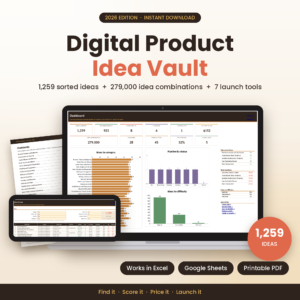
Digital Product Ideas 2026 Spreadsheet
Price: $3.00 | Best for: sellers choosing between several ideas
An Excel and Google Sheets file with 1,259 sorted digital product ideas, each showing the product type, the tool to make it in, rough hours and a typical price range. The Idea Scorecard rates up to 25 ideas on demand, competition, ease, profit and enjoyment and gives each a score out of 100 with a verdict. Start by filtering for ideas under your available hours, star ten, and score them.
Step 3: Talk to real buyers before you build
Conversations are the cheapest test there is. They cost a coffee, or nothing at all. Aim for ten talks with people who match your buyer sentence, not friends who will be polite.
The rule that makes these talks useful: ask about the past, not the future. “Would you buy this?” gets a kind yes that means nothing. “Tell me about the last time you had this problem” gets the truth. Good questions sound like this:
- When did this last happen to you?
- What did you do about it?
- What did that cost you, in money or time?
- What have you tried that did not work?
- If you could wave a wand, what would change?
Write notes straight after each talk. Look for the same pain coming up three or four times in different words. That is your signal. If ten people shrug, that is a signal too, and a cheap one to get.
A structured log keeps you honest here, because it stops you remembering only the encouraging bits.
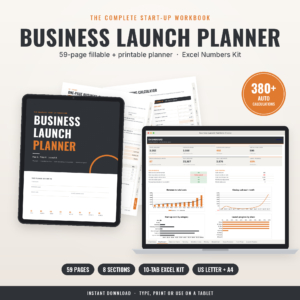
Business Launch Planner
Price: $14.99 | Best for: first-time founders testing a real idea
A 59-page planner in fillable and print-and-digital PDF, US Letter and A4, plus a 10-tab Excel Numbers Kit. The Idea and Market sections include an idea scoring matrix, a customer conversation guide and log, competitor research and a page called test your idea. Fill in the conversation log after your first three talks, then move to the Money pages once the idea passes.
Step 4: Build the smallest test that asks for money
Talk is useful. Money is proof. Your next test should ask people to pay, pre-order or at least hand over an email address with a clear reason. Here are tests that cost very little:
The pre-sale
Describe the product, show a mock-up and take orders with a delivery date. A cake decorator could post three sample designs in a local group and take ten deposits before buying a single tier stand. If nobody pays, refund the few who did and thank them.
The one-page offer
A single web page or social post that explains the offer and has a button: book a call, join the waitlist, buy now. Count clicks against visitors. A free page builder or your social profile is enough for this.
The do-it-by-hand version
Before you build an app that matches dog walkers with owners, match five of them yourself by text message. You learn what people actually ask for, and you spend nothing on code.
The tiny batch
Make 20, not 2,000. Sell them at one market or one online shop. Twenty candles, ten tote bags, one printable. Small enough to survive a flop.
Pick one. Not all four. One clear test is worth more than three fuzzy ones.
Step 5: Set a pass mark before you see the results
This is the step people skip, and it is the one that saves the most money. Before the test runs, write down the number that means yes. If you wait until after, you will talk yourself into whatever the results say.
A worked example
Say you want to sell a meal prep planner printable. You plan a two-week test with a simple shop listing and a few posts in two parenting groups. You decide in advance:
- Pass: 15 or more sales in 14 days.
- Maybe: 5 to 14 sales. Change one thing (the title, the photo, the price) and run another two weeks.
- Fail: fewer than 5 sales. Park the idea and test the next one on your list.
Now do the money side. If the planner sells for $6 and platform fees take about $1.10, you keep $4.90 a sale. Fifteen sales is about $73. That will not pay the rent, but it proves strangers will pay, which is the whole point of the test. Our guide on how to price digital products walks through fees and price points in more detail.
Write the pass mark on a sticky note and put it where you will see it. When the result lands you just read it off. No agonizing.
Why digital products make a cheap first test
If you are unsure what kind of business to try, digital downloads are one of the cheapest places to practice the whole loop. There is no stock to store, no shipping, and a failed test usually costs only your time. A planner, a worksheet, a template or a printable can be made in a few evenings with tools you may already have.
That also makes them a fine training ground. You learn to write a listing, read your numbers, talk to buyers and change course, all skills you will need for a bigger business later. A teacher who sells 40 copies of a reading log has learned more about customers in a month than many people learn from a year of planning.
The hard part is choosing which product to test. An idea list with buyer and demand signals helps you skip the guesswork.

Launchloom 640 Digital Product Ideas
Price: $2.49 | Best for: new sellers wanting quick tests
A 102-page Idea Atlas PDF with 640 digital product ideas in 16 niches, each tagged with format, buyer, skill level, price tier and whether demand is evergreen, seasonal or rising. The Excel and Google Sheets tracker has an Idea Scorer, a Profit Calculator and a 30-day launch plan. Shortlist five ideas from one niche you know well, then run the scorer to pick your first test.
Mistakes that turn a cheap test into an expensive one
- Buying the logo first. Branding feels like progress. It is not a test. A plain name and a clean photo are enough until someone pays.
- Asking family. Your mom will say yes. Your aunt will order two. Neither tells you if strangers care.
- Testing five things at once. If you change the price, the photo and the audience in the same week, you cannot tell which change worked.
- Running the test too short. Three days is rarely enough. Two weeks gives quiet days and busy days a chance to even out.
- Ignoring a clear no. Parking an idea is not failure. It frees your next two weeks for something better.
- Forgetting the costs you cannot see. Fees, packaging, travel to the market, your own hours. Our startup costs calculator guide lists the ones that catch people out.
A two-week testing schedule you can follow
Here is a simple plan for someone with about an hour a day after work.
| Days | What to do |
|---|---|
| 1 to 2 | Write your four guesses. Circle the riskiest. Score your ideas if you have more than one. |
| 3 to 6 | Hold five to ten short conversations with likely buyers. Log notes the same day. |
| 7 | Read your notes. Set the pass mark for the money test. |
| 8 to 9 | Build the smallest test: a pre-sale post, a one-page offer or a tiny batch. |
| 10 to 13 | Share the test where your buyers already gather. Count every click, reply and sale. |
| 14 | Compare results to the pass mark. Decide: go, change one thing, or park it. |
Fourteen days. Maybe $50 to $150 spent. And a clear answer instead of a hopeful hunch. That is a good trade.
What to do once an idea passes
A pass does not mean quit your job tomorrow. It means you earned the right to spend a little more. Run a slightly bigger test: a batch of 100 instead of 20, a second sales channel, a higher price to see where buyers push back.
This is also when a proper plan starts to pay off. Write down your start-up costs, your monthly running costs and the number of sales you need to break even. If the numbers work at a small scale and still work at a medium one, you have something real. If they only work when everything goes perfectly, keep testing before you spend your savings.
Frequently asked questions
How much money do I need to test a business idea?
Often less than $200. Conversations are free, a one-page offer can be free, and a tiny batch of physical stock or a single digital product costs a little more. Spend on learning, not on looking official.
What is a minimum viable product in simple words?
It is the smallest version of your idea that someone could pay for. Not a broken version, a small one. One flavor, one service package, one printable.
How many customer interviews are enough?
Ten is a good starting number. If the same problem comes up in six or seven of them, you have a pattern worth testing with money.
Can I test an idea without quitting my job?
Yes, and you probably should. The two-week schedule above fits into an hour a day. Keep your income steady until a test shows real paying customers.
What if my test gets zero sales?
Check the reach first. If only 30 people saw it, you have not tested the idea yet, just the audience. If 500 people saw it and nobody bought, change one thing or park the idea.
Your next step
Tonight, write your four guesses on one page and circle the riskiest. Tomorrow, message three people who fit your buyer and ask about the last time they had the problem. If you want the conversation log, scoring matrix and money pages in one place, the Business Launch Planner walks you from first test to opening day.