SMEs run on planning that usually lives in one person’s head. The owner knows which supplier gets paid on the 15th, which client always pays late, and what to do when the card machine goes down. That works until the owner gets sick, goes on holiday, or simply runs out of hours in the day.
This guide is for owners and managers of small and medium businesses who want that planning out of their head and onto paper or a screen. You will get a plain breakdown of the planning jobs every SME has, a worked example from a real-sized business, a weekly routine you can start on Monday, and four Taskdale tools that cover operations, bookkeeping and forward planning.
None of this needs expensive software. A Word manual and a couple of spreadsheets will carry a business with 3 staff or 60.
Quick picks: planning tools for SMEs
| Product | Best for | Price | Link |
|---|---|---|---|
| Daily Operations SOP for Small Businesses | Writing down how the business runs each day | $9.00 | View |
| Small Business Bookkeeping Spreadsheet Bundle Plan | Simple books plus an invoice tracker | $3.00 | View |
| Small Business Bookkeeping Spreadsheet Dashboard Bundle | Cash flow view and bill tracking | $9.00 | View |
| Small Business Command Center Spreadsheet Bundle | Forecasts, KPIs and scenario planning | $9.99 | View |
What makes planning different for SMEs
SMEs sit in an awkward middle. A one-person business can plan on the back of an envelope. A large company has a finance team, an operations manager and a planning calendar. Small and medium businesses have the problems of the second group with the staff of the first.
Take a print shop with 11 employees. It has payroll every two weeks, a dozen suppliers, a few big trade accounts and a steady flow of walk-in customers. The owner still does the quotes. The office manager still chases the invoices. Nobody has the title of planner, yet planning is happening all day, in emails, sticky notes and memory.
That’s the real goal of a planning tool at this size. Not a fancy system. Just a shared, written version of what already happens, so that the business keeps working when one person is out of the room.
The definition question
Definitions of an SME vary by country and by agency. Some count staff, some count annual turnover, some use both. For planning purposes, the label matters less than the shape: a business big enough to have staff, regular bills and repeat customers, but small enough that the owner still touches most decisions.
The four planning jobs every small and medium business has
Most planning headaches in SMEs fall into four buckets. Sorting them this way makes it easier to pick the right tool instead of buying one that tries to do everything.
- Operations. Who opens up, who handles complaints, how a new client gets set up, what happens when the internet drops. This is process planning.
- Money in and money out. Recording sales and costs, sending invoices, chasing late payers, paying bills on time. This is bookkeeping.
- Looking ahead. Will there be enough cash in March? What happens if the biggest client leaves? Which product line actually earns money? This is forecasting.
- People. Hiring, onboarding, training and reviews. At this size it usually sits inside operations, so the same documents cover it.
A business with a solid handle on the first two can survive a lot. Add the third and you stop being surprised by your own bank balance. The rest of this guide takes them in that order.
Plan the daily work with written procedures
Written procedures sound dull. They are also the single biggest relief an owner can give themselves. Once the steps for invoicing, opening, refunds and onboarding are written down, you can hand them to a new hire on day one instead of shadowing them for three weeks.
A common sticking point is knowing where to start. Begin with the tasks that cause the most phone calls to you. For a dental practice that might be appointment changes and patient complaints. For a small builder it might be quote follow-ups and supplier orders. Write those first, test them on one staff member, and fix what confuses them. Our guide to the daily operations checklist from open to close shows how to turn the start and end of the day into a short, repeatable list.
If you would rather not start from a blank page, a ready-made manual saves weeks of drafting.
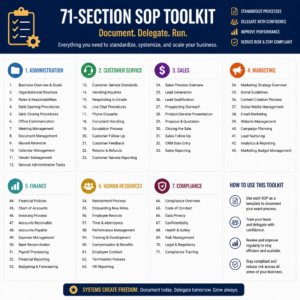
Daily Operations SOP for Small Businesses
Price: $9.00 | Best for: Owners handing work to staff
An editable Word (.docx) manual with 71 sections across 10 modules, covering admin, customer service, sales, marketing, finance, hiring, projects, quality control and business continuity. Each SOP is a template you rewrite to match how your business works. Start with the finance module, especially invoicing and receivables follow-up, because those steps pay for themselves fastest.
One tip from businesses that make this stick: put a review date at the bottom of every procedure. A procedure written in January and never touched again will be wrong by June.
Plan your money with a simple bookkeeping spreadsheet
Plenty of SMEs pay for accounting software and still keep a spreadsheet on the side, because the spreadsheet is the thing they actually understand. If that sounds familiar, it may be worth making the spreadsheet the main record and letting your accountant pull from it at year end.
The minimum a small business ledger needs is short: a list of money in, a list of money out, categories for both, and a monthly profit and loss that adds them up. Anything beyond that is a bonus. The part most owners wish they had sooner is an invoice tracker that shows how many days each unpaid bill is overdue.
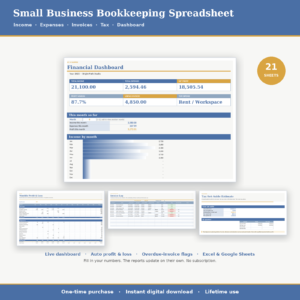
Small Business Bookkeeping Spreadsheet Bundle Plan
Price: $3.00 | Best for: Owners who want simple, reliable books
One spreadsheet built on three entry sheets: money in, money out and transfers. Pick a category from the dropdown and the file builds a running register, monthly profit and loss, category breakdowns, an invoice tracker with days overdue, a tax estimate sheet and a dashboard. It opens with a sample business filled in, so clear those rows and enter last month’s figures first.
Here is how small the daily habit can be. A florist with 6 staff enters the day’s card total and cash total as two lines each evening, then drops the week’s supplier invoices in on Friday. That’s about 15 minutes a week. The monthly report builds itself.
See the whole picture: dashboards for cash flow and bills
Some owners are happy with a ledger. Others need to see it. If you glance at rows of numbers and feel nothing, a dashboard view with a cash flow chart and a list of upcoming bills can be the difference between checking your finances weekly and avoiding them for a quarter.
The bill side is easy to overlook. A small manufacturer might have rent on the 1st, equipment finance on the 10th, insurance quarterly and software subscriptions scattered all over the month. Missing one costs a late fee. Missing several costs a supplier relationship.
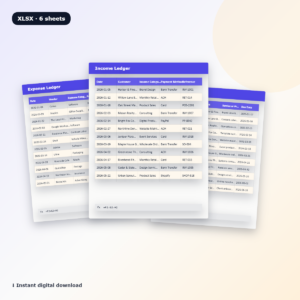
Small Business Bookkeeping Spreadsheet Dashboard Bundle
Price: $9.00 | Best for: Service businesses tracking bills and cash
An XLSX file that works in Excel or Google Sheets, with an income tracker, expense tracker, monthly profit and loss summaries, a cash flow dashboard, an invoice log, a bill tracker and tax estimate tabs. Setup instructions are included. Fill in the bill tracker first with every recurring payment you know about, so the next due dates are in front of you from week one.
If you are torn between this and the bundle above, the short answer is this. Pick the first if invoice chasing is your main pain. Pick this one if bills and cash timing keep catching you out.
Plan ahead with forecasts, KPIs and what-if scenarios
Bookkeeping tells you where you have been. Forecasting tells you where you are heading, and that’s where medium-sized businesses tend to feel the gap. Once you have staff, stock and a lease, a bad month is not just a bad month. It is a payroll question.
Three planning tools carry most of the weight here:
- A cash flow forecast that projects your bank balance forward from what you know is coming in and going out.
- A small set of KPIs such as profit margin, average order value and monthly growth, checked on the same day every month.
- A scenario planner that compares a worst, expected and best case before you sign a new lease or hire another person.

Small Business Command Center Spreadsheet Bundle
Price: $9.99 | Best for: Growing shops and makers planning ahead
One file for Excel or Google Sheets. Log sales and costs on two tabs and it builds an executive dashboard, a yearly snapshot, a sales tracker by channel, an invoice log with overdue flags, an inventory tracker with low-stock alerts, a cash flow forecast, a tax estimator, a KPI scorecard and a worst, expected and best case scenario planner. Run the scenario planner first on the one big decision you are weighing right now.
A good forecast is never exact. That’s fine. Its job is to warn you in August about a tight October, while you still have time to delay a purchase or push for an early payment.
A worked example: one month of planning at a 14-person catering company
Picture a catering business with 14 staff, two vans and around 30 events a month. Here is how the four planning jobs play out across one month.
Week 1: operations
The owner writes procedures for event setup and client onboarding, the two things new staff ask about most. A senior chef reads them, spots that the allergy check is missing from the setup list, and it goes in. Two procedures done. Both tested.
Week 2: money in and out
Every invoice from the past 60 days goes into the bookkeeping sheet. Four are unpaid, worth $6,200 in total. One is 47 days overdue. The office manager follows the written follow-up procedure, sends the reminders, and two of the four pay within the week.
Week 3: looking ahead
The cash flow forecast shows a dip in January, when corporate events dry up but rent and van finance do not. The owner sees it in November instead of in January. So the team books two wedding fairs to fill the slow weeks and moves a planned oven upgrade to March.
Week 4: review
The monthly profit and loss shows that the small office lunches earn a better margin than the big weddings once staff hours are counted. That’s a surprise, and a useful one. The owner adjusts the sales push for the next quarter.
Nothing here needed new software. Just a written process, a tidy spreadsheet and an hour a week of looking at it.
A weekly and monthly routine that keeps plans current
The best planning tool is the one that gets opened. So build a rhythm and keep it small.
Every week (about 30 minutes)
- Enter the week’s sales and costs, or check that whoever does it has.
- Look at overdue invoices and send reminders for anything past 14 days.
- Check the bill list for the next 10 days.
- Note one process that caused confusion and add it to the list for writing up.
Every month (about 90 minutes)
- Review the profit and loss against last month and the same month last year.
- Update the cash flow forecast for the next three months.
- Check three to five KPIs and write one sentence about each.
- Review or rewrite one procedure.
Put both on the calendar as fixed appointments. A Friday afternoon slot for the weekly check and the first Tuesday of the month for the longer review works well for many owners. For a broader list of templates that support this kind of routine, see our roundup of the best small business templates.
Planning mistakes that trip up small and medium businesses
Most of these are easy to spot in hindsight and hard to see while you are busy.
- Buying a system before writing a process. A new tool on top of an unclear process just makes the confusion faster. Write the steps first.
- Keeping two sets of numbers. If the software says one figure and the spreadsheet says another, nobody trusts either. Pick one record.
- Forecasting only the good case. Every plan looks fine when the big client renews. Run the version where they do not.
- Tracking 25 KPIs. Five numbers you actually read beat 25 you scroll past.
- Planning alone. Staff who follow the procedures should help write them. They know where the steps break.
- Skipping the review. A plan that is never checked against what happened is just a wish list.
Who these planning tools are not for
Spreadsheets and Word templates suit most SMEs, but not all. If you run a business with several locations, hundreds of transactions a day and a full finance team, you probably need dedicated accounting and inventory software with user permissions and audit trails. A spreadsheet will strain at that size.
The same goes for regulated industries. A clinic, a law firm or a food manufacturer may have procedures that must follow specific legal standards. A general SOP template is a solid starting structure, but the content will need to match your own rules and be checked by someone who knows them.
And if you are a solo freelancer with five clients, these tools may be more than you need right now. A single bookkeeping sheet is plenty until you hire.
Frequently asked questions
What planning tools do SMEs need first?
Start with bookkeeping and an invoice tracker, because cash problems close more small businesses than anything else. Add written procedures next, then a cash flow forecast once the books are up to date.
Can a small business plan in Excel or Google Sheets instead of software?
Yes. Many small and medium businesses run their books, forecasts and KPI tracking in spreadsheets for years. It works well as long as one person owns the file and entries are made weekly.
How often should an SME update its cash flow forecast?
Monthly is enough for most. Update it weekly during a tight patch, a big purchase or a seasonal slump so you can see trouble a few weeks before it lands.
How many SOPs does a small business need?
Fewer than you think to begin with. Write the five to ten procedures that cause the most questions or mistakes, then add more as new staff join or problems repeat.
Which KPIs matter most for small and medium businesses?
Profit margin, cash on hand, days to get paid, average order value and monthly growth cover most businesses. Pick the ones tied to your biggest current worry and check them on the same day each month.
Your next step
Block 30 minutes this Friday and list every unpaid invoice and every bill due in the next two weeks. That one list will show you which planning gap to close first. If it is the money side, set up the Small Business Bookkeeping Spreadsheet Bundle Plan and enter last month’s figures before the weekend.