It is 10:15 on a wet Tuesday. Your preschooler has built a fort, knocked it down and asked for a snack twice. You have markers. You also have a pale sofa. Here is how to bring those two things together without tears.
This guide gives you a dozen marker activities for three- to five-year-olds that keep the ink on the page and off the furniture. Some use a sheet protector and a dry-erase pen. Some use clear-ink markers. Some use a tablet. All of them have been chosen because a preschooler can do them with little help, and because they last longer than the usual four minutes. There is also a sample indoor morning at the end, for the days when the rain just does not stop.
Quick picks for indoor marker days
| Product | Best for | Price | Link |
|---|---|---|---|
| Letter Parade Alphabet Coloring Book | Tracing letters in a wipe-clean sleeve | $3.99 | View |
| Indoor Activities Coloring Book Adventure | Rainy-day scenes to color, then act out | $2.99 | View |
| Swish & Shade Digital Coloring Pages | Stylus coloring with no ink at all | $4.99 | View |
| Tap Tap Treehouse Digital Quiet Book | A break from markers for younger preschoolers | $5.99 | View |
Which markers count as mess-free?
Three kinds of marker keep a preschool morning tidy, and each one has a job.
Dry-erase markers used inside a clear plastic sheet protector. The child draws on the plastic, you wipe it with a tissue, and the page underneath is ready again. This is the star of this guide, because it turns any printed page into a reusable activity.
Clear-ink markers that only show color on their own coated pad. Stray lines on the table or a sleeve stay invisible. Good for free coloring, though you are limited to the pictures in the pad.
Washable markers on paper. Not mess-free on their own, but with a placemat underneath and a baby wipe nearby, most marks come off skin and hard surfaces. Keep them for the table, never the sofa.
A fourth option needs no ink at all: a stylus on a tablet. More on that further down.
Twelve marker activities that keep preschoolers busy
1. Trace-and-wipe letters
Slide a letter page into a sheet protector and hand over a dry-erase marker. Your child traces the big letter, colors the picture, then wipes and goes again. Three tries at the letter B feels like a game, not a lesson.
2. Letter hunt
Print a page full of mixed letters, put it in a sleeve, and ask your child to circle every M. Then every S. Each round is about two minutes and children love the hunt.
3. Color by shape
Draw a simple key at the top of a page: circles red, triangles blue, squares yellow. Your preschooler colors each shape to match. It is sorting practice in disguise.
4. Roll and color
Number six parts of a picture. Roll a die, color that part. Repeated numbers mean a pass. It sounds dull to adults. Four-year-olds will play it five times in a row.
5. Mazes in a sleeve
A simple maze in a sheet protector can be solved over and over. Start with wide paths. Pen control improves fast when the stakes are low and wiping is easy.
6. Dot-to-dot to 10
Counting and drawing in one go. Draw your own with ten dots shaped like a house, a fish or a star, and slide it into a sleeve so you can reuse it all week.
7. Finish the picture
Draw half a face, half a butterfly or a house with no windows. Your child adds the missing parts. There is no wrong answer, which suits the shy colorist.
8. Color the room, then play the room
Color a picture of a tea party or a blanket fort, then go and do it for real. The page becomes a plan. This one can stretch a whole morning.
9. Mirror drawing
Fold a page in half, draw half a pattern on one side, and ask your child to copy it on the other. Hard for a three-year-old, a fun challenge at five.
10. Window drawing with dry-erase
Many dry-erase markers wipe off glass. Test a small corner first, then let your child draw rain clouds on the window and watch the real rain behind them.
11. Clear-ink free coloring
For days when you just need ten quiet minutes, a clear-ink pad on the sofa is safe. Nothing shows on the cushions.
12. Tablet coloring with a fat stylus
No ink, no cleanup, and a fresh page every time. Best saved for the end of the morning, when energy dips.
Turning printed pages into wipe-clean activities
The sheet protector trick changes how much you get out of a printable. Instead of printing 26 letter pages and watching them get scribbled once, you print one set, slip each page into a sleeve and use them all term. Keep them in a ring binder so the pages stay in order.
Alphabet pages are the obvious place to start, because tracing is the activity preschoolers want to repeat most.
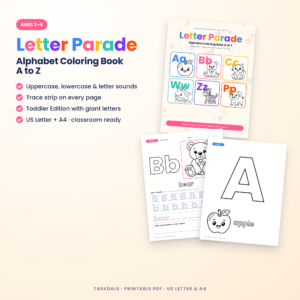
Letter Parade Alphabet Coloring Book
Price: $3.99 | Best for: Ages 2 to 6 learning their letters
Letter Parade has 26 alphabet pages, each with a hollow uppercase and lowercase letter, a picture from apple to zebra, the word in hollow letters, and three trace rows on handwriting lines with a start dot. There is also a Toddler Edition with one huge letter per page, an alphabet chart, letter hunt pages and an Alphabet Star certificate. Print it on US Letter or A4, put the trace pages in sleeves, and start with your child’s first initial.
A few tips to make the sleeves last:
- Pick heavy, clear sleeves. Thin ones crinkle and the marker skips.
- Use low-odor, fine-tip dry-erase markers. Chunky whiteboard pens smudge on plastic.
- Wipe with a dry tissue or a small square of felt. A damp cloth leaves streaks.
- Cap the markers at the end of every session, or they dry within a day.
If you are looking for more pages to put in sleeves, our guide to preschool coloring pages lists bold, simple sets.
Scenes that start a game
The best indoor activity is the one that leads to another. A coloring page that shows something your child can then go and do keeps the morning moving without you inventing every step.
That is why home scenes work so well on rainy days. A child colors a picture of someone baking cookies, then wants to stir the bowl. A page with a puppet show leads to a sock puppet behind the sofa.
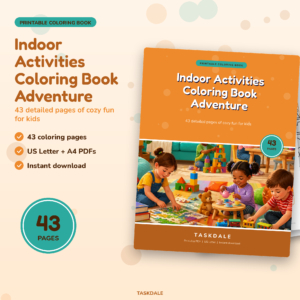
Indoor Activities Coloring Book Adventure
Price: $2.99 | Best for: Rainy days and sick days at home
Indoor Activities has 43 detailed scenes of things kids do inside: a blanket fort, a reading nook, puzzle time, a tea party, a puppet show, board game night, cooking help and a window garden. Younger children fill the big shapes first and older ones can spend half an hour on rugs and shelves. Print the blanket fort page, color it together, then build the real thing.
These scenes are detailed, so for a three-year-old, color one corner of the page and call it done. A five-year-old may finish the whole thing over two sessions.
When to switch from markers to a screen
Around 11am, most preschoolers hit a slump. Fine motor work gets sloppy, caps get lost and frustration creeps in. That is a good time to put the markers away and bring out a tablet for twenty minutes.
A stylus gives the same feeling of drawing with no ink at all. And because the outlines sit on a separate layer, the picture never looks ruined, which matters to a tired four-year-old.

Swish & Shade Digital Coloring Pages
Price: $4.99 | Best for: Preschoolers ready for a stylus
Swish & Shade includes 18 Big Adventures pages made for ages 4 to 8: under the sea, a farm, a space explorer, a pirate ship, a fire truck, a bakery and more, plus 18 thicker toddler pages for younger siblings. Pages come as transparent PNGs and a hyperlinked PDF, so they work in GoodNotes, Notability, Ibis Paint X or Procreate. Set up one page with the fill tool before you hand it over.
For a younger three-year-old, coloring may not be the best break. A tap-and-play book asks for less hand control and gives quick, happy feedback.

Tap Tap Treehouse Digital Quiet Book
Price: $5.99 | Best for: Young threes who tire of markers
Tap Tap Treehouse is a tablet quiet book with 15 tap-and-play activities: shapes, colors, counting, matching, a dress-up doll and a weather board, plus 6 coloring pages. It is a hyperlinked PDF for iPad and Android that works offline. The weather board is a fun one for a rainy day: tap the rain and the whole scene changes.
A sample indoor morning
| Time | Activity | Marker type |
|---|---|---|
| 9:00 | Trace-and-wipe letters, three letters | Dry-erase in sleeves |
| 9:20 | Roll and color | Washable on paper |
| 9:40 | Snack and a dance break | None |
| 10:00 | Color a home scene, then act it out | Washable on paper |
| 10:40 | Mazes and dot-to-dot | Dry-erase in sleeves |
| 11:00 | Tablet coloring or quiet book | Stylus |
| 11:20 | Help tidy the marker box | None |
Do not worry about sticking to the clock. The point is the rhythm: a seated activity, then movement, then seated again. Preschoolers last longer at the table when they know a break is coming.
If you like planning themed weeks, our preschool lesson plan template guide shows how to string a letter, a color and a theme together over five days.
Setting up a marker station that stays tidy
Where the markers live decides where the marks end up. A fixed station at the kitchen table teaches your child that markers belong there.
- A wipe-clean placemat under every page
- A cup for each marker type, labeled with a sticker: dry-erase, washable
- A binder of sleeved pages that your child can flip through and choose from
- A small cloth or tissues for wiping sleeves
- A cap check at the end: every marker clicks shut before anyone leaves the table
Make the cap check a game. Count the clicks out loud. A four-year-old who gets to say “ten clicks, all done!” is much happier to tidy up.
Keeping the activities fresh for weeks
Even the best marker game wears thin by the tenth go. The fix is not more stuff. It is rotation.
Split your sleeved pages into three small piles and only put one pile in the binder at a time. Swap piles every Monday. Pages your child was bored of three weeks ago come back feeling new, and you have not printed a single extra sheet.
Small changes to the rules help too. Trace the letter with the left hand. Color the maze path in rainbow order. Finish the dot-to-dot with your eyes half closed and then check it. Preschoolers love a silly twist on a game they already know, because they get to feel clever and laugh at the same time.
Numbers are another easy way to refresh things. Color-by-number pages slide into sleeves just as well as letters, and the same page can be colored in a new set of colors next week. Our guide to color by number pages for preschool learning has simple sets that suit this age.
Finally, mark the wins. A sticker on a chart for every letter traced, or a small star on the binder spine when a page is done, gives a three-year-old something to aim for. When the chart is full, the reward can be as simple as choosing the next rainy-day snack. The pride on their face is worth more than the sticker.
When marks do happen
They will, now and then. A washable marker line on a hand or a hard tabletop usually comes off with soap and warm water or a baby wipe. On fabric, rinse with cold water as soon as you can. Dry-erase on a sleeve wipes off, but dry-erase on paper or fabric can be stubborn, so keep those markers for the plastic only.
The easiest fix is prevention: markers stay at the station, and the sofa is a marker-free zone. Say it once, kindly, and repeat it every time. Children learn place rules surprisingly fast.
Frequently asked questions
What marker activities can preschoolers do alone?
Trace-and-wipe letters in sheet protectors, mazes, simple dot-to-dots and clear-ink free coloring all work with little help. Show your child once, then let them repeat it.
Can you use dry-erase markers on sheet protectors?
Yes. Dry-erase markers wipe off most clear plastic sleeves with a dry tissue. Heavy sleeves work best, and fine-tip markers smudge less than chunky ones.
How do I keep my preschooler busy indoors on a rainy day?
Mix seated marker activities with short movement breaks every 20 minutes. Coloring a home scene and then acting it out, like building a blanket fort, can stretch a morning.
Are washable markers really washable?
Most come off skin and hard surfaces with soap and water. Fabric is harder, so rinse quickly in cold water and keep markers at the table, away from soft furniture.
What age can kids use dry-erase markers?
Many three-year-olds manage them well with supervision. Pick low-odor, fine-tip markers and keep caps on your side of the table for younger children.
Your next step
Buy a pack of clear sheet protectors and four fine-tip dry-erase markers, then print one set of letter pages and sleeve them in a binder. Letter Parade is a good first set to sleeve, because your preschooler can trace the same letters every rainy morning this term.