Call it a worksheet and a five-year-old groans. Call it a game and the same child pulls up a chair. Educational coloring games use the exact same skills as a worksheet: naming colors, spotting shapes, matching pairs. The difference is a roll of a die, a race against a sand timer or a mystery picture that only shows up if you color the right spaces.
This guide is for parents, homeschoolers and early years teachers who want educational coloring games that help children practice colors, shapes, and matching. You will get more than a dozen printable and no-prep games, how to set up a reusable game station, ways to play with siblings or a small group, and four Taskdale books with pages that slot straight into these games.
Quick picks for game-style coloring
| Product | Best for | Price | Link |
|---|---|---|---|
| Crayon Campus Preschool Learning Coloring Worksheets | Color, shape and matching pages, ages 3 to 5 | $4.99 | View |
| Letter Parade Alphabet Coloring Book A to Z | Uppercase and lowercase matching | $3.99 | View |
| Roar to Z Dinosaur Coloring Book A to Z | Name-matching game and fact cards | $4.49 | View |
| Gallop Gallery Horse Breeds Coloring Book | Coat color and markings games | $4.99 | View |
Why a game works when a worksheet does not
Young children learn through play. That is not a slogan. It is simply how a four-year-old spends their day. A game gives them three things a plain page does not: a reason to start, a bit of suspense in the middle and a clear finish. “Roll the die and color that many stars” has all three. “Color 4 stars” has none.
Games also take the sting out of mistakes. If a child picks the wrong shape in a game, they just miss a turn. Nobody marks it wrong in red. That small shift makes cautious children braver, and braver children try more.
There is one more bonus. Games are social. A grandparent, an older sibling or a friend can join in, and suddenly a ten-minute coloring task becomes twenty minutes of chatting, laughing and counting together.
Color games for ages 2 to 5
Color names are some of the first abstract words a child learns. They are tricky because “red” is not a thing you can hold. It is a quality of things. Games help because they make children say and use the word again and again.
Color dice
Take a plain wooden block or a paper cube and put a dot of a different color on each side. Your child rolls it, names the color, then colors one part of their picture in that shade. A sun might end up purple. Brilliant. They have said “purple” out loud and found it in the box.
Crayon detective
Hold up a crayon behind your back. Give one clue: “It is the color of a banana.” Your child guesses, then colors something on their page in that color. Swap roles. Kids love being the one giving clues, and it stretches their vocabulary as they hunt for descriptions.
Color by the room
Before coloring a page, your child runs to find one object in the room that matches each color you name. Red, a cushion. Blue, a cup. Then they use those exact colors on their page. Great for a rainy afternoon when energy is high.
Rainbow race
Two players, two copies of the same simple page. Each player must use the colors in rainbow order, one per section. First to finish all six colors wins. Older kids can do it with a sand timer instead of racing each other.
Shape games that build sharp eyes
Shape games train children to look closely, compare and decide. That careful looking feeds straight into reading later on, when they need to tell “p” from “q”.
Shape bingo
Draw a 3 by 3 grid with a different shape in each square. Call out shapes one at a time. Your child colors the matching square. Three in a row wins. Make two cards with the shapes in different spots and play against each other.
Mystery picture
Color-by-shape pages are the star here. Every circle is yellow, every triangle is green, every square is blue. As the child colors, a hidden picture appears. The reveal at the end gives them a little jolt of pride every time.
Odd one out
Draw a row of four shapes where one is different. Your child finds it and colors it. Then make it harder: four triangles where one is upside down. That one catches out a lot of five-year-olds and makes them laugh when they spot it.
Ready-made pages save you the drawing. One set covers color-by-shape pictures, shape counting, shape matching and color-word pages, all with one skill per page.
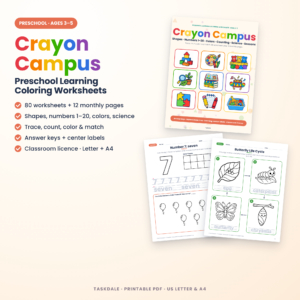
Crayon Campus Preschool Learning Coloring Worksheets
Price: $4.99 | Best for: ages 3 to 5, games and centers
Eighty one-skill pages including 12 shape pages with color-by-shape pictures, 10 color pages with color words and a color-mixing page, and 6 matching pages such as find the shadow and match the halves. Answer keys and a skills checklist are included in the 96-page US Letter and A4 PDFs. Slide pages into sheet protectors and they become reusable dry-erase games.
Matching games for memory and attention
Matching is a quiet superpower. A child who can match a shadow to its object, or a big letter to a small one, is building the visual memory that reading and early math depend on.
Shadow match
Color a picture of an animal, then draw (or print) its plain black shadow plus two wrong shadows. Your child draws a line to the right one. Simple, quick and surprisingly absorbing for three-year-olds.
Find the other half
Cut a colored page in half with a wavy line. Mix it with two other halved pages. Your child matches the halves back together. It works as a puzzle and a reward for finishing the coloring.
Big and small letter pairs
This one is perfect for four- to six-year-olds learning to read. Color a big A, then find the small a among a few lowercase letters. Many children know their capitals first, so this game bridges the gap gently.
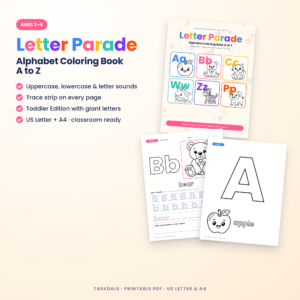
Letter Parade Alphabet Coloring Book A to Z
Price: $3.99 | Best for: ages 3 to 6 learning letter pairs
Twenty-six letter pages with uppercase and lowercase side by side, plus four Match Big and Small pages for pairing letters and three Letter Hunt pages (find B, M and S). The Toddler Edition gives every letter its own giant page for ages 2 to 4. US Letter and A4 PDFs are included, with a one-teacher classroom license.
Memory pairs
Print two copies of a page with several small pictures. Color both sets the same way, cut them into cards and play a classic memory game face down. Coloring the cards first means your child already knows them, so the game is about memory, not guessing.
Name games for dinosaur fans
Some kids light up at dinosaurs and switch off at anything else. Lean into it. Matching games built around real animals teach the same skills as letter cards, plus real facts they will happily repeat at dinner.
Name that dinosaur
Color a few dinosaurs first. Then lay out their name cards and ask your child to match each name to its picture, using the first letter as a clue. T for Triceratops. S for Stegosaurus. A five-year-old who matches “Parasaurolophus” correctly will tell everyone they meet.
Fact card snap
Once a few dinosaurs are colored, read a fact aloud: “I had three horns on my face.” Your child slaps the matching picture. Then they read or say a fact for you to guess. It is quick, noisy and a great way to end a quiet coloring session with a bit of energy.
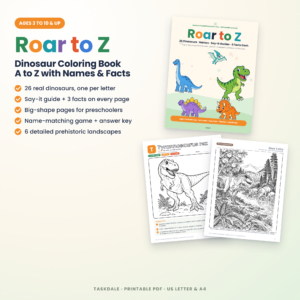
Roar to Z Dinosaur Coloring Book
Price: $4.49 | Best for: dinosaur fans ages 3 to 10
Twenty-six real dinosaurs and prehistoric reptiles from A to Z, each with a say-it guide and three facts. The games section includes a Name That Dinosaur matching game at two levels, a word search and a maze, plus 26 cut-out fact cards and a size chart. You get US Letter and A4 PDFs, licensed for personal use and one teacher’s own class.
Color games for horse lovers
Horses are a gift for color practice, because real horses come in named colors that children love to learn. A seven-year-old who knows the difference between bay and chestnut feels like an expert, and expert feelings keep children coming back to the page.
Coat color match
Horse fans can play a color game with real horse words. Name a coat color like bay, palomino or chestnut, show a swatch, and the child colors a horse to match. Then add a marking: a white blaze on the face or socks on the legs. It is color practice and vocabulary at the same time.
Spot the marking
Color two copies of the same horse, but give one a star on its forehead and the other a long blaze. Ask a sibling to spot the difference. Then swap. Children start to notice small details, which is exactly the skill that matching games build.
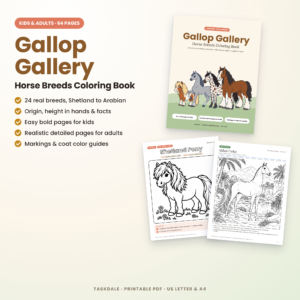
Gallop Gallery Horse Breeds Coloring Book
Price: $4.99 | Best for: horse-crazy kids and their grown-ups
Twenty-four real horse breeds, each drawn as an easy page with thick outlines and a realistic page for older kids and adults. A know-how section has face and leg markings guides, a coat colors guide with swatches and a Design Your Own Horse page where you tick a color and markings, then color to match. US Letter and A4 PDFs are included.
Set up a reusable game station
A game station turns a pile of pages into something a child can use on their own. It takes twenty minutes to set up and lasts for months.
- Get a shallow tray or box. A shoebox lid works fine.
- Add sheet protectors. Slide in five or six game pages: a shape bingo card, a color dice page, a letter match page.
- Add dry-erase crayons or markers. Children color on the plastic, then wipe it clean with a cloth.
- Add a die and a sand timer. These turn almost any page into a game.
- Swap one page each week. Keeps it fresh without starting over.
A teacher with 20 pre-K children can set up three of these trays as a learning center. A parent can keep one on a low shelf for the “I’m bored” moments. For more classroom ideas, our post on coloring printables for classroom centers covers setup and rotation.
Playing with siblings or a small group
Coloring games work best with two to four players. More than that and the waiting gets long. A few tips that keep things friendly:
- Give younger players a head start. In a race, a three-year-old gets two extra turns. Nobody minds, and it keeps the little one in the game.
- Use teams. Pair an older child with a younger one. The older child reads the clues, the younger one colors.
- Celebrate finishing, not winning. Everyone who completes their picture gets a sticker.
- Keep rounds short. Five to ten minutes per game, then switch.
Older kids often enjoy screen versions too. If you want a tablet option for a long car trip, our guide to coloring games online lists free picks for kids and adults.
Mistakes that spoil a good game
Too many rules
A game with five rules is a lesson in disguise, and children can tell. Keep it to one or two rules a four-year-old can repeat back to you.
Always letting the adult win
Or always letting the child win. Both get boring. Let the dice decide. Losing now and then, and getting another go straight away, is a healthy little lesson.
Skipping the talk
“Why did you pick that one?” is the most useful question in any matching game. It shows you how your child is thinking, and it helps them notice their own reasoning.
Playing too long
The best moment to stop a game is while everyone still wants one more round. Pack it away on a high and the next session starts with excitement instead of a sigh.
Frequently asked questions
What are good coloring games for preschoolers?
Color dice, shape bingo, color-by-shape mystery pictures and memory pairs are easy to set up and suit ages 3 to 5.
How do coloring games help children learn?
They repeat skills like naming colors, spotting shapes and matching pairs in a playful way, so children practice more without feeling tested.
Can I make coloring pages reusable?
Yes. Put pages in clear sheet protectors and use dry-erase crayons or markers. Wipe clean and play again.
What age can kids play matching games?
Simple shadow and picture matching works from about age 2 and a half. Letter matching suits most children from 4.
Are printable coloring games good for classrooms?
They work well as learning centers and early-finisher activities. Check that the set includes a classroom license before printing copies for a class.
Do I need special supplies for coloring games?
No. A die, a sand timer, crayons and a few printed pages cover nearly every game in this guide. Sheet protectors are a nice extra if you want to reuse pages.
Your next step
Find a die and one simple picture today. Play color dice for ten minutes after lunch and see if your child asks for a second round. If they do, the color and shape pages in Crayon Campus make an easy first game station.