Two people earn the same pay. One checks the balance with a calm shrug. The other feels a knot in the stomach every time a bill arrives. The difference is rarely the number. It is the story each person tells about money, picked up long before they ever had a paycheck. That story is your money mindset, and the good news is that it can be edited.
This guide gives you practical exercises to spot your old money beliefs and write better ones, plus three Taskdale printables that put them on paper. A quick note first: this is general information and self-help material, not financial advice, and not a replacement for a therapist or a qualified adviser.
Quick picks
| Product | Best for | Price | Link |
|---|---|---|---|
| The Calm Money Method | A full money mindset workbook with budget pages | $11.99 | View |
| Future Self Blueprint Workbook | A mindset reset focused on who you are becoming | $5.99 | View |
| Calm Money Budget Binder | Turning new thinking into a monthly budget | $3.49 | View |
What Is a Money Mindset, Really?
Your money mindset is the set of beliefs, feelings and habits you carry about money. Whether it feels safe or scary. Whether you think you deserve more. Whether saving feels like a treat or a punishment.
Most of it was learned early. What you heard at the dinner table, how the adults around you reacted when money was short, what got celebrated and what got whispered. You absorbed all of it without choosing it. A child who hears “we cannot afford that” a hundred times can grow into an adult who flinches at every price tag, even on a good salary.
None of this means you are stuck. It just means that if your budget keeps failing, the spreadsheet may not be the real problem. Sometimes the belief underneath is.
Signs Your Money Mindset Is Working Against You
Check yourself against this list. Not to feel bad, just to notice.
You avoid opening your bank app, and you only look when you have to. You overspend after a stressful week, then feel awful. You feel guilty buying anything for yourself, even small things. You undercharge for your work, or avoid asking for a raise. You think more money would fix everything, yet you spent the last bonus within weeks. Or you hoard, afraid to spend even on needs.
If two or three of these ring true, you are in good company. Most people have at least one. Naming it is the first step.
Exercise 1: Write Your Money Story
Take a piece of paper and set a timer for fifteen minutes. Write answers to these prompts without editing.
What is your earliest memory about money? What did the adults in your home say about it? Was money talked about openly, or hidden? Did anyone fight over it? What did you decide, as a kid, about people with money, and people without it?
When you finish, read it back and underline any sentence that starts with “money is” or “people who have money are.” Those lines are your inherited beliefs. You will use them in the next exercise.
Exercise 2: Catch and Rewrite the Belief
Pick one underlined belief. Say it is “money always runs out.” Now ask three questions.
Where did I learn this? Is it always true, or only sometimes? What would a more useful version sound like?
You are not trying to swap it for a fantasy like “money is infinite.” That never sticks. You want a believable step up. “Money runs out when I do not plan for it, and I am learning to plan” is something your brain can actually accept. Write the new line on a card and read it when the old one shows up.
Here is a simple table to try.
| Old belief | Where it came from | A more useful version |
|---|---|---|
| Money always runs out | Tight months growing up | Money lasts longer when I plan it |
| I am bad with money | One overdraft years ago | I am learning, and one mistake is not my whole story |
| Wanting more is greedy | Things I heard as a child | Wanting a stable life is reasonable |
Exercise 3: Look at Where the Money Actually Goes
Mindset work gets slippery without facts. So pair the feelings with numbers. For one week, write down every purchase. All of them. The goal is not to judge. It is to see.
At the end of the week, mark each purchase in one of three ways: needed, wanted and enjoyed, or wanted and regretted. Most people find the third group is small but loud. Notice what was happening just before those purchases. Tired? Stressed? Bored? That is often the real trigger, and it has little to do with the item.
If you want those numbers to live somewhere simple once the week is over, a printable budget binder gives them a monthly home.
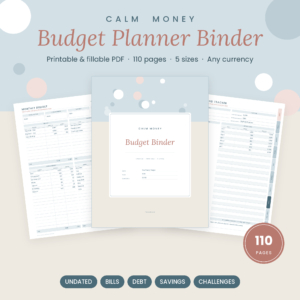
Calm Money Budget Binder
Price: $3.49 | Best for: Turning new thinking into a monthly budget
A printable budget planner binder as a fillable PDF with a bill tracker, debt snowball and savings tracker. It gives your new money beliefs a practical place to land.
Exercise 4: Define Enough
This one surprises people. Write down what “enough” looks like for you, in plain life terms. Where do you live? What do you eat? What do you want to do on a free Saturday? Then put a monthly figure beside each one.
Without a picture of enough, every number feels too small. With one, you can aim. It also takes the sting out of comparing yourself to others, since their enough is not yours.
Exercise 5: Make One Small, Visible Promise
Beliefs change when actions back them up. So choose one small thing, and do it this week. Move $10 to savings. Open that envelope you have been avoiding. Pay one bill early. List your debts on one page.
The size does not matter. What matters is the evidence you give yourself that you can handle your money. Do it, tick it, and let it build.
Affirmations That Do Not Feel Fake
Many people roll their eyes at affirmations, and fair enough. Shouting “I am a money magnet” at the mirror can feel silly when your account is low. The trick is to keep them true.
Use statements you can honestly agree with today. “I am learning to read my statements.” “I can look at my balance without panicking.” “I pay my bills on time, and that counts.” “I am allowed to want a steady life.” If you wince at one, soften it until it feels believable, then raise it a little next month.
Say them while you do something practical, like paying a bill or filling in a tracker. The words stick better when an action sits beside them.
If the future-self angle appeals to you, there is a workbook built entirely around it.
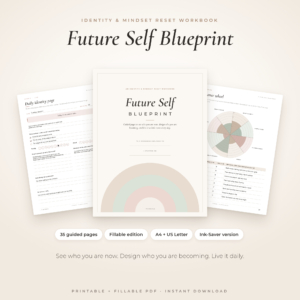
Future Self Blueprint Workbook
Price: $5.99 | Best for: A mindset reset focused on who you are becoming
A printable and fillable identity shift journal and mindset reset workbook with a habit tracker, as a US Letter and A4 PDF. It suits anyone who wants to work on self-image alongside money habits.
A Seven-Day Money Mindset Starter Plan
Want a simple route? Try this for one week. Each task takes about fifteen minutes.
Day one: write your money story. Day two: underline the beliefs and pick one. Day three: rewrite it in a believable form. Day four: list every bill and debt on one page, even the ones you dread. Day five: track every purchase and mark each as needed, enjoyed or regretted. Day six: write down what enough looks like for you. Day seven: make one small promise, like a $10 transfer, and do it.
That is a whole week, and you have done real work. You have a story, a new line to read, a list of what you owe, and one action in the bank. Not bad for under two hours.
After the week, decide what to keep. Maybe you do the purchase tracking for another month. Maybe you add a weekly check-in with a printable budget. Let the practice grow slowly, so it lasts.
Money Mindset Printables From Taskdale
You can do all of the above on blank paper. But a structured workbook keeps you honest, and having the budget pages beside the mindset pages helps the thinking turn into action. Here are three options.
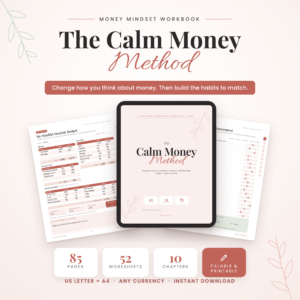
The Calm Money Method
Price: $11.99 | Best for: A full money mindset workbook with budget pages
A money mindset workbook as a printable and fillable PDF. It also includes budget planner and financial planner worksheets, plus a debt and savings tracker, so the thinking and the numbers sit together.
Compare the Three Money Mindset Printables
| Product | Format | Price | Best for | Link |
|---|---|---|---|---|
| The Calm Money Method | Printable and fillable PDF | $11.99 | A full money mindset workbook with budget pages | View |
| Future Self Blueprint Workbook | Printable and fillable PDF, US Letter and A4 | $5.99 | A mindset reset focused on who you are becoming | View |
| Calm Money Budget Binder | Printable and fillable PDF | $3.49 | Turning new thinking into a monthly budget | View |
How to Use a Money Mindset Workbook Without Burning Out
Go slowly. A workbook is not a race, and you do not need to finish it in a weekend. A page or two a day is plenty. Pick a regular time, say after dinner or on a Sunday morning, and keep it short.
Expect some pages to feel uncomfortable. If you notice strong feelings, pause. Take a walk, make tea, and come back tomorrow. If old feelings about money feel heavy or tied to something painful, a counselor or therapist is the right person to talk to, and a workbook is not a substitute.
Pair the thinking with a practical habit. After each mindset session, spend five minutes on the numbers. Update a bill tracker. Check your savings. Small actions confirm the new belief.
And be kind to yourself. You will slip. You will overspend, avoid a statement, or hear the old voice again. That is part of it. Note what happened, and go on to the next page.
When to Ask for Extra Help
A workbook can shift how you think about money, but it cannot fix everything. If debt collectors are calling, or you are behind on rent, you may need a practical plan on top of the mindset work. Many areas have free or low-cost debt advice services, so look for one near you.
The workbook is a self-help tool and general information, not financial advice or a replacement for a qualified professional. Use it to get clear on your habits and beliefs, and then take that clarity to someone who can look at your actual numbers.
Frequently Asked Questions
What is a money mindset?
A money mindset is the collection of beliefs, emotions and habits you hold about money, mostly learned in childhood. It shapes how you save, spend, earn and talk about money. Changing it starts with noticing the beliefs and testing whether they are still useful.
Can you really change your money mindset?
Many people shift their habits by noticing old beliefs, writing more useful ones, and backing them with small actions. It takes repetition rather than one big moment. A workbook gives you a structure for that practice, but it is a self-help tool, not a guaranteed fix.
Is a money mindset workbook the same as a budget?
No. A budget deals with the numbers. A money mindset workbook deals with the beliefs behind your choices. The two work well together, which is why The Calm Money Method includes budget planner worksheets and a debt and savings tracker.
How long does it take to change how you think about money?
There is no set timeline, and it differs for everyone. Many people notice small shifts within a few weeks of regular practice, such as checking balances more calmly. Deeper beliefs may take longer. Stay patient and keep the habit going.
When should I talk to a professional instead?
If money worries cause serious distress, affect your sleep or relationships, or connect to past trauma, speak to a counselor or therapist. For debt or investing decisions, a qualified financial adviser can help. Workbooks are general self-help and cannot replace professional support.
Your Next Step
So, start small. Tonight, spend fifteen minutes writing your money story. Then underline one belief you are ready to rewrite. If you want a full structure to follow, The Calm Money Method pairs mindset pages with budget worksheets. If you want to start with the numbers, the Calm Money Budget Binder is the easy first step. Either way, you will have the first page done before bed.