One kettlebell. One square metre of floor. That is all you need to get strong, sweat properly and finish in thirty minutes. But walk into a gym and pick up a kettlebell with no plan, and you will either swing it badly or put it down after four minutes. This guide gives you a kettlebell workout for beginners built across eight weeks, with the moves explained in plain language, a simple weekly structure and a printable kit from Taskdale to keep you on track. No jargon, no six-pack promises, just a clear path from first swing to confident routine.
General fitness information, not medical advice. If you have an injury, back or shoulder problems, or a health condition, check with your doctor or a qualified coach before you start.
Quick picks
| Product | Best for | Price | Link |
|---|---|---|---|
| Kettlebell Strength Kit | 60 exercise charts, an 8-week program and a fitness planner | $4.69 | View |
| The Complete Health & Fitness Planner | Logging workouts, meals and habits | $4.25 | View |
| Home Workout Chart Library | 16 printable charts and 320 exercises | $8.99 | View |
Why a Kettlebell Workout for Beginners Works So Well
A kettlebell is a cannonball with a handle. The weight sits away from the grip, which makes every move a bit more demanding on your balance, your grip and your core. A few simple exercises cover your whole body: legs, hips, back, shoulders and arms.
It also saves time. Because swings and squats use big muscles, even a short session gets your heart rate up. You do not need a rack of equipment. One bell, one mat, one corner of the living room. For anyone who has ever bought a gym membership and used it twice, that is a relief.
The catch is technique. Kettlebells reward good form and punish sloppy form, especially the swing. That is why a plan matters, and why you should start lighter than your ego wants.
Choosing Your First Kettlebell
Pick a weight you can lift overhead with control for a few reps, but one that still feels light enough for ten smooth swings. If you are unsure, go a size lighter. You can always add a heavier bell later, and many people end up owning two.
Look for a flat base so it sits steady on the floor, a smooth handle that is not too thick for your hand, and a finish that does not chew up your skin. Cheap bells with rough seams can leave blisters. If you can try one in a shop first, do. Otherwise, check the return policy.
Clear a safe space
Give yourself room. Swing the bell with a clear floor in front, no fragile items nearby and a mat or hard flat surface under your feet. A kettlebell that slips is not a funny story.
The Six Moves You Need to Learn First
- Deadlift. The bell sits between your feet. Push your hips back, flat back, stand up tall. This teaches the hinge that every swing relies on.
- Goblet squat. Hold the bell at your chest and squat down, keeping your chest up. A great way to learn squat depth.
- Swing. Hinge, snap your hips forward and let the bell float to chest height. The hips do the work, not the arms.
- Halo. Circle the bell around your head. A gentle shoulder warm-up that loosens your upper back.
- Overhead press. Press the bell from shoulder to overhead, with a tight core and no leaning back.
- Row. Hinge forward and pull the bell to your hip, one arm at a time.
Spend your first week of any kettlebell workout for beginners on form only. Film yourself from the side if you can. You are checking that your back stays flat and that your hips, not your arms, drive the bell.
An 8-Week Kettlebell Workout for Beginners at a Glance
Here is a simple outline for a kettlebell workout for beginners that you can follow with any bell. Three sessions a week, with a rest day between. It is general guidance, and you should adjust it to your own fitness.
| Weeks | Focus | Sessions per week | Rough structure |
|---|---|---|---|
| 1 and 2 | Learn the moves | 3 | Deadlift, goblet squat, halo, row, two to three rounds, slow |
| 3 and 4 | Add the swing | 3 | Add swings in short sets with rest, then the squat and row |
| 5 and 6 | Build volume | 3 | More rounds, add the overhead press, short carries |
| 7 and 8 | Put it together | 3 | Circuit of all six moves, steady pace, track your rounds |
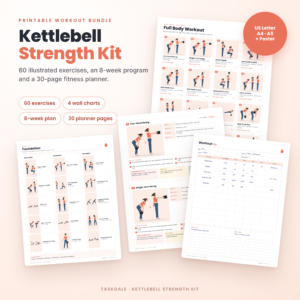
Notice what is missing: heroic weights, killer finishers and complicated flows. Beginners improve fastest by repeating a few moves with good form. The Kettlebell Strength Kit has its own 8-week program, so if you prefer to follow ready-made pages instead of this outline, that is the easier route.
The Printable Kettlebell Kit for Beginners
Kettlebell Strength Kit
Price: $4.69 | Best for: beginners who want a printable plan and charts
The kit is made for exactly this situation. Sixty exercise charts mean you are not stuck with the same six moves forever, the 8-week program gives you structure, and the planner gives you somewhere to tick things off. Print the pages you need, tape the chart where you train and you are set.
If you want a general log for meals and habits too, The Complete Health & Fitness Planner is a 102-page undated printable planner with a workout log, meal planner, habit and measurement trackers.
Home Workout Chart Library
Price: $8.99 | Best for: extra variety beyond kettlebells
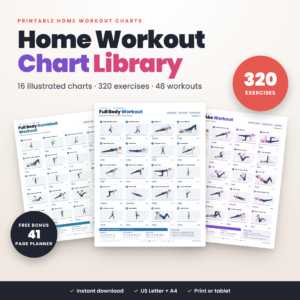
Use it on your non-kettlebell days. A walk, some bodyweight work or mobility pages from a chart library make a good complement to the bell.
Side-by-side comparison
| Product | Format | Price | Best for | Link |
|---|---|---|---|---|
| Kettlebell Strength Kit | Printable bundle: 60 charts, 8-week program, planner | $4.69 | Following a kettlebell plan | View |
| Complete Health & Fitness Planner | Printable, undated, fillable PDF | $4.25 | Logging workouts, meals and habits | View |
| Home Workout Chart Library | 16 printable charts, 320 exercises, planner | $8.99 | Variety on other days | View |
A Sample Kettlebell Workout for Beginners You Can Try Today
Want to test the water before you commit to eight weeks? Try this short circuit after a five minute warm-up. Use a light bell and keep every rep smooth.
- Deadlift, 10 reps
- Goblet squat, 8 reps
- Row, 8 reps each side
- Halo, 5 circles each way
Rest for a minute, then repeat for a total of three rounds. That is about fifteen minutes. If it felt easy, great, you have room to grow. If it felt hard, even better, because you now know where to start. Write it down, and repeat it in two days to see how it changes.
Kettlebell or dumbbell?
People ask this a lot. Dumbbells are friendlier for slow lifts like presses and rows. Kettlebells shine for swings, carries and moves that flow. For a kettlebell workout for beginners, one bell is plenty to start with. If you already own dumbbells, use them for the goblet squat and row while you save for a bell.
How to Structure a Single Beginner Session
Every session can follow the same shape. Spend five minutes warming up with halos, hip bridges and a few bodyweight squats. Spend twenty minutes on your main work, doing your moves in rounds with short rests. Spend five minutes cooling down and stretching your hips, back and shoulders.
Count rounds, not minutes. If you did three smooth rounds today and two last week, you got stronger. That simple record is more useful than a stopwatch.
Rest matters
Take the rest days. Your grip, hips and back are doing new work, and they need time to adapt. A walk on your day off is fine. Another hard session is not.
Mistakes to Avoid in Any Kettlebell Workout for Beginners
The swing is the big one. People squat it instead of hinging, which strains the lower back. Remember that a swing is a hip movement. Push your hips back, snap them forward and let the arms hang on like ropes.
The second is going too heavy. A bell that is too heavy ruins your form, and bad form leads to sore wrists and a cranky back. Start light. The third is skipping the warm-up. Five minutes is enough. And the fourth is rushing. Slow reps teach your body the pattern, and speed comes later by itself.
One more thing: grip. Do not squeeze the handle like you are strangling it. A firm but relaxed grip lets your forearms last longer and saves your hands.
Tracking Your Progress Over Eight Weeks
Write down your starting bell weight, the number of rounds you did and how each session felt. After four weeks, look back. Can you do more rounds? Do the moves feel smoother? Did you move up a bell size? Any of those counts as progress.
Do a repeat test in week eight. Pick the same circuit from week one and see how it feels now. Most beginners are surprised by how much easier it seems. Write that down, too. Then pick your next eight weeks.
What comes after week eight?
Good question, and a nice problem to have. You have a few options. You can repeat the same eight weeks with a slightly heavier bell. You can keep the bell you have and add rounds or reps. Or you can start learning new moves from your chart pages, like single-arm swings, cleans or carries.
Whichever you choose, change one thing at a time. If you add a heavier bell and new moves in the same week, you will not know what worked or what hurt. Slow progress is still progress, and it lasts longer than a quick burst that ends in an injury.
Keep logging, too. A plain notes page with the date, bell weight, rounds and how it felt is enough. Six months from now, that page will remind you how far a beginner can go with one kettlebell and a bit of patience.
Recovery, Soreness and What Normal Feels Like
New lifters often worry when they feel sore the day after. A bit of stiffness in the glutes, hamstrings and shoulders is common when you start swinging a kettlebell, and it usually fades within a couple of days as your body gets used to the work.
Sharp pain is different. If something pinches in your lower back, wrist or shoulder, stop the set, put the bell down and check your form before you try again. A mirror or a quick phone video from the side helps a lot.
On rest days, walk, stretch gently and drink water. You do not need to earn rest. It is part of the plan, and strength shows up between sessions, not during them.
Sleep matters too. Aim for a regular bedtime, and eat something with protein after your session. Simple habits like these keep you training week after week, which beats any clever program.
This is general information, not professional advice. If you have an injury or a health condition, talk to a doctor or qualified trainer first.
Frequently asked questions
What weight kettlebell should a beginner start with?
Choose a weight you can control for ten smooth swings and lift overhead with good form. If you are between two sizes, go lighter. Technique matters more than weight at the start, and you can always buy a heavier bell once the basics feel easy.
How often should beginners do kettlebell workouts?
Three sessions a week with a rest day between works well for most beginners. It gives your hips, back and grip time to recover. After eight weeks, you can add a fourth short session if you feel good.
Can I learn kettlebell swings without a coach?
Many people do, but technique matters. Start with the deadlift to learn the hinge, film yourself from the side, and keep the weight light. If you feel pain in your lower back, stop and ask a qualified coach to check your form.
What is in the Kettlebell Strength Kit?
According to its listing, it is a printable kettlebell workout bundle with 60 exercise charts, an 8-week program and a fitness planner. Check the product page for the full details before you buy.
Is a kettlebell workout good for weight loss?
Kettlebell sessions use large muscles and can raise your heart rate, so they can be part of a healthy routine. Results depend on your overall eating, sleep and activity. This is general information, so speak to a doctor or dietitian about weight goals.
So, the short version: choose a light bell, learn the hinge, and follow a plan for eight weeks. If you want the charts and program printed and ready, get the Kettlebell Strength Kit and book your first session for this week.