Children color their own world with a focus they rarely give a stock cartoon. Show a four-year-old a coloring page of the family dog, and the crayons come out before you have put the paper down. A picture to coloring page for kids is that simple idea: take a photo from your life, turn it into thick black outlines, and print it.
This guide goes one step further. A coloring page on its own lasts ten minutes. Add a name to trace, a few things to count and a question to answer, and the same sheet holds a child for half an hour and sneaks in some learning. You will see how to convert a picture so the lines suit small hands, how to build it into an activity sheet, and which ready-made pages fill the gaps on busy weeks.
It suits parents, grandparents, childminders and teachers of children aged roughly 3 to 8.
Quick picks for custom kids’ activity sheets
| Product | Best for | Price | Link |
|---|---|---|---|
| Marquee Me Personalized Name Coloring Pages | Name banners plus a page for your own photo line art | $4.99 | View |
| Little Explorers Preschool Coloring Book | Big-shape pages for ages 2 to 5 | $3.49 | View |
| Orbit Pals Printable Coloring Book | Single PNG pages for building your own sheets | $3.99 | View |
Why kids love coloring their own pictures
Recognition is a powerful hook. A child who spots their own red wellies, their own baby brother, their own swing in the back garden feels like the page was made for them. Because it was.
There is a learning bonus too. Talking about a photo page comes naturally. “Where were we that day?” “Who is standing next to Grandad?” “What did we have for lunch?” Those questions build memory and speaking skills without anyone calling it a lesson.
And it is cheap. One photo, one sheet of paper, a few minutes of effort. On a wet Tuesday at 4 pm, that is a small miracle.
Choosing a picture that works for kids
Children’s pages need fewer, bigger shapes than adult pages. That changes which photos work.
- One main subject. The cat. The new bike. Mum holding the baby. One thing, filling most of the frame.
- Plain background. Grass, sky, a bare wall. Busy kitchens turn into confusing tangles of lines.
- Clear outline. Side-on photos of animals and vehicles convert beautifully, because the shape is easy to read.
- Good light. Daylight, no deep shadows. Shadows become black patches that a child cannot color.
Good first choices: the family pet lying down, a child standing on the beach, a tractor on a farm visit, a birthday cake, a favorite teddy on a plain bed. Avoid crowd shots and anything taken at night.
Turning the picture into kid-friendly line art
Any free photo editor will do. Photopea runs in a web browser, so there is nothing to install. The basic recipe:
- Crop tight around the main subject.
- Remove color so the image is black and white.
- Raise the contrast until the subject stands out from the background.
- Find the edges with an edge or sketch filter, then use a threshold setting so lines turn solid black and the rest goes white.
- Erase the clutter. For kids, be ruthless. Remove background objects, fur texture, wood grain, grass blades.
- Thicken every line. This is the step people skip. Lines for children should be bold, about the width of a felt-tip stroke.
The no-software option works well too. Print the photo, tape it to a sunny window, tape plain paper over the top and trace the outline with a thick black marker. You will naturally leave out the fussy bits, which is exactly what young children need.
How simple is simple enough?
A useful guide: count the closed spaces on the page. For ages 3 to 4, aim for about 10 to 20 spaces. Ages 5 to 6 can manage 30 to 50. Ages 7 and up are happy with more detail, and some will ask for it.
A ready home for your converted picture
Once you have a clean outline, it needs a page. You can drop it into a Word document and add a title. Or you can use a set that already has a framed page for your own picture, with the child’s name in big colorable letters above it.
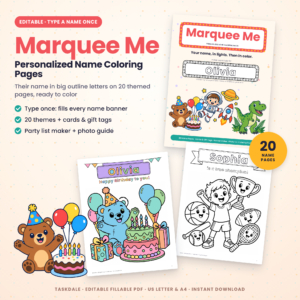
Marquee Me Personalized Name Coloring Pages
Price: $4.99 | Best for: Parents making photo pages for kids
A fillable PDF in US Letter and A4 with 20 themed name coloring pages: type the child’s name once and it fills every banner in hollow outline letters. The offline Name Banner Maker also makes a Your picture page for your own photo line art, and a 7-page bonus guide explains how to turn a family or pet photo into a coloring page with free tools. Start by converting a pet photo and placing it under the name banner.
Building a full activity sheet around the picture
This is where a coloring page becomes an activity sheet. Leave the picture in the top two-thirds of the page and use the bottom third for one or two small tasks. Mix and match from these.
Trace the name
Type the child’s name, or the subject’s name, in a dotted tracing font under the picture. “BISCUIT” under a photo of the dog. Children practice letters while thinking about something they love.
Count and circle
If the photo has repeated items, ask the child to count them. “How many candles are on the cake? Write the number in the box.” Add a box beside the question.
Find and color
Give simple instructions. “Color the ball red. Color Grandad’s hat blue.” This practices listening and color names at the same time.
Draw what happens next
Add an empty box with the prompt “What did Biscuit do after this?” Kids love inventing the next scene.
Simple maze or dot-to-dot
Draw a short wiggly path from the child to the ice-cream van. Or add a few numbered dots that join to make a sun in the corner.
One task is plenty for a 3-year-old. Two suits most 5-year-olds. Older kids can handle three, but leave the picture as the main event.
Worked example: the zoo trip sheet
Say your five-year-old spent Saturday at the zoo and would not stop talking about the giraffe. Here is how Sunday morning’s sheet comes together in about 20 minutes.
- Pick the clearest giraffe photo, side-on against the sky.
- Convert it in Photopea, erase the fence and the crowd, and thicken the outline. Leave the patches as big shapes so there are maybe 25 spaces to color.
- Place the giraffe in the top two-thirds of a page in Word.
- Underneath, type GIRAFFE in a dotted tracing font.
- Add one question: “How many legs does a giraffe have? Write the number.”
- Add a small empty box: “Draw the food the giraffe ate.”
The result is a page that feels like a memory and a lesson at once. Expect it to be stuck on the fridge by lunchtime, and expect a request for the penguin next.
Activity sheet ideas by age
Ages 2 to 4
Picture plus one instruction. “Color the duck yellow.” Big shapes only. A 3-year-old will mostly scribble, and that is fine: the aim is grip practice and naming things. For tiny hands, a handful of ready pages with extra-thick outlines is useful to keep alongside your homemade ones.
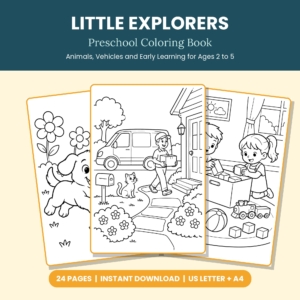
Little Explorers Preschool Coloring Book
Price: $3.49 | Best for: Toddlers and preschoolers aged 2 to 5
24 simple pages with thick outlines and open spaces, sorted into Friendly Animals, Busy Vehicles and Early Learning with counting, shapes, feelings and big-and-small. It is an instant download PDF. Print the vehicle pages for a child who loves diggers, and use them as a model for how bold your own photo pages should look.
Ages 5 to 6
Picture plus tracing and counting. This age loves seeing their name and spotting things. A beach photo with “Trace the word SEA” and “How many shells can you see?” covers literacy and numbers in one go.
Ages 7 to 8
Picture plus writing. Add three lines and ask, “Write about this day.” A child who will not write a word in a workbook will often write five sentences about their own birthday party. That small win feels huge when it happens.
For more ideas on matching coloring pages to each stage, see our guide to preschool coloring pages, which goes into what younger children can and cannot handle.
Mixing photo pages with ready-made pages
Converting photos takes time, and kids burn through pages fast. A good balance is one photo page for every three or four ready-made pages. Keep a folder of both, and slot the photo pages in as treats.
Ready-made pages that come as single image files are especially handy, because you can drop one into your own activity template next to your tasks. A space animal picture with “Count the stars” and a name to trace looks just like your photo sheets.
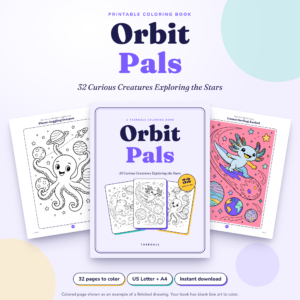
Orbit Pals Printable Coloring Book
Price: $3.99 | Best for: Kids from about seven and up
32 full-page drawings of animals loose in space, such as an axolotl surfing a comet and an octopus juggling planets. You get US Letter and A4 PDFs plus a single-page PNG pack of all 32 pictures, which makes it easy to place one picture on your own activity sheet template. Pick one page, add a counting question and a name to trace, and print.
Make one reusable template
Save a blank Word file with a picture box at the top, a dotted tracing line in the middle and a question box at the bottom. Each new sheet then takes five minutes: drop in the picture, change the word, change the question. After a month you will have a stack of 20 or 30 custom sheets, and you will barely remember making them.
Ways to use custom sheets at home and in class
- After a day out. Turn the best photo from a zoo trip into a sheet that evening. It becomes a souvenir and a recap.
- Before a big change. A photo of the new school gate, the new bedroom or the new baby helps a child talk through what is coming.
- Class books. A teacher with 24 pupils can photograph each child holding a favorite toy and make a page for each. Bind them, and the class has a book every child is in.
- Grandparent post. Send a sheet of the grandchild in the post. Ask Grandma to color one too and post it back.
- Waiting rooms and travel. A clipboard, three photo sheets and a small pencil case cover a 40-minute wait.
If you are building a bigger stash of screen-free activities, the guide to coloring pages for kids lists sets children actually finish.
Printing tips for kids’ sheets
- Print one test first. Lines that look bold on screen can come out thin and gray.
- Use plain copy paper for crayons and slightly heavier paper for markers.
- Laminate a favorite and use dry-erase crayons, so the sheet can be colored again and again.
- Save each sheet as a PDF in one folder named by child, so siblings can get their own copy later.
- Print in black only to save color ink. The child adds all the color.
Common mistakes to avoid
- Too much detail. A preschooler handed a page with 200 tiny spaces will give up in a minute.
- Thin lines. Crayons wander. Thick lines give a clear target and a better result.
- Too many tasks. Five questions on one sheet turns play into homework.
- Photos the child dislikes. If they hate that picture of themselves crying at the farm, skip it.
- Correcting colors. A purple dog is a perfectly good dog.
Frequently asked questions
How do I turn a picture into a coloring page for kids?
Crop the photo, remove color, raise contrast, use an edge filter and threshold, then erase background clutter and thicken the lines. Tracing by hand over a window works too.
What is the best free tool to make coloring pages from photos?
Photopea is a free browser-based editor that handles every step. GIMP and Inkscape are free desktop options.
How thick should lines be on a toddler coloring page?
About the width of a felt-tip marker stroke. If you hesitate over whether a line is thick enough, make it thicker.
What can I add to a coloring page to make it an activity sheet?
A name to trace, a counting question, a simple coloring instruction, a short maze or a box to draw what happens next.
Can I make coloring pages from my child’s drawings?
Yes. Photograph the drawing in daylight, convert it the same way and thicken the lines. Kids are thrilled to color their own art.
Is it safe to use online photo converters with pictures of my kids?
Check where the photo is uploaded and stored. Offline tools such as GIMP, Inkscape or hand tracing keep your child’s photo on your own device.
Your next step
Pick one photo of your child’s favorite animal or toy tonight. Trace or convert it, add the name to trace and one counting question, and print it for tomorrow. To skip the layout work, drop the picture into the Your picture page from Marquee Me Personalized Name Coloring Pages with your child’s name already above it.