Seasonal preschool coloring pages do more than fill the ten minutes before snack. A pumpkin page in October gives a 4-year-old something to count, a word to say and a reason to talk about the leaves outside the window. Pick the right page for the month and coloring becomes a small lesson that kids do not notice they are having.
This guide is for preschool and pre-K teachers, childminders and homeschool parents who want a year of seasonal printables that actually teach. You will get a month-by-month plan, ideas for tying each page to circle time, a way to match letters to the seasons, tips for holiday weeks, and a simple system for printing a class set without a Friday scramble at the copier.
Quick picks: seasonal preschool printables
| Product | Best for | Price | Link |
|---|---|---|---|
| Crayon Campus Preschool Learning Coloring Worksheets | A seasonal page for every month plus science | $4.99 | View |
| Letter Parade Alphabet Coloring Book A to Z | Letter of the week matched to the season | $3.99 | View |
| Twinkle Town Christmas Coloring Book for Kids | December with a classroom pack | $4.49 | View |
| Little Explorers Preschool Coloring Book | Rainy days and the youngest group | $3.49 | View |
Why seasonal pages work so well in preschool
Young children live in the here and now. Ask a 3-year-old what season it is and you may get a blank look. Show them a page with a snowman while there is frost on the playground and the penny drops. The page connects to what they can see and feel that week.
Seasonal pages also give you a built-in rhythm. September means apples and the school bus. October means pumpkins. By the third time the year turns, your returning 4-year-olds start predicting what comes next. “Is it snowman time yet?” That small sense of order is calming for kids who are still figuring out how a school day works.
And they make planning lighter. When you know the January page is a snowman, half of your January theme is already decided. Winter clothes, cold and warm, melting ice in a tray at the science table. One page sets the tone for a week.
A month-by-month plan for the school year
Here is a full year, starting in September. For each month there is a coloring focus, a talking point and a quick follow-up activity.
Fall: September to November
- September, apples and the school bus. Count the apples on the tree. Talk about how everyone got to school today. Follow up with an apple tasting: red, green and yellow.
- October, pumpkins. Color big orange pumpkins and count the seeds in a real one. Ask, “Is a pumpkin heavy or light?” and let kids try to lift a small one.
- November, turkeys and falling leaves. Color a turkey, then collect leaves outside and sort them by color on a tray.
Winter: December to February
- December, gingerbread houses and holiday shapes. Count the candies on the roof. Talk about families and the different ways they celebrate.
- January, snowmen. Color a snowman and stack three circles from big to small. Freeze water in a cup and check it after lunch.
- February, hearts. Color hearts and talk about kindness. Make a class chain of hearts, one for each kind act.
Spring: March to May
- March, kites and wind. Color a kite, then wave scarves outside to feel the wind.
- April, rain boots and puddles. Color boots and an umbrella. Set a cup outside to catch rain and measure it with a sticker line.
- May, flowers. Color flowers and plant a bean in a clear cup so kids can watch roots grow.
Summer: June to August
- June, the beach. Color a beach scene and count shells. Play with sand and water at the sensory table.
- July, picnics. Color a picnic and plan a pretend picnic in the dramatic play corner.
- August, getting ready. Color the school bus again and talk about what the kids remember from the start of the year. Watch their faces when they realize how much they have grown.
A set that already has one page per month keeps this plan running without a hunt for new pictures every four weeks.
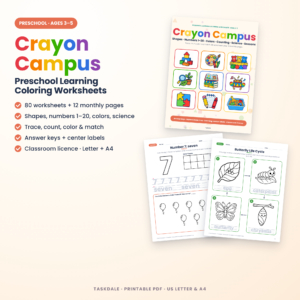
Crayon Campus Preschool Learning Coloring Worksheets
Price: $4.99 | Best for: preschool and pre-K teachers
Crayon Campus includes 12 seasonal pages, January to December (snowman, hearts, kite, rain boots, flowers, beach, picnic, school bus, apples, pumpkins, turkey and gingerbread house), and each one asks children to circle the season, count something and add a drawing. Alongside them are 80 skill worksheets for shapes, numbers 1 to 20, colors, matching and simple science, plus answer keys, a skills checklist and learning-center labels. It prints in US Letter or A4 with a classroom licence for one teacher. Print this month’s seasonal page first and use it at your next circle time.
Tying the page to circle time
A coloring page is best when it follows a conversation, not when it replaces one. Try this five-minute circle routine before handing out the month’s page.
- Look outside. “What do you see out the window today?” Write two or three answers on the board.
- Show the page. Hold up a blank copy. “What is on this page? Have you seen one?”
- Ask one counting question. “How many apples can you find?” Count together, pointing.
- Ask one season question. “Is this a hot day or a cold day? How do you know?”
- Send them off. Pages go to the tables with crayons already out.
Weather pages fit beautifully here. A “dress for the weather” sheet in January leads straight into a talk about coats and mittens, then a quick dress-up race with a basket of hats and scarves. Ten minutes, three skills, lots of giggling.
When a page sparks a good question, write it down. “Why do leaves change color?” from a 4-year-old in October is the start of next week’s science table.
Letters that match the season
Letter of the week sits nicely beside the seasons if you choose the order with care. Instead of strict A-to-Z, pick letters whose pictures match the month.
- September: A for apple, B for bus
- November: L for leaf, N for nest
- January: S for snow, I for igloo, M for mitten
- March: K for kite, W for wind
- April: U for umbrella, R for rain
- June: S for sun, F for fish, T for turtle
Kids remember a letter better when it shows up twice in a week: once on the letter page and once in the world. K for kite on Monday, then real kites outside on Thursday. That repeat does the work for you.
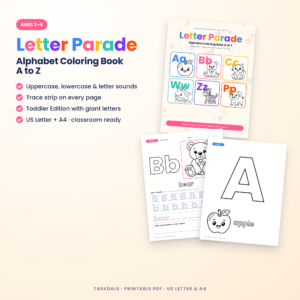
Letter Parade Alphabet Coloring Book A to Z
Price: $3.99 | Best for: letter of the week in preschool
Letter Parade has one page per letter with a big uppercase and lowercase letter, a picture (apple, igloo, kite, moon, sun, umbrella and more), the word, and trace rows with a start dot, plus a name line on every page. It also includes an alphabet chart, match pages, letter hunt pages and a Toddler Edition for the youngest children, in US Letter and A4 PDFs. The licence covers personal use and one teacher’s own classroom. Match this month’s letters to the list above and print a class set of the first one.
If you track letters across the year in a planner, our post on choosing a Classroom Compass teacher planner shows how to lay out themes and skills by month.
Holiday weeks without the chaos
Holiday weeks are loud. The children are excited, the timetable is full of extras, and the last thing you need is a craft with glitter. Coloring pages are the calm option. Hand out a page after a busy party hour and the room settles in about two minutes.
Keep two things in mind for December in particular. Many classrooms include families who celebrate different holidays, or none. So keep a stack of winter-only pages (snowmen, mittens, hot cocoa) alongside the holiday ones and let children choose. And if a book includes faith content, such as Nativity pages, decide ahead of time whether it fits your setting. In a church preschool it might be the heart of the week. In a public program, you may leave it out.
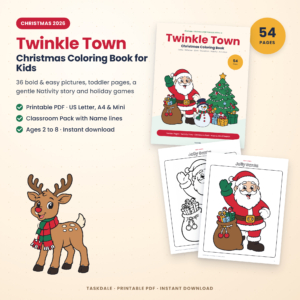
Twinkle Town Christmas Coloring Book for Kids
Price: $4.49 | Best for: December in preschool and pre-K
Twinkle Town has 36 original Christmas coloring pictures, including an 8-page Tiny Hands section with one big shape per page for toddlers, 22 bold and easy pages, an optional 6-page Nativity section and activity pages like a maze and word tracing. It includes a 12-sheet Classroom Pack with name and date lines, licensed for one teacher to print for their own class or one Sunday school group, plus a Mini Edition for favor booklets. Print the Classroom Pack’s snowman and mitten pages for children who prefer winter scenes.
For more ideas on running a calm December in class, see our guide to Christmas coloring pages for classroom holiday activities.
Printing a class set without the Friday rush
Twenty children, twelve months, plus extras. That is a lot of paper if you print week by week. A little batching saves hours.
- Print a month at once. On the last Thursday of each month, print next month’s seasonal page, the letter pages and two spare skill sheets. With 18 children, that is roughly 80 to 100 sheets in one go.
- Use a folder per month. Twelve labeled folders in a crate. Next year, you open October and it is ready.
- Print one extra of everything. Someone always drops a page in the water table.
- Black and white is fine. Line art prints cleanly without color ink.
- Print at actual size. Shrinking to fit makes the counting objects smaller and harder for little fingers to point at.
One licence note. A set licensed for one teacher covers that teacher’s own class. If the room next door wants the same pages, they need their own copy. It keeps things fair for the people who make the files.
For younger groups, or mixed-age rooms with 2-year-olds, simpler pages with fewer details work better. Little Explorers has a Rainy Day page and chunky animals and vehicles that suit those days when the big kids are on a field trip and you have the little ones. Our guide to preschool coloring pages in PDF covers line thickness and detail by age.
Displaying seasonal work through the year
Finished pages are worth showing. A seasonal display board changes four times a year and gives parents something to look at during pick-up.
A simple layout: a big tree cut from brown paper, with the season’s pages arranged around it. Apples in fall, snowmen in winter, flowers in spring, beach scenes in summer. Kids point out their own page every single day. That little hit of pride is worth the staples.
Then send the pages home in a portfolio at the end of each term. A parent who flips from a scribbly September apple to a careful May flower can see their child’s growth right there in crayon. Many teachers find these portfolios spark better conversations at parent meetings than any checklist.
Common mistakes with seasonal pages
- Running ahead of the weather. Snowmen in early November when it is still warm out confuse the point. Follow what kids can see.
- Too much detail. A busy autumn scene with 30 leaves overwhelms a 3-year-old. One big pumpkin is better.
- No talk before coloring. Without the circle chat, the page is just coloring. With it, the page is a lesson.
- Only holidays. Seasons are more than holidays. Weather, plants and animals give you far more weeks of material.
- Same page every year with no change. Keep the theme, but swap the follow-up activity so it feels fresh for returning children.
Frequently asked questions
What are good seasonal coloring pages for preschool?
Choose one big picture tied to the month, like apples in September, pumpkins in October, snowmen in January and flowers in May. Bold outlines and something to count make the page more useful.
How often should preschoolers do coloring worksheets?
A short page most days works well, often as morning work or a center activity. Ten to fifteen minutes is plenty for ages 3 to 5.
Can I use one coloring set for my whole preschool?
Only if the licence allows it. Many sets are licensed for one teacher’s own class, so each teacher needs their own copy.
How do I make seasonal coloring pages educational?
Talk before coloring, ask one counting question and one season question, then add a short follow-up activity like a leaf sort or a melting ice test.
What should I use for December if families celebrate different holidays?
Keep winter pages, like snowmen, mittens and cocoa, beside any holiday pages and let children pick. It keeps everyone included.
Your next step
Look at the date, find this month in the plan above, and write the coloring focus, the talking point and the follow-up on a sticky note for your planning book. Then print next month’s page before the rush starts. For a full year of seasonal pages plus 80 skill worksheets in one download, start with Crayon Campus.