Cartoon turkeys are sweet, but they stop being fun around the age of nine. Older kids and grown-ups want a bird that looks like a bird. Shimmering bronze feathers. A barred wing. That strange, bright head that seems to change color while you watch.
Realistic turkey coloring pages give you all of that, and they are a lovely way to spend a quiet hour in November. They reward a sharp pencil and a bit of patience, and the finished page looks good enough to frame or tuck into a Thanksgiving card.
This guide is for older kids, teens and adults who want to color a turkey properly. You will learn what a wild turkey actually looks like, which pencils to use for each part, how to make feathers shine, and where to find printable realistic turkeys worth your time.
Quick picks: realistic turkey and bird pages
| Product | Best for | Price | Link |
|---|---|---|---|
| Thankful Feathers Turkey Coloring Pages with Gratitude Prompts | Realistic wild turkeys and harvest scenes | $3.49 | View |
| Backyard Birds Coloring Book | Warm-up bird pages and younger siblings | $3.49 | View |
| Gather & Gravy Thanksgiving Planner Spreadsheet | Hosts who want a calm hour to color | $9.99 | View |
What makes a turkey page realistic
A realistic page is drawn from how the bird really looks, not from a cartoon shortcut. You can spot one in a few seconds.
- Feathers drawn in rows. Real turkey bodies are covered in overlapping, rounded feathers, like roof tiles. A realistic page shows these as small scalloped shapes.
- A believable pose. Walking through grass, strutting with the tail fanned, or a close head portrait. No hats, no smiles.
- Natural setting. Autumn woods, a field, a fence line. Backgrounds give you room to practice leaves and grass too.
- Fine lines. Thinner outlines that disappear under layered color, so the finished page looks painted rather than outlined.
These pages are not for little ones with chunky crayons. They suit kids from about eight or nine with steady hands, teens, and adults who like detail. If you have younger children at the table too, our guide to free turkey coloring pages for kids covers easy cartoon turkeys and where to find them.
Know your turkey before you color it
Five minutes looking at photos of wild turkeys will change how you color. Here is what to notice.
Tom or hen?
Males, called toms or gobblers, are the showy ones. They have the big fanned tail, the brightest head and a dark, hair-like tuft hanging from the chest called a beard. Hens are smaller and more muted, with brown feathers and a mostly gray-blue head. If your page shows a strutting bird with a fanned tail, color it as a tom.
The body feathers
From a distance a wild turkey looks dark brown. Up close, each body feather has a shine of bronze, copper, gold and even green, with a dark tip. In sunlight, the whole bird glitters. This is the part that makes a realistic page so satisfying.
The wings
The long flight feathers on the wing are barred with black and white stripes, like a zebra pattern running across each feather.
The tail fan
Each tail feather is brown with fine black bars and a dark band near the end, finished with a pale tip. On many eastern wild turkeys the tips are a rich chestnut brown. On some western birds they are pale tan or almost white.
The head
Bare skin, no feathers. It can be red, white or bright blue, and often all three at once. The fleshy flap that hangs over the beak is the snood. The bright red lumps on the neck are caruncles, and the flap under the chin is the wattle.
A realistic turkey palette
You do not need a huge set. Around twelve pencils will color a convincing turkey.
| Part | Pencils to use | Tip |
|---|---|---|
| Body feathers | Dark brown, burnt sienna, copper or orange, gold, dark green | Base of dark brown, then streaks of copper and gold, a touch of green |
| Feather tips | Black | A thin dark edge on each scallop makes the rows stand out |
| Wing bars | Black, warm gray | Leave the white stripes as bare paper |
| Tail fan | Medium brown, black, chestnut or tan | Band of black near the end, pale tip on the edge |
| Head and neck | Scarlet, crimson, sky blue, light gray | Blend red into blue softly, no hard line |
| Legs and beak | Pinkish gray, tan | Light pressure, a little gray shadow on one side |
| Beard | Black, dark brown | Fine flicking strokes downward |
A white gel pen is the secret extra. A few tiny white marks on the body feathers and the eye bring the shine to life at the very end.
Step by step: coloring a strutting tom
Here is how a realistic turkey page comes together in about an hour. Use colored pencils on paper with a little tooth, such as 24 to 32 lb printer paper, and keep your pencils sharp.
- Start with the head. Color the snood and wattle in scarlet with firm pressure. Fill the face with sky blue, then let the two colors meet with soft, light strokes. It is the brightest part, and doing it first sets the mood.
- Base the body. Lay down a light, even layer of dark brown over all the body feathers. Do not press hard yet.
- Add the shine. Inside each feather scallop, add a short streak of copper or gold on the upper half. Add a whisper of dark green on a few feathers near the neck.
- Edge the feathers. With a sharp black pencil, trace a thin dark line along the bottom edge of each scallop. The body suddenly looks three-dimensional.
- Color the tail fan. Medium brown first, then fine black bars across each feather, then the dark band and a pale tip. Work from the center outward.
- Do the wings. Black bars with white paper showing between. Add warm gray in the shadows where the wing meets the body.
- Finish the background. Keep it softer than the bird. Muted greens and tans for grass, a pale wash of orange for autumn leaves.
- Highlight. A few white gel pen dots on the body feathers, one in the eye, and you are done.
Step back and look at it from across the room. That moment, when a flat outline turns into a living bird, is the best part.
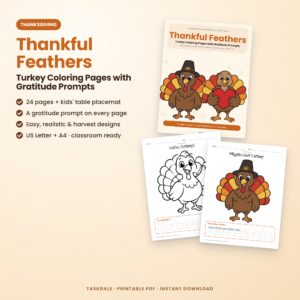
Thankful Feathers Turkey Coloring Pages
Price: $3.49 | Best for: older kids, teens and adults
Thankful Feathers includes 6 realistic wild turkey pages, such as a turkey strutting, one walking through tall grass, a detailed head portrait and a feathered fan, plus 6 detailed harvest scenes. Each has a reflective gratitude prompt and journal lines, and the set also has 12 easy cartoon turkeys for younger children. It prints on US Letter or A4, so start with the head portrait to practice blending red into blue.
Techniques that make feathers shine
Layer light to dark
Every great pencil page is built in layers. Start light and add pressure slowly. Three gentle layers look richer than one heavy one, and you keep room to adjust.
Leave the white paper
White highlights are easier to keep than to add. Before you color a feather, decide where the light hits and leave a tiny patch of paper bare. A white gel pen can rescue it later, but bare paper looks more natural.
Follow the feather
Move your pencil in the direction the feather grows, not back and forth across it. Short curved strokes that follow each scallop make the texture look real.
Use complementary shadows
For a deep shadow under the wing or the tail, try a dark blue or dark purple under the brown instead of black. It looks deeper and less flat. Painters have used this trick for centuries, and it works just as well with pencils.
Burnish at the end
Once the color is built up, go over the shiny body feathers with a light cream or white pencil using firm pressure. It blends the layers into a smooth, glossy finish. Only do this at the very end, because the paper will not take much more color after.
Older kids: turn it into a nature lesson
A realistic turkey page is a sneaky science lesson. Kids who might groan at a worksheet will happily look up why a turkey’s head changes color, or how many feathers a turkey has, while they color.
Some questions to explore together:
- What is the difference between a wild turkey and a farm turkey? (Most farm turkeys are bred white, which is why they look so different.)
- Why are the wing feathers barred while the body feathers shine?
- What other birds have bare heads, and why might that help them?
Kids who enjoy that kind of question often like coloring other birds they can see in their own yard, then matching the page to the real thing outside. Our post on bird coloring pages has backyard birds, herons and eagles to keep going.
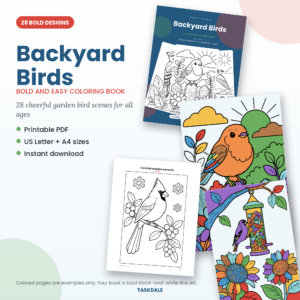
Backyard Birds Coloring Book
Price: $3.49 | Best for: bird lovers and younger siblings
Backyard Birds has 28 friendly garden birds, such as a cardinal on a berry branch, a blue jay on an oak and a barn owl in moonlight, drawn with thick outlines and large shapes. It comes as US Letter and A4 PDFs. It is bold and easy rather than detailed, so use it as a quick warm-up on bird colors, or hand it to a younger sibling while you work on a realistic turkey.
A quiet adult hour in Thanksgiving week
For a lot of adults, Thanksgiving week is the opposite of relaxing. Lists, shopping, cleaning, cooking. Coloring a realistic turkey on Tuesday night is a small way to take a breath and enjoy the season before the busy day arrives.
Pair it with a gratitude prompt. Color for forty minutes, then write three lines about something good from this year. It is a calmer kind of preparation, and the page can go on the table on Thursday as a place card or a centerpiece card.
If the thing stopping you from sitting down is the cooking schedule in your head, put it on paper first. Knowing exactly when the turkey needs to come out of the fridge and when the oven is free makes it much easier to switch off for an hour.

Gather & Gravy Thanksgiving Planner Spreadsheet
Price: $9.99 | Best for: hosts who want the timing worked out
Gather & Gravy is an Excel workbook that turns your guest list and dishes into a full plan. It sizes the turkey, sets the thaw date, counts back from dinner time to give every dish a start time and flags oven clashes. Fill it in on Monday, and you will know exactly which evening you have free to color.
Mistakes that flatten a realistic turkey
- Coloring the whole body one brown. It looks like a paper bag. Add copper, gold and a little green.
- Pressing hard from the start. You fill the paper tooth and lose the chance to layer.
- Black outlines everywhere. Keep black for feather edges and wing bars. Soft edges elsewhere look more natural.
- A loud background. Bright, busy grass competes with the bird. Keep the setting muted.
- Skipping reference. Even five minutes looking at photos helps you place the colors with confidence.
If you love this kind of slow, detailed page, you may also enjoy our roundup of intricate adult coloring pages for the rest of the year.
Frequently asked questions
What colors should I use for a realistic turkey?
Use dark brown, copper, gold and a touch of green for the body, black and white bars on the wings, brown with black bands and pale tips on the tail, and scarlet with sky blue on the head.
What age are realistic turkey coloring pages for?
They suit kids from about eight or nine with steady hands, teens and adults. Younger children usually enjoy bold cartoon turkeys with thick outlines more.
Are colored pencils or markers better for a realistic turkey?
Colored pencils. They let you layer and blend the shimmering feathers and leave white highlights. Markers give flat color, which works for cartoon turkeys but looks less lifelike.
How do I make turkey feathers look shiny?
Base the feathers in dark brown, add short streaks of copper and gold on the upper half of each one, edge them in black, leave tiny bits of white paper, and finish with a few white gel pen dots.
What is the difference between a male and female turkey on a coloring page?
Males have a fanned tail, a bright red and blue head and a beard on the chest. Females are smaller, browner and less colorful, with a mostly gray-blue head.
Your next step
Pick one evening this week, sharpen twelve pencils from the palette above, and color a single realistic turkey from head to tail. Start with the head and save the white gel pen for last. For a set with strutting toms, a head portrait and gratitude prompts, print Thankful Feathers Turkey Coloring Pages.