Best Teen Therapy Worksheets
The best teen therapy worksheets are the ones that match what your teen is actually working on and are short enough to finish. For low self-esteem, look at Rooted & Worthy. For self-sabotage, look at Unhooked. For perfectionism, choose The Good Enough Workbook. For a wide practitioner toolkit, Steady Ground is the one.
Choosing can feel harder than it should. Every listing promises confidence, calm or clarity, and it isn't obvious which will suit a sixteen-year-old who rolls their eyes at anything that looks like homework. We'll go through what separates these workbooks so you can choose with confidence. Browse all 8 options below once you know which focus you need.
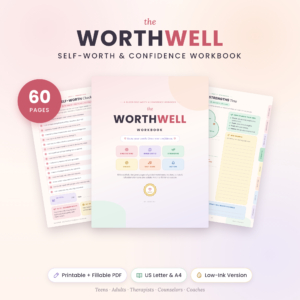 Self-Worth Workbook Printable & Fillable PDF | WorthWell Self-Esteem & Confidence Worksheets with Check-In, Thought Record, Boundaries & 30-Day Tracker | US Letter & A4
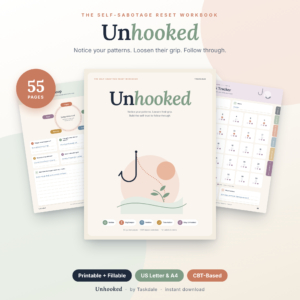 Unhooked: Self-Sabotage Workbook, Printable and Fillable CBT Worksheets PDF for Adults and Teens
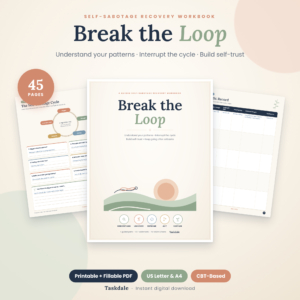 Break the Loop: Self-Sabotage Workbook, Printable and Fillable CBT Worksheets PDF for Adults and Teens
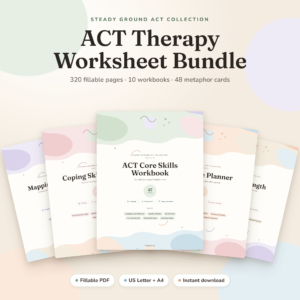 Steady Ground ACT Therapy Worksheets Bundle | 320 Fillable Acceptance and Commitment Therapy Pages, 10 Workbooks + 48 ACT Metaphor Cards | Values, Defusion, Mindfulness & Coping Skills | US Letter & A4 PDF
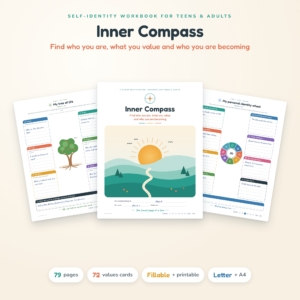 Inner Compass Self-Identity Workbook | 79-Page Printable & Fillable Who Am I Self-Discovery Journal with 72 Core Values Cards for Teens & Adults | US Letter & A4 PDF
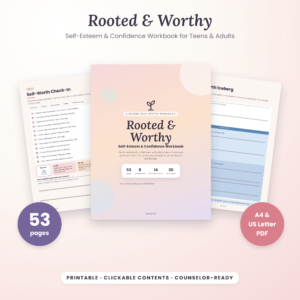
Table of Contents
Toggle
- What should you look for in teen therapy worksheets?
- How do the best teen therapy worksheets on this page compare?
- Which teen therapy workbook suits which teenager?
- How do you use teen therapy worksheets well?
- What mistakes should you avoid with teen therapy worksheets?
- What affects the price of teen therapy worksheets?
- How to choose the best teen therapy worksheets with confidence
- Common questions
Key facts at a glance
- Every workbook on this page is a digital PDF that you print or type into, and each is supplied in US Letter and A4.
- The shortest workbook, Kinder Within, runs to 41 pages, while Steady Ground is a bundle of 320 pages across 10 workbooks.
- Four of the workbooks include a scored check-in or before-and-after score, so progress can be seen rather than guessed.
- Several include a session plan for therapists, counsellors or teachers, which makes them usable in a classroom or clinic as well as at home.
- Worksheets support therapy and self-reflection. They don't replace a qualified professional when a teenager is struggling.
What should you look for in teen therapy worksheets?
Look for a clear focus, a way to measure progress, a format your teen will actually use, a manageable length and, if an adult is helping, a guide for that adult. Those five factors separate a workbook that gets finished from one that sits in a downloads folder.
A clear, single focus
A teen therapy workbook works best when it tackles one problem well. Perfectionism, self-sabotage, self-forgiveness and self-esteem each call for different exercises, even though they overlap.
The Good Enough Workbook, for example, builds around real-life experiments that test impossible standards. Kinder Within deals with guilt and shame through a Responsibility Pie and an amends planner. If your teen's difficulty is easy to name, a focused workbook usually beats a general one.
Scored check-ins and trackers
A scored check-in is a short questionnaire your teen completes at the start and again later, so any change shows up as a number. Rooted & Worthy, Self-Worth Workbook, Unhooked and The Good Enough Workbook all include one or a before-and-after score.
This matters for teenagers because they tend to dismiss vague advice. Seeing a score move gives them evidence rather than reassurance. Most of the workbooks also add a 30-day tracker, which turns the work into a daily habit.
Printable, fillable, or both
Every workbook here is a PDF in US Letter and A4, and most can be typed into on a computer or tablet as well as printed. That suits different teenagers. Some think better with a pen, and some would never write by hand.
Inner Compass goes furthest here, with more than 3,000 fillable fields and clickable navigation between pages. If your teen lives on a tablet, that kind of file will feel natural.
Length and pacing
Short workbooks get finished. Break the Loop has 45 pages in five parts, and Kinder Within has 41. Longer ones such as Inner Compass at 79 pages or Self-Worth Workbook at 60 pages suit a teenager who enjoys reflective writing or who works with a counsellor over several weeks.
A teen who stalls halfway through a long book may feel they've failed again, which is the opposite of the aim.
Guidance for the adult in the room
A user guide explains the order to work in and how to introduce the pages. Some workbooks go a step further with a structured plan for professionals. Rooted & Worthy has an eight-session plan, Self-Worth Workbook and The Good Enough Workbook each have a six-session plan, and Steady Ground comes with a practitioner toolkit.
If you're a parent working without a therapist, a clear user guide matters more than any extra pages.
How do the best teen therapy worksheets on this page compare?
The table below compares the workbooks on what differs between them: size, main focus and the kind of support included.
| Product | Size and contents | Main focus | Adult or practitioner support |
|---|---|---|---|
| Self-Worth Workbook Printable & Fillable PDF | WorthWell Self-Esteem & Confidence Worksheets with Check-In, Thought Record, Boundaries & 30-Day Tracker | US Letter & A4 | 60 pages, 30 prompts, 27 affirmation cards | Self-worth, strengths, boundaries | Six-session facilitator plan |
| Unhooked: Self-Sabotage Workbook, Printable and Fillable CBT Worksheets PDF for Adults and Teens | 55 pages, 12 pocket coping cards | Self-sabotage and follow-through | User guide, solo or with clients |
| Break the Loop: Self-Sabotage Workbook, Printable and Fillable CBT Worksheets PDF for Adults and Teens | 45 pages in five parts | Self-sabotage, shorter format | Step-by-step user guide |
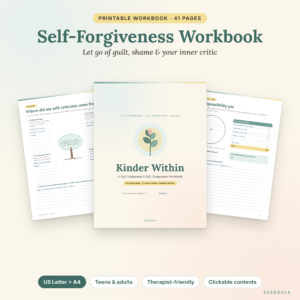 Kinder Within Self-Forgiveness Workbook | 41 pages, affirmation cards | Guilt, shame, self-criticism | User guide |
| Steady Ground ACT Therapy Worksheets Bundle | 320 Fillable Acceptance and Commitment Therapy Pages, 10 Workbooks + 48 ACT Metaphor Cards | Values, Defusion, Mindfulness & Coping Skills | US Letter & A4 PDF | 320 pages, 10 workbooks, 48 metaphor cards | Values, defusion, mindfulness, coping | Practitioner toolkit, DOCX user guide |
| Inner Compass Self-Identity Workbook | 79-Page Printable & Fillable Who Am I Self-Discovery Journal with 72 Core Values Cards for Teens & Adults | US Letter & A4 PDF | 79 pages, 70 illustrated values cards plus 2 blank | Identity and values | 10-page user guide |
| Rooted & Worthy Self-Esteem Workbook | 53-Page Printable Self-Worth & Confidence Worksheets for Teens & Adults | Counsellor Handouts | A4 & US Letter PDF | 53 pages in eight parts, 16 affirmation cards | Self-esteem with before-and-after comparison | Eight-session plan, Word user guide |
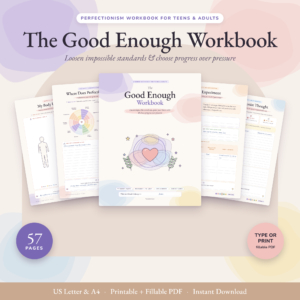 The Good Enough Workbook: Perfectionism Workbook for Teens & Adults, 57-Page Printable & Fillable CBT Worksheets PDF | 57 pages, 16 coping cards | Perfectionism | Six-session therapist plan, user guide |
Which teen therapy workbook suits which teenager?
The right workbook depends on the pattern you're seeing in your teen, so match the focus first and the format second.
- A teen who puts themselves down constantly: Rooted & Worthy Self-Esteem Workbook is the clearest fit. It starts with a scored check-in and ends with a before-and-after comparison. Self-Worth Workbook covers similar ground and adds boundaries work.
- A teen who avoids starting or abandons things: Unhooked is the fuller choice, with a Reframe Bank, If-Then plans and a 7-Day Challenge. Break the Loop covers the same problem in fewer pages, which suits a teen who is easily put off.
- A teen who can't finish unless it's flawless: The Good Enough Workbook is built for this, with experiments that deliberately test "good enough" in real life.
- A teen weighed down by guilt after a mistake: Kinder Within is the gentlest of the group and the shortest, so it feels less like a mountain.
- A teen working out who they are: Inner Compass uses values cards, which gives a restless teenager something to sort with their hands.
- A therapist, counsellor or teacher building a toolkit: Steady Ground gives you ACT material across values, defusion, acceptance and mindfulness in one purchase.
How do you use teen therapy worksheets well?
Use teen therapy worksheets in short, regular sessions of 10 to 20 minutes, starting with the check-in and working through the pages in the order the user guide sets out.
- Read the user guide yourself first so you can explain the first exercise in a sentence.
- Complete the scored check-in together or let your teen do it privately. Their score is theirs to share or keep.
- Work through one worksheet at a time, ideally at the same point in the day.
- Use the 30-day tracker or coping cards between sessions, so the skills appear in daily life and not only at the desk.
- Retake the check-in at the end, and talk about what changed.
Keep printed pages in a folder your teen controls. Privacy makes honesty far more likely.
What mistakes should you avoid with teen therapy worksheets?
The most common mistakes are choosing for yourself rather than your teen, pushing the pace and treating a workbook as a substitute for professional help.
- Handing over the whole book at once. A 79-page or 320-page file can feel like a verdict. Offer one section.
- Reading their answers. If the workbook becomes something you inspect, you'll get guarded answers.
- Picking the biggest bundle by default. Steady Ground is excellent for practitioners, but a single teenager at home may do better with one focused workbook.
- Skipping the check-in. Without a starting score, the end result has nothing to be compared with.
- Ignoring warning signs. If your teen talks about self-harm or seems persistently low, speak to your GP or another qualified professional. A worksheet isn't the right tool for that moment.
What affects the price of teen therapy worksheets?
Price mostly follows how much material you get and who it's written for. A bundle of ten workbooks with metaphor cards and a practitioner toolkit costs more than a single 41-page workbook.
Extras also add up. Card sets, fillable fields, a facilitator plan and a user guide all take work to produce. A workbook aimed at professionals often costs more than a focused title for one teenager. Because these are digital files, you can print as often as you need without paying again, though the store shows the live price on each product card.
How to choose the best teen therapy worksheets with confidence
Name the main difficulty in one sentence, then pick the workbook whose focus matches it. If you can't decide between two, choose the shorter one, because a finished workbook helps more than an ambitious one left half-done.
If you're a professional, or you want a long-term resource for several teenagers, consider Steady Ground. If you're a parent starting out, begin with a single focused title and see how your teen responds.
Common questions
Are printable worksheets enough for a teenager in therapy?
Worksheets work best alongside therapy, not instead of it. A therapist can pick the right pages and respond to what your teen writes. For mild everyday struggles, a focused workbook used at home can be a sensible first step.
Can my teen use these worksheets on a tablet?
Yes, for the fillable files. Most listings say you can type into the PDF on a computer or tablet and save it. Inner Compass is built for this, with more than 3,000 fillable fields. You can also print any of them.
Do these workbooks come in UK paper sizes?
Yes. Every workbook on this page is supplied in both US Letter and A4, so you can print on standard UK paper without resizing or trimming the pages.
What is a thought record?
A thought record is a worksheet that helps a teen write down a upsetting thought, look at the evidence for and against it, and write a fairer version. It's a core CBT tool, and several workbooks here, including Unhooked and Kinder Within, include one.
How long does it take to finish one of these workbooks?
It depends on the pace. Sessions of 10 to 20 minutes a few times a week suit most teens. Several workbooks include a 30-day tracker, and those with six or eight-session plans are designed to be worked through over that many meetings.