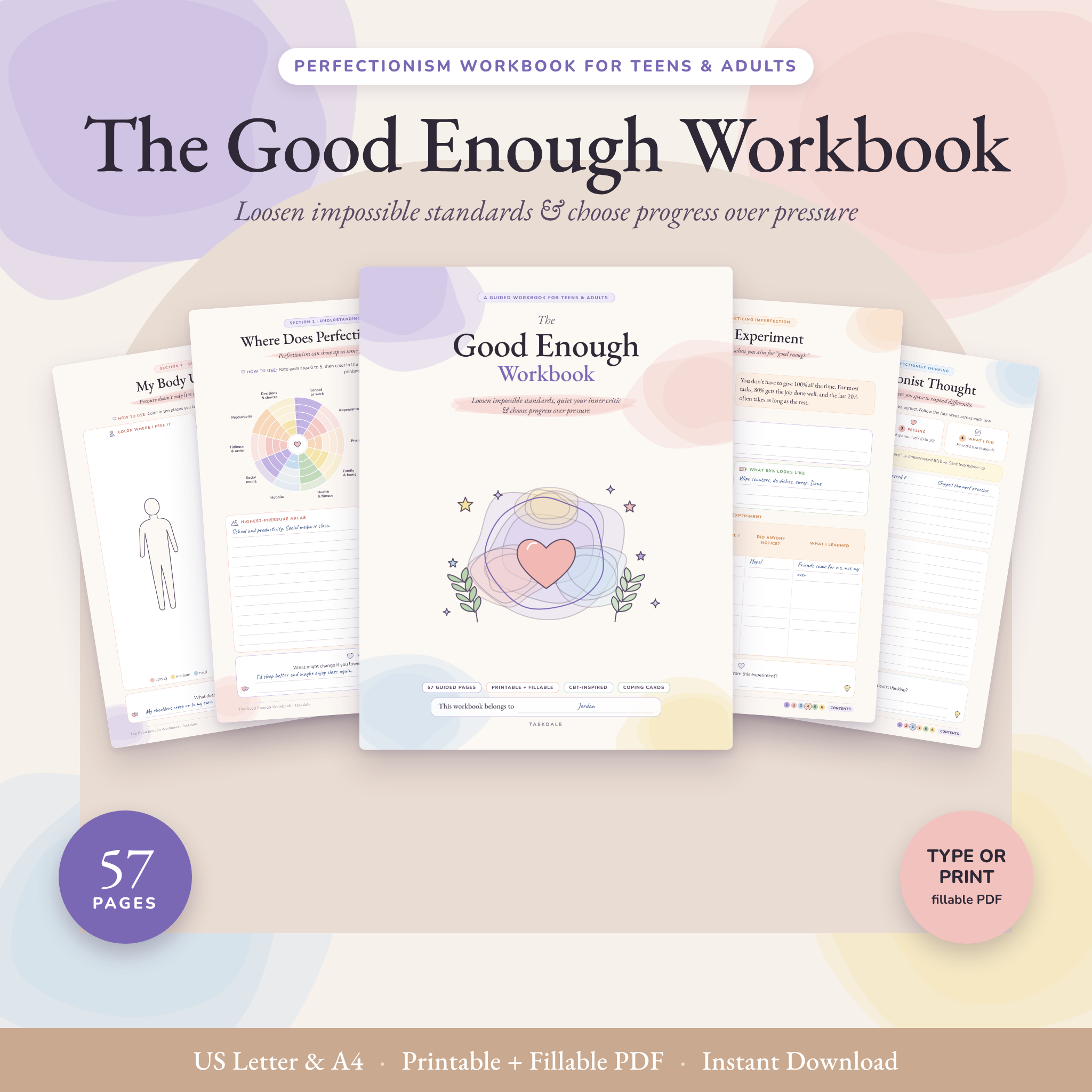
The Good Enough Workbook is a 57-page perfectionism workbook for teens and adults who are tired of redoing, overchecking and putting things off until the “perfect” moment. You can print it, or type straight into it on a computer or tablet. Each page tackles one idea. Some teach, some ask good questions, and some send you out to try a small experiment in real life.
You won’t be told to stop caring. Caring is fine. The goal is to notice when high standards turn into pressure, then practice a lighter way of working, resting and talking to yourself.
What this perfectionism workbook helps you do
- See where perfectionism shows up in your life, and what switches it on
- Catch harsh, all-or-nothing thoughts and weigh them against the evidence
- Test your fears with small, safe experiments (the results usually surprise people)
- Cut back on checking, procrastination and people-pleasing
- Build a kinder inner voice and rest without feeling you have to earn it
- Track your progress and measure the change with a before-and-after score
Who it’s for
It’s written for ages 13 and up. Examples cover school, work, sport, home and social media, so it suits teens, college students and adults alike.
- Individuals working on perfectionism, self-criticism, burnout or fear of failure
- Therapists, counselors and psychologists who want ready-made handouts or a structured program
- School counselors and teachers running wellbeing or study-stress sessions
- Coaches and group leaders covering confidence, procrastination or people-pleasing
What’s included
- The Good Enough Workbook, US Letter PDF (57 pages, printable and fillable)
- The Good Enough Workbook, A4 PDF (57 pages, printable and fillable)
- User guide (Word document) with printing tips, a page-by-page guide, troubleshooting and FAQs
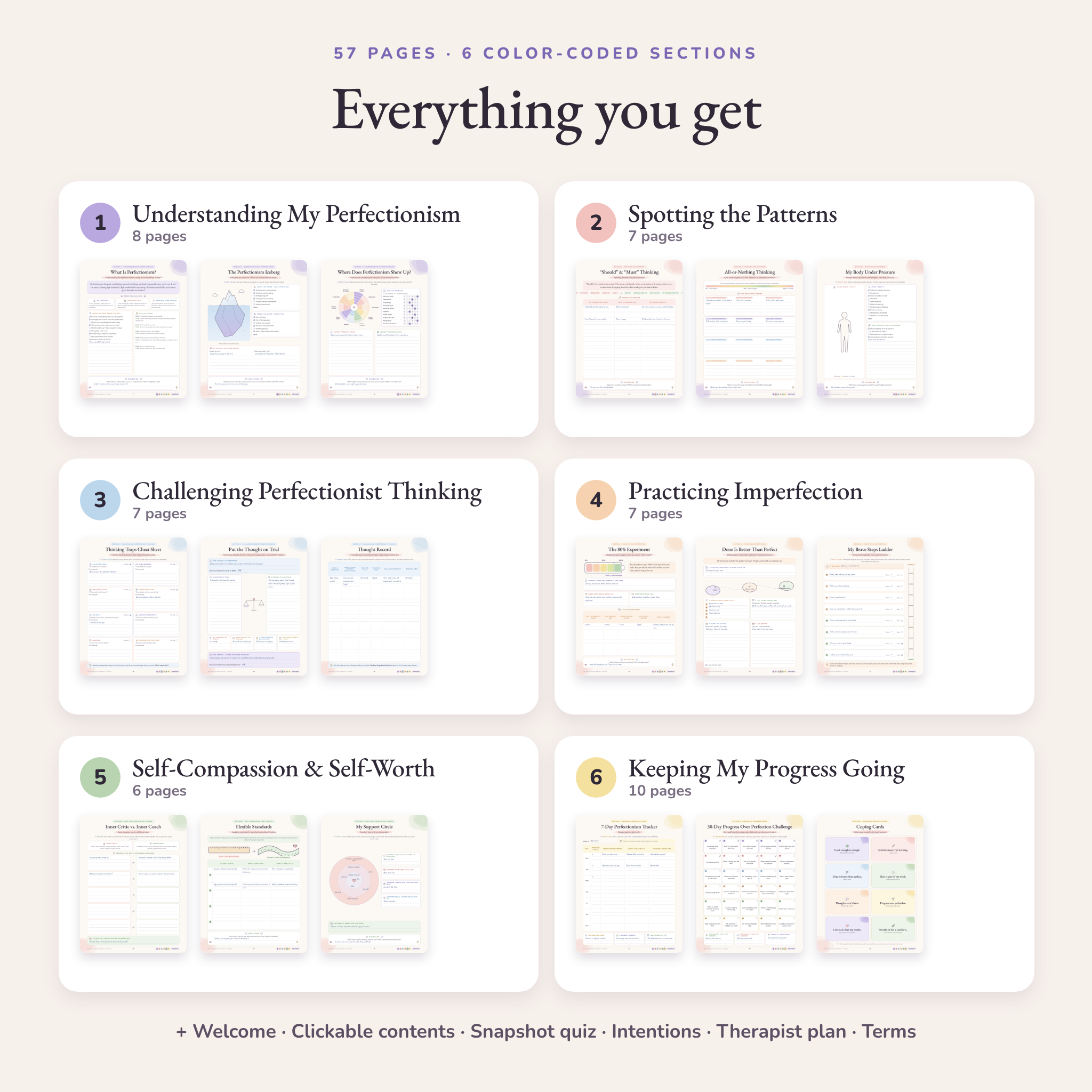
Inside the 57 pages
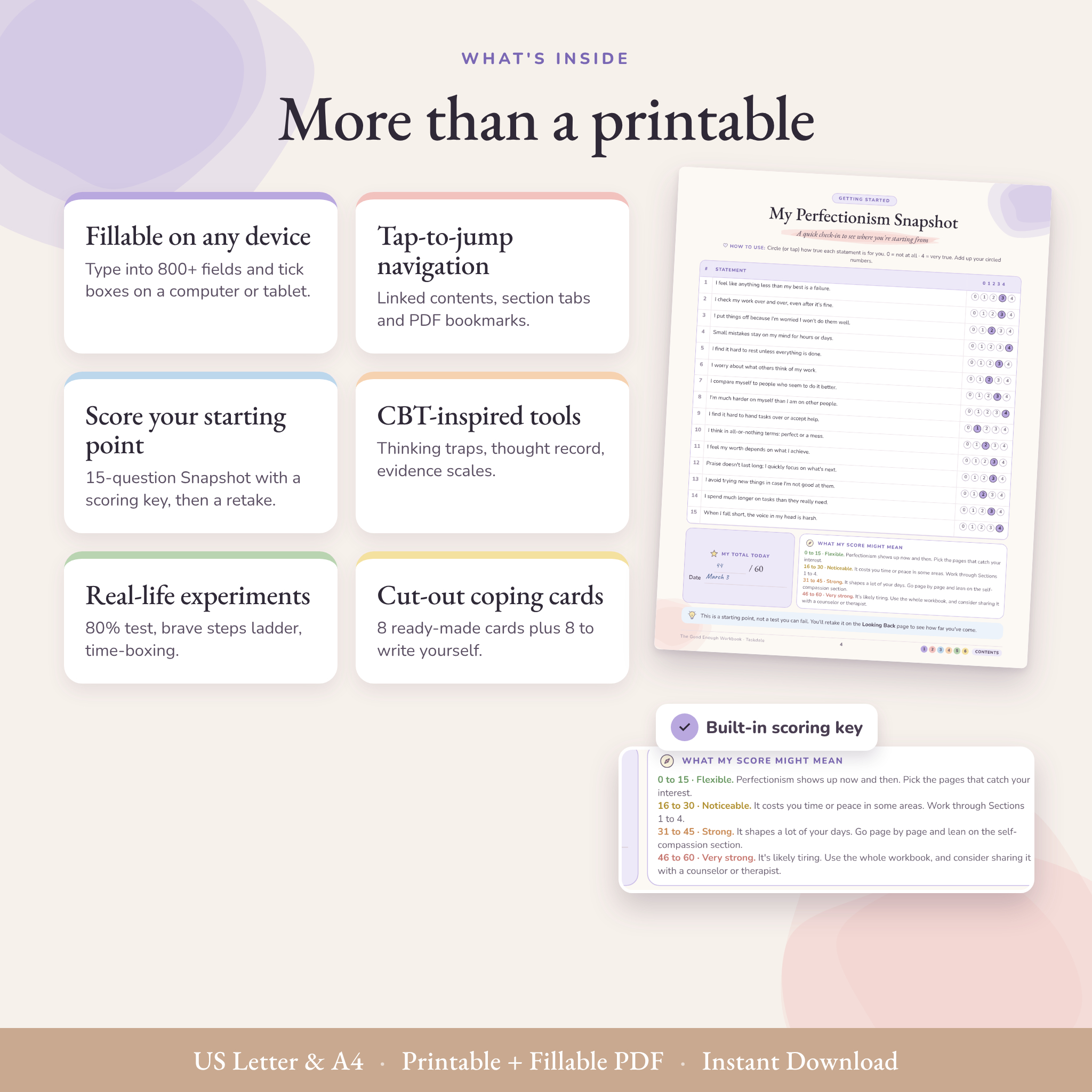
Getting started: welcome page, clickable contents, a 15-question Perfectionism Snapshot with a scoring key, and an intentions page.
Section 1, Understanding My Perfectionism: what perfectionism is, healthy striving vs. perfectionism, the perfectionism iceberg, a 10-area pressure wheel, triggers, the perfectionism cycle, where your standards came from, and meeting your inner perfectionist.
Section 2, Spotting the Patterns: hidden rules, “should” and “must” thinking, all-or-nothing thinking, procrastination, a body map for stress, the comparison trap, and people-pleasing.
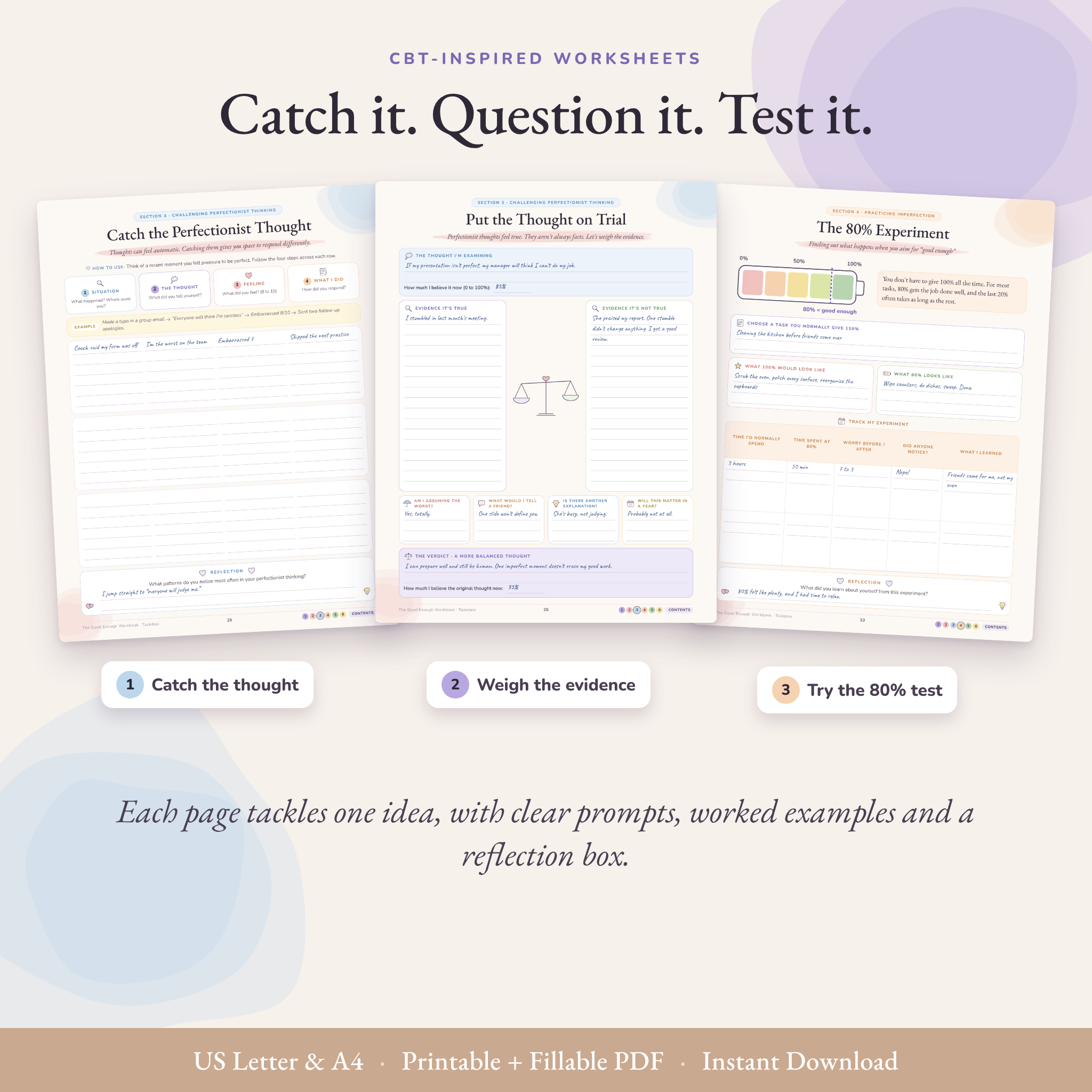
Section 3, Challenging Perfectionist Thinking: a thinking traps cheat sheet, catch the thought, put the thought on trial, from perfect to “good enough,” reframing mistakes, fear of failure, and a reusable thought record.
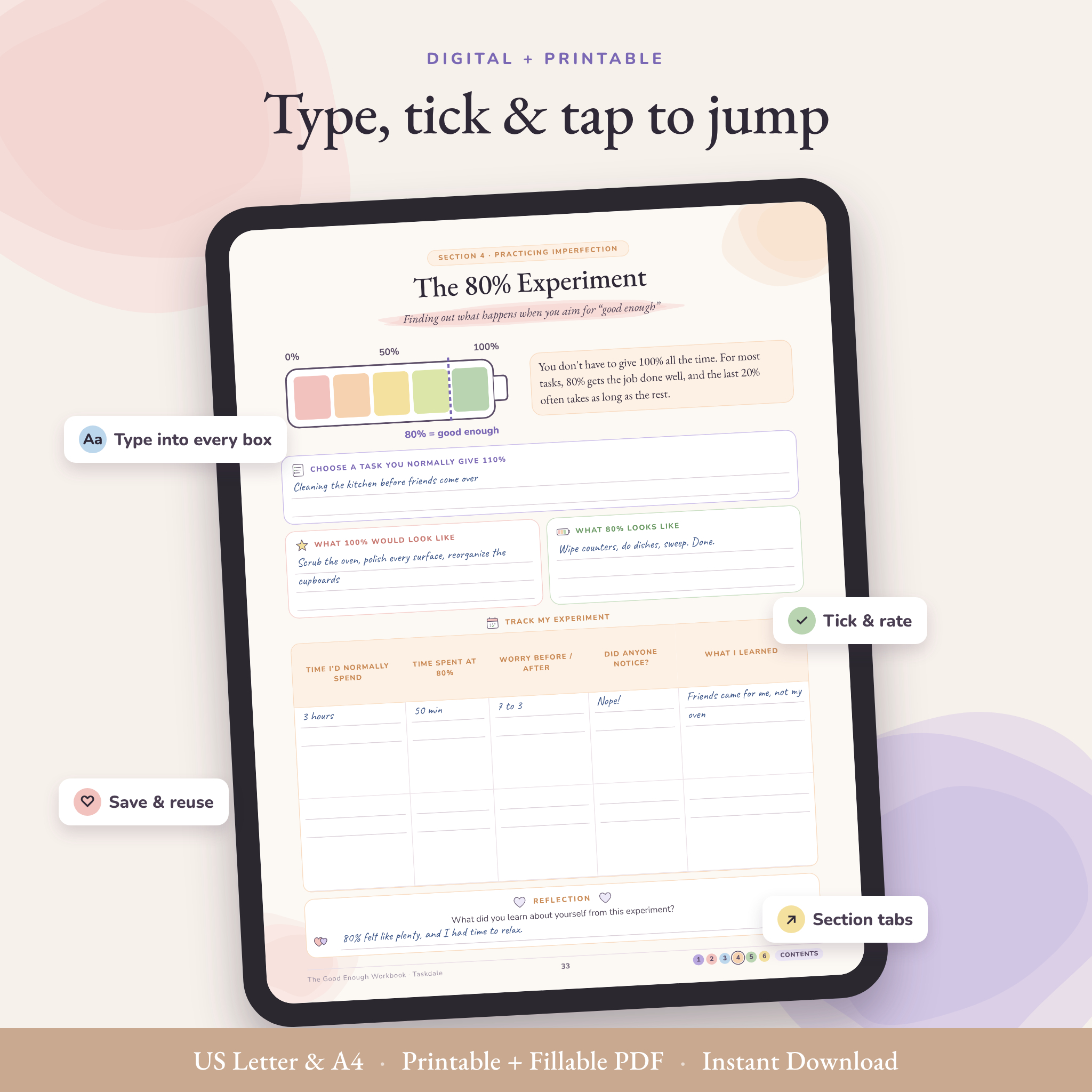
Section 4, Practicing Imperfection: imperfection experiments, the 80% experiment, making a mistake on purpose, a step-down plan for checking, done is better than perfect, a brave steps ladder, and a time-box planner.
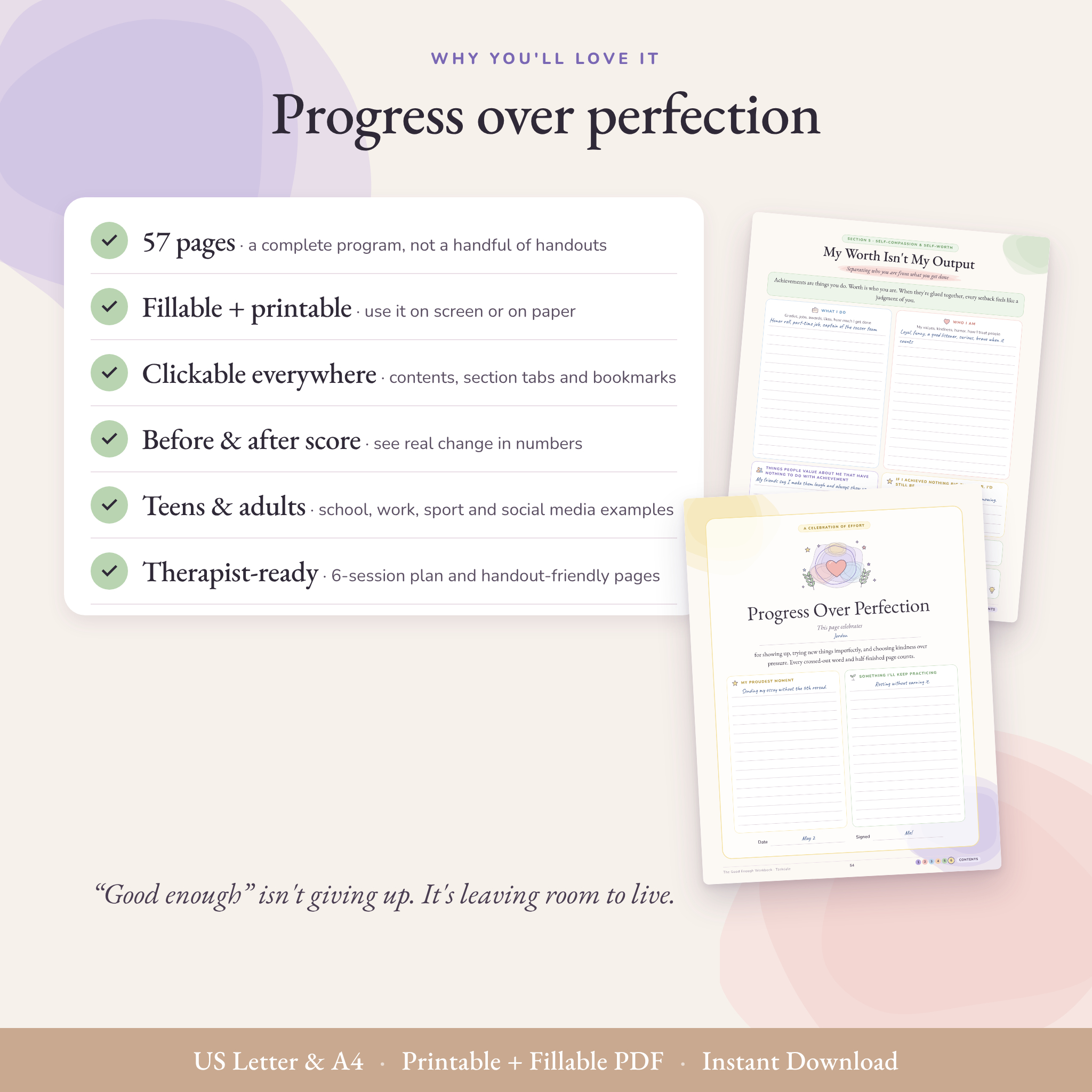
Section 5, Self-Compassion & Self-Worth: inner critic vs. inner coach, separating worth from achievement, flexible standards, rest without earning it (with permission slips), a support circle, and a kind letter to yourself.
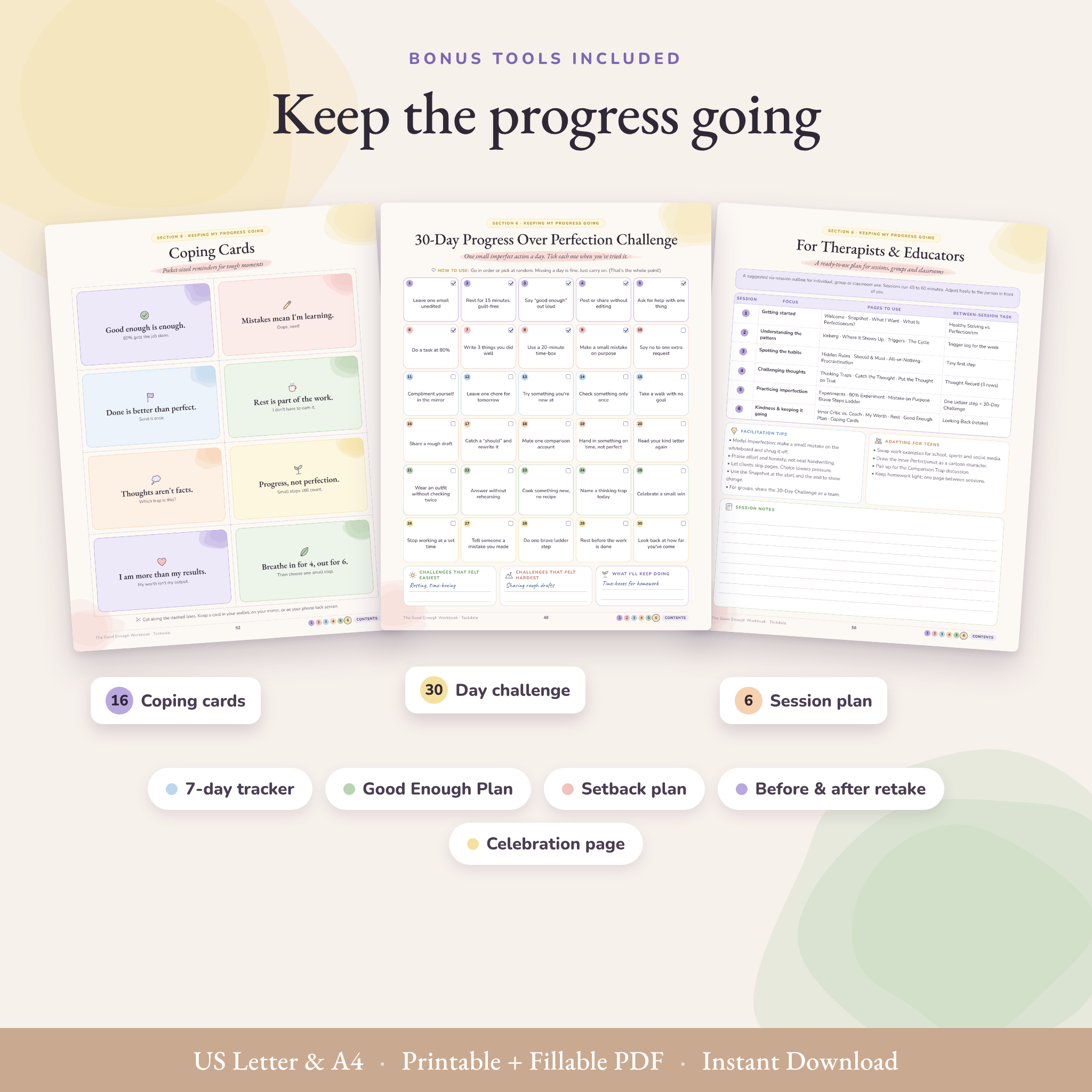
Section 6, Keeping My Progress Going: a 7-day tracker, a 30-day “Progress Over Perfection” challenge, a Good Enough Plan, a setback plan, a Snapshot retake, 8 ready-made coping cards, 8 blank coping cards, a celebration page, a notes page and a six-session plan for therapists and educators.
Features that make it easier to use
- Fillable fields throughout. More than 800 text boxes, checkboxes and rating circles. Type your answers and tick boxes on screen.
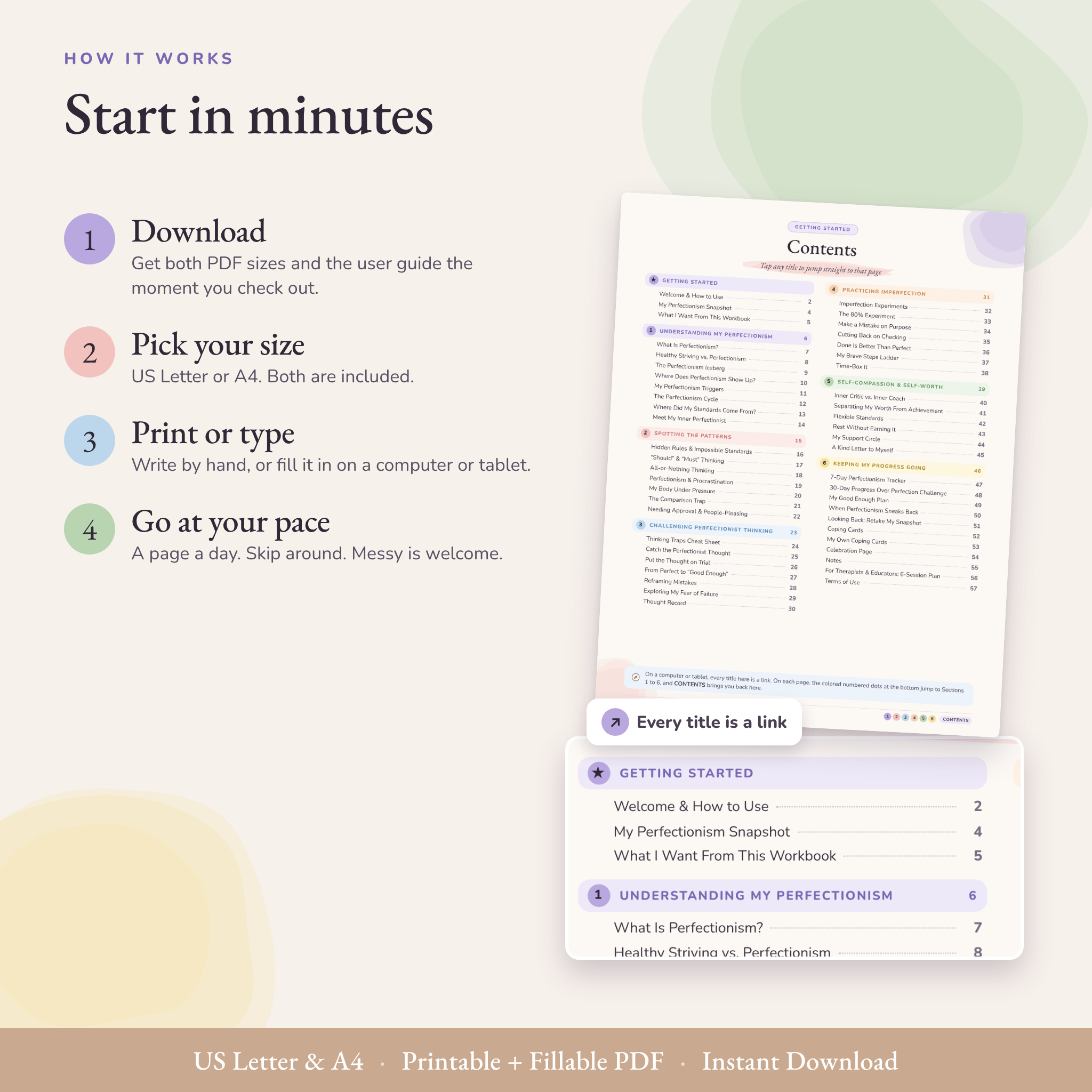
- Tap-to-jump navigation. Every title on the contents page is a link. Colored section tabs on each page jump between sections, and PDF bookmarks list every page.
- A score you can compare. Take the Snapshot at the start, retake it at the end, and see the change in numbers.
- Calm, clear design. Soft pastel sections, roomy writing lines and one idea per page, so nothing feels crowded.
- Worked examples. Key pages include a short example so you know exactly what to write.
How it works
- Download your files right after checkout.
- Pick US Letter (US and Canada) or A4 (most other countries).
- Print the pages you need, or open the PDF and start typing.
- Start with the Snapshot, set an intention, then work through the sections at your own pace.
File formats and software
You get two PDF files and a DOCX user guide. Any PDF reader opens the workbook. To type into the fields, use a PDF reader that supports fillable forms, such as Firefox or the free Adobe Acrobat Reader, and save your copy as you go. Prefer handwriting on a tablet? Import the PDF into a note-taking app that supports PDFs and write with a stylus. For printing, choose “Actual size” and turn on background graphics so the soft colors print.
Customize it
Print only the pages you need. Print extra copies of the trackers, thought record and experiment pages, or duplicate them in your PDF app. Color in the pressure wheel and body map. Write your own reminders on the blank coping cards and print the card pages on card stock.
Ways you could use it
- A college student could use the time-box planner to stop rewriting essays at 2 a.m.
- A counselor might hand out the Iceberg and Catch the Thought pages in a first session, then follow the six-session plan.
- A parent and teen could work through the Comparison Trap together after a rough week online.
- A busy professional might keep the coping cards on their desk and run the 80% experiment on weekly reports.
- A school counselor could run the 30-Day Challenge as a group activity before exam season.
Perfectionism workbook FAQ
Is this a physical product?
No. It’s an instant digital download. Nothing is shipped.
Can I fill it in on my computer or tablet?
Yes. The PDFs have fillable fields. Open them in a PDF reader that supports forms, or import the file into a note-taking app and write by hand.
Is it suitable for teenagers?
Yes. It’s written for ages 13 and up, with school, sport and social media examples.
Can therapists use it with clients?
Yes. You may print or share pages with your own clients or students in your own sessions. Please don’t post the files online or resell them.
Which paper size do I get?
Both. US Letter and A4 are included.
Is it based on CBT?
The worksheets draw on CBT and self-compassion ideas, written in plain language.
Does it replace therapy?
No. It’s a self-help and learning resource. It can work well alongside support from a qualified professional, but it isn’t a diagnosis or treatment.
License
Personal use license. Professionals may share printed pages with their own clients or students. Reselling, sharing or uploading the files anywhere is not allowed. All artwork was created for Taskdale.

Reviews
There are no reviews yet.