If you have colored your fortieth rose and your twelfth fox and felt nothing, you are not alone. Flowers and animals fill most coloring shelves because they sell. But after a while every page starts to look like the last one, and the pencils stay in the tin. Unique coloring books with unexpected themes beyond flowers and animals can bring the spark back fast.
This guide is for adult colorists, teens and curious older kids who want something different on the table. You will find four unusual themes worth trying, a list of other odd subjects to hunt for, and a few tricks for making a strange page feel like yours. Four printable Taskdale books are featured, none of them a bouquet.
Quick picks: four themes you probably have not tried
| Product | Best for | Price | Link |
|---|---|---|---|
| Wonky Wonder Homes Printable Coloring Book | Fans of whimsy and impossible buildings | $3.99 | View |
| Lumen and Lead Stained Glass Coloring Book | Marker lovers who want bold, glowing pages | $4.49 | View |
| Psychology Coloring Study Guide | Students who want to color and learn | $9.49 | View |
| Bakery Coloring Book | Bakers and anyone who wants a quick, cozy win | $3.49 | View |
Why a strange theme can wake up your coloring
Boredom kills hobbies quietly. You do not decide to stop coloring. You just reach for the phone instead, night after night, because the next page in the book is another lily. A new theme fixes that by giving your brain something to solve.
Think about the first time you colored a mandala. You had no idea which colors would work, so every choice felt fresh. An unusual subject puts you back in that place. What color is a house shaped like a teapot? How do you make glass look like it glows? What shade of pink is a neuron? There is no “right” answer you have seen a hundred times, so you start playing again.
Odd themes also make better conversation. A finished rose is lovely. A finished cottage floating on balloons gets a “wait, what is that?” from everyone who walks past the fridge. That little moment of delight is worth a lot when you are trying to keep a hobby going through a busy month.
If calm is your main goal, our guide to coloring books for relaxation and stress relief pairs nicely with this one. Unusual themes can be just as soothing, once you find one that clicks.
Impossible architecture: homes that break every rule
Buildings are an underrated subject. They have straight lines and curved ones, big walls and tiny windows, so you get a satisfying mix of fast fills and slow detail. Now make the buildings impossible. A boot that walks. A teapot you can live in. A cottage lifted into the sky by balloons.
Fantasy houses are perfect if you like stories. Every page asks a question: who lives here, and why is their front door upside down? Many colorists end up giving each house a backstory and a color scheme to match. A grumpy wizard gets dark purples. A family of mice gets warm oranges and creams.
Palette idea for wonky houses
Pick one “main” color for the walls, one contrasting color for doors and window frames, and one bright accent for something small, like a chimney or a flag. Three colors plus a neutral keeps a busy page from turning to mud.
Roofs deserve their own plan. Tiles and shingles look best when you shade every third row slightly darker, which gives the roof depth without much effort. Windows can stay pale yellow, as if a lamp is on inside. That one touch makes a strange house feel lived in.
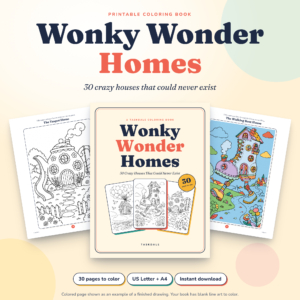
Wonky Wonder Homes Printable Coloring Book
Price: $3.99 | Best for: teens and adults who love whimsy
Thirty full-page drawings of homes that could never exist, from a walking boot to a balloon-lifted cottage and a teapot house. You get US Letter and A4 PDFs, a pack of single-page PNGs for reprinting, and a short illustrated Word guide with print settings. It suits kids from about seven, teens and adults. Start with the balloon cottage and give every balloon a different color.
Light through glass: stained glass windows
Stained glass pages look like they should be hard. They are not. The heavy black lines that hold real glass panes together do all the hard work. Each pane is a clear, closed shape, so you just pick a color and fill it. The black frame makes even simple color choices look rich.
Yes, some stained glass designs include flowers and birds. That is fair. But the experience is completely different from coloring a realistic rose. You are not shading petals. You are building a window of light, pane by pane. It feels more like a mosaic than a drawing.
There is also a craft angle most books never offer. Print a design on vellum or translucent paper, color it with alcohol markers, and tape it to a sunny window. Morning light comes through your colors exactly like a real church window. People who try this once often do it again for every season.
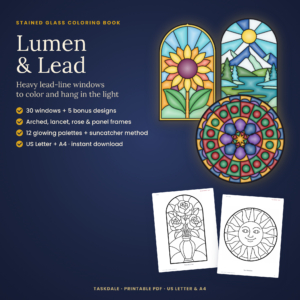
Lumen and Lead Stained Glass Coloring Book
Price: $4.49 | Best for: adults and teens who love markers
Thirty window designs plus five bonus windows, all drawn with heavy, even lead lines and large panes: rose windows, sun and moon designs, birds and florals. It includes 12 glowing palettes to pick from and a Suncatcher Method for printing on translucent paper. It comes in US Letter and A4. Try a sun and moon window first, using one warm and one cool palette.
Coloring that teaches: diagrams of the brain and mind
Here is a theme almost nobody thinks of: school subjects. Medical and science students have colored anatomy diagrams for years, because coloring a structure makes you look at every part of it. The same idea works for psychology, biology and more.
A brain diagram with four lobes is, honestly, a lovely shape to color. So is a neuron, with its branching dendrites and long axon. You pick a color for each part, then cover the labels and see what you remember. It is calm, hands-on, and surprisingly effective before an exam.
This theme is a gift for a high school or college student who is stuck rereading the same chapter. It is also great for curious adults who never took psychology and want a gentle way in. A 20-minute session on the senses or memory leaves you with a finished page and a few new words you actually understand.
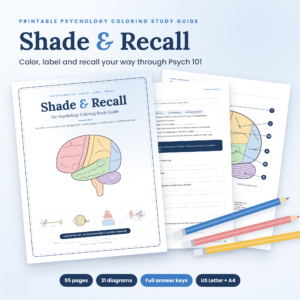
Psychology Coloring Study Guide
Price: $9.49 | Best for: Psych 101 and AP Psychology students
A printable workbook covering an intro psychology course in 14 units, with 31 original coloring diagrams of the brain, neurons and senses, each with a numbered color and label key. Every unit ends with a Review and Recall page with a word bank and exam-style questions, and full-color answer keys are included. Color one diagram, then label it from memory before you check.
Food you can color: the bakery shelf
Food is one of the most fun unexpected themes, and it is perfect for short sessions. A cupcake page takes 15 minutes. A croissant takes 10. You get the joy of a finished page without committing your whole evening.
Bakery pages also let you play with color in a way realistic subjects rarely do. Icing can be mint green, lavender or electric blue. Sprinkles are an excuse to use every pencil you own. And browns finally get their moment: golden crust, toasted edges, a chocolate drip. Layer a light tan, a medium brown and a touch of orange and your bread will look warm out of the oven.
One small joy: color a page of the treat you are baking that day while the dough rises. It is a cozy loop, and the page makes a sweet label for a gift box of cookies.
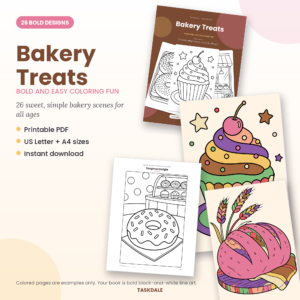
Bakery Coloring Book
Price: $3.49 | Best for: quick cozy sessions for all ages
Twenty-six bold, easy designs of bakery treats: a frosted cupcake, golden croissant, lattice berry pie, cinnamon roll, macaron tower and a celebration cake, plus a few shop window scenes. Thick lines and big shapes mean even a chunky marker stays inside. It prints on US Letter or A4. Begin with the layer cake slice and give every layer its own flavor color.
More unexpected themes worth hunting for
Once you start looking, odd themes are everywhere. Here are some that make excellent coloring, whether you find them on Taskdale or elsewhere.
- Maps. Real or invented. Coloring a map of a city you love, or a fantasy kingdom, is oddly relaxing.
- Vintage vehicles. Old cars, trucks and trains have chrome, curves and big wheels. Taskdale’s Classic Vehicles book is one option here.
- Machines and robots. Gears, pipes and panels suit anyone who likes neat, technical detail.
- Everyday objects. Teacups, sewing tins, a messy desk. Ordinary things become charming when you color them slowly.
- Weather and sky. Storm clouds, rainbows, a single lightning bolt over a field.
- Carnivals and fairgrounds. Rides, lights and striped tents are a playground for bright color.
- Science and anatomy. Cells, skeletons, plant cross-sections and star maps.
The best test is simple. Look at a sample page and ask: do I already know what colors I would use? If the answer is “no idea, but I want to find out,” that is your theme.
A second test: imagine the finished page on your wall or fridge. If it makes you grin, or if you can already picture someone asking about it, you have found a winner. If it looks like something you would scroll past, skip it, however clever the idea sounds.
How to pick the right unusual theme for you
Four quick questions help you choose.
- How long are your sessions? Fifteen minutes on a lunch break suits bold food or vehicle pages. A slow Sunday suits detailed fantasy houses.
- What tools do you love? Markers shine on stained glass and bold pages. Colored pencils suit detail and soft shading.
- Do you want a story or a skill? Fantasy themes give you stories. Study diagrams give you knowledge. Both keep you coming back.
- Who else might color with you? Bakery pages work for a grandparent and a seven-year-old side by side. A psychology workbook does not.
For a broader look at adult books ranked by style, see our list of the best coloring books for adults.
Making a strange page feel like yours
An unusual theme is only half the fun. The other half is what you do with it.
Try a limited palette. Pick four colors and use only those for a whole page. On a teapot house, that might be teal, coral, cream and gold. Restriction forces creative choices.
Flip expectations. Color a stained glass window in only cool blues and greens for a winter look. Make a croissant purple. Make a brain diagram match your favorite sports team. Nobody is grading this.
Write a caption. Add a line at the bottom of the page. “The house where Aunt Rose would live.” It turns a coloring page into a little piece of art with a voice.
Date it. Six months from now, flipping back through your odd collection will make you smile. You will remember the rainy week you colored nothing but cakes.
Mix themes in one sitting. Color a bakery page while you wait for a stained glass page to dry. Switching subjects keeps both feeling fresh, and you end the evening with two finished pages instead of one half-done one.
Who should stick with flowers and animals
Unusual themes are not for everyone, and that is fine.
If you color mostly to switch off, and familiar shapes help you do that, a favorite floral book may serve you better than a surprise. Comfort has value. Some evenings you want the same quiet path, not a puzzle.
Young children usually do best with themes they already know, such as animals, vehicles and simple shapes. A teapot house is funny to a nine-year-old but confusing to a three-year-old.
And if you are buying a gift for someone whose tastes you do not know well, a classic theme is the safer bet. Save the stained glass and brain diagrams for people you know would love them.
Frequently asked questions
What are some unusual coloring book themes for adults?
Fantasy architecture, stained glass windows, maps, vintage vehicles, food and bakery scenes, machines, weather and science diagrams are all good places to start.
Are stained glass coloring pages good for beginners?
Yes. Thick lines and large closed panes make them forgiving, and the black outlines make simple color choices look bright and finished.
Can coloring help you study?
Coloring a diagram makes you look at each part closely. Pairing it with labeling from memory turns it into active practice, which many students find helpful before tests.
What is a good unique coloring book gift?
Match it to the person’s interests. A baker might love a bakery book, a student a study guide, and someone who loves fairy tales a book of impossible houses.
Do printable coloring books work as well as printed ones?
They work very well, and you can choose your own paper. Heavier sheets handle markers better, and you can reprint a favorite page any time.
Your next step
Pick the theme that made you curious while reading, print one page, and color it this week with a palette you have never tried. If impossible buildings made you smile, the Wonky Wonder Homes Printable Coloring Book is a fun place to begin.