Best Wholesale Price Calculator for Handmade Sellers
The best wholesale price calculator for handmade sellers works out your true cost per item, including your time, packaging and fees, before it suggests a wholesale price. Of the three on this page, Craft Profit Compass suits most makers who want guided, offline pricing, while Profit Loom suits sellers spread across several sales channels.
Wholesale pricing can feel like guesswork, because you are selling at a lower price and still need to pay yourself. A good calculator removes that worry by showing the numbers before you quote a stockist. We'll cover what to look for, how the three options differ, and how to choose.
Key facts at a glance
- A wholesale price calculator is a tool that adds up materials, labour, packaging, overhead and fees to give a cost per item, then suggests a price you can sell at in bulk.
- All three tools here are for handmade and small-business sellers, and none needs a subscription according to their listings, except where a listing says nothing (the third product does not state either way).
- Two are spreadsheets that open in Excel and Google Sheets, and one is an offline app that runs in your browser.
- Only Handmade Pricing Calculator Spreadsheet (Profit Loom) and Craft Profit Compass state that they produce wholesale and retail prices side by side.
- Browse all 3 options below to compare what each one includes.
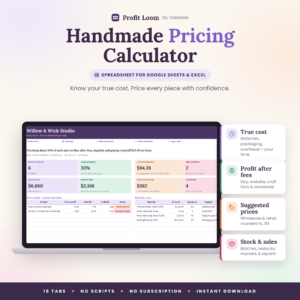 Handmade Pricing Calculator Spreadsheet | Profit Loom Excel & Google Sheets Product Pricing Template with Etsy Fees, Profit Dashboard, Inventory & Craft Fair Planner
Table of Contents Toggle
- What should you look for in a wholesale price calculator?
- How do the three calculators compare?
- Which calculator suits which seller?
- How do you use a wholesale price calculator step by step?
- What mistakes should you avoid when setting wholesale prices?
- What affects the price of a wholesale price calculator?
- Which wholesale price calculator should you pick?
- Common questions
What should you look for in a wholesale price calculator?
A wholesale price calculator should do five things: count every cost including your time, show wholesale and retail prices together, handle selling fees, fit the way you work, and give you something to hand to a buyer. Each factor below changes how safe your prices are.
Does it count your time and overheads?
A calculator that only adds up materials will always flatter you. Wholesale leaves a thinner margin than retail, so a missing cost hurts more. Look for fields for your hourly rate, packaging and overhead.
Craft Profit Compass asks for materials by the pack, your time and hourly rate, packaging, overhead and selling fees. Profit Loom adds batch recipes, which helps if you make items in runs rather than one at a time.
Does it show wholesale and retail prices together?
Seeing both prices from the same cost figure stops the two drifting apart. Wholesale price is what a shop pays you for stock, and retail price is what the shop charges its customers. If the two are set separately, you can end up with a wholesale price that barely covers your costs.
Profit Loom and Craft Profit Compass both suggest wholesale and retail prices from one cost calculation. The third product, Product Pricing Calculator Spreadsheet for Small Business, focuses on what to charge and what you keep from each sale. Its listing does not mention wholesale, so you would set the wholesale figure yourself from the cost it shows.
Does it handle selling fees for where you sell?
Fees change what you keep. A craft fair has a pitch fee, Etsy takes its cut, and wholesale usually has none. A tool that treats them all the same hides the real profit.
Profit Loom lists 2026 fees for 8 sales channels, including Etsy, your website, craft fairs and wholesale. The third product includes an Etsy fee calculator. Craft Profit Compass lets you enter selling fees yourself.
Does it work the way you work?
A spreadsheet suits people who like to see every formula and edit it. An app suits people who want to be led through the steps. Neither is better, but the wrong one stays unused.
Profit Loom and the third product work in Microsoft Excel and Google Sheets. Craft Profit Compass runs offline in your browser, which helps if your workspace has patchy internet.
Does it produce something you can hand to a buyer?
Stockists want a clear list, not your working. Craft Profit Compass makes printable line sheets, which are one-page product lists with wholesale prices. The third product includes six printable pricing pages in A4, US Letter, A5 and Half Letter. Profit Loom provides quotes and reports among its 16 tabs.
How do the three calculators compare?
The three calculators differ mainly in format, how much they track beyond price, and what they hand you to print or send. The table sets out what each listing states.
| Product | Format | Wholesale and retail prices | Fees covered | Extras | Best for |
|---|---|---|---|---|---|
| Handmade Pricing Calculator Spreadsheet | Profit Loom Excel & Google Sheets Product Pricing Template with Etsy Fees, Profit Dashboard, Inventory & Craft Fair Planner | Spreadsheet, 16 tabs, Excel and Google Sheets | Yes, suggested for both | 2026 fees for 8 channels | Dashboard, stock, sales log, quotes, craft fair planner, reports | Makers selling across several channels |
 Craft Profit Compass | Handmade Pricing Calculator for Retail & Wholesale Prices, Cost Per Item & Profit Margin, Offline App | Offline app in your browser | Yes, clear prices for both | Selling fees you enter | 5-step guide, live charts, profit checker, sale tester, goal planner, line sheets, CSV export, backups | Makers who want guided pricing and printable line sheets |
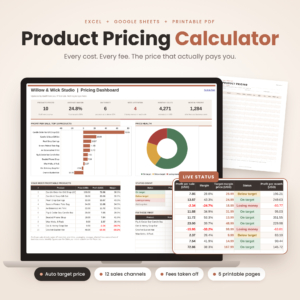 Product Pricing Calculator Spreadsheet for Small Business, Excel & Google Sheets Pricing Template with Etsy Fee Calculator and Printable Pricing Sheets | Spreadsheet, Excel and Google Sheets | Shows what to charge and what you keep | Etsy fee calculator | Six printable pricing pages in four paper sizes | Small sellers wanting a simple, printable calculator |
Which calculator suits which seller?
Each calculator suits a different seller: Profit Loom for multi-channel businesses, Craft Profit Compass for first-time wholesalers, and the third spreadsheet for simple, printable pricing. Match the tool to how much you want to track.
Profit Loom suits you if you sell on Etsy, your own website, at craft fairs and to shops, and want one file to compare them. It shows break-even price and earnings per hour, which tells you quickly whether a channel is worth your time. The trade-off is size. Sixteen tabs is a lot to learn if you only need a price.
Craft Profit Compass suits you if wholesale is new. The guided 5-step calculator shows cost and profit as you type, so you see the effect of each change. The sale tester and profit checker help you judge a discount before you offer it. Because it runs in your browser and keeps backups, you also get a place to store your product library.
Product Pricing Calculator Spreadsheet for Small Business suits you if you want a plain sheet and printouts. It is the least wide in scope, so it fits a seller with a small range who mainly needs to stop guessing.
How do you use a wholesale price calculator step by step?
You use a wholesale price calculator by entering costs first, reading the cost per item, and only then testing wholesale and retail prices. Do it for one product before you do the whole range.
- List materials by what you actually buy. Enter pack prices and how many items each pack makes, so waste is included.
- Add your time. Time how long one item takes, including finishing and packing, and multiply by an hourly rate you would accept from an employer.
- Add packaging and overhead. Include boxes, labels, tools wearing out and workspace costs, spread across what you make.
- Add selling fees for the channel. Choose the channel and enter its fees. For wholesale, this is often little or nothing.
- Read the true cost per item and break-even price. The break-even price is the lowest price at which you lose nothing.
- Test a wholesale price. Check that the profit left still pays you for your time. If it does not, change the recipe, the batch size or the price.
- Save or print the result. Use a line sheet or pricing page so the number you quote matches the number you worked out.
What mistakes should you avoid when setting wholesale prices?
The most common mistakes are leaving out your own time, copying a competitor's price, and forgetting that wholesale orders come in volume. Each can be fixed before you send a quote.
- Pricing from materials alone. If your wage is missing, the margin is not real. Always use a calculator with an hourly rate field.
- Setting wholesale after retail without checking. A retail price that works can still leave a wholesale price below your cost.
- Ignoring batch effects. Making twenty at once costs less per item than making one. Profit Loom's batch recipes help here, but check that your saving is real.
- Using last year's fees. Platform fees change. Profit Loom states 2026 fees, but check any figure against the platform's current page before relying on it.
- Giving discounts without testing them. Craft Profit Compass has a sale tester for this. Use it before agreeing to a bulk deal.
What affects the price of a wholesale price calculator?
The price of a wholesale price calculator depends on how much it tracks, how it is delivered, and whether it carries ongoing fees. You will see the live price on each product card.
A calculator that also manages stock, sales and craft fair planning costs more than one that only prices an item. Profit Loom's 16 tabs sit at the larger end. Format also counts: a spreadsheet is a file you keep, while an app may bundle features such as backups and CSV export. Subscriptions are a separate matter. Profit Loom and Craft Profit Compass both state no subscription, so you pay once. Check the third listing for its terms before you buy.
Which wholesale price calculator should you pick?
Pick Craft Profit Compass if you are new to wholesale and want guidance, Profit Loom if you sell through several channels, and the Product Pricing Calculator Spreadsheet for Small Business if you want a simple sheet with printouts.
A quick rule: if you can name three or more places you sell, choose Profit Loom. If you sell in one or two and want to be walked through, choose Craft Profit Compass. If you only need to price and print, choose the third. Whichever you pick, price one best-selling item today and check that the wholesale figure still pays you for your time.
Common questions
What is a wholesale price?
A wholesale price is the amount a shop or reseller pays you for items bought in bulk to sell on. It sits below your retail price, because the shop needs room to make its own profit. A calculator helps you set it without losing money.
How much lower should wholesale be than retail?
A common rule of thumb is wholesale at about half of retail, though the right gap depends on your costs. Test it first. If half of your retail price does not cover your true cost per item, raise retail or cut costs.
Do these calculators need a subscription?
Handmade Pricing Calculator Spreadsheet (Profit Loom) and Craft Profit Compass both state no subscription. The listing for Product Pricing Calculator Spreadsheet for Small Business does not say either way, so read its details on the product card before buying.
What is a line sheet and do I need one?
A line sheet is a one-page list of your products with wholesale prices, sent to shops that might stock you. You need one when approaching stockists. Craft Profit Compass produces printable line sheets from the prices you have worked out.
What is the difference between margin and markup?
Markup is the amount added to cost as a percentage of cost, while margin is profit as a percentage of the selling price. A 100% markup is only a 50% margin. Check which one your calculator shows before comparing figures.