Your training plan lives in one notebook, your meal plan sits on the fridge, and the grocery list is somewhere in your phone. Then leg day lands on the same evening as an empty fridge, and dinner becomes toast. Putting your workout and meal plan in one printable planner fixes that, because you see both on the same page when you plan the week.
This article is for people who train two to five times a week and want food to support it without a second app or a second notebook. You will learn which pages matter, how to set up a binder in one evening, how to match meals to training days, and which three Taskdale planners hold workouts and meals together.
Quick picks: fitness and food planners in one file
| Product | Best for | Price | Link |
|---|---|---|---|
| Well Within Fitness & Life Planner | A full binder: training, meals, body stats | Original price was: $4.49.$1.19Current price is: $1.19. | View |
| Daily Balance Planner | One calm page a day with workout and meals | $7.49 | View |
| Bloom & Lift Digital Fitness Planner | Planning on a tablet, printing the extras | $3.96 | View |
Why training and food belong on the same page
A workout plan tells you what to do. A meal plan tells you what to eat. Neither one knows about the other, and that is where weeks fall apart. You schedule a long run for Saturday morning and plan a late Friday curry. You lift heavy on Thursday and have nothing planned for a quick dinner afterwards.
When both plans share a page, you catch these clashes on Sunday instead of Thursday night. Hard session at 6 pm? Then dinner should be something already cooked or ready in 15 minutes. Rest day? That’s the night for the recipe that takes an hour. Simple. But it only happens when you can see both at once.
There is a quieter benefit too. People who log meals and workouts in one place tend to spot patterns faster: the week the scale stalled was the week of three takeaway dinners and two skipped sessions. Seeing that in your own handwriting is more convincing than any app chart.
The five pages that do most of the work
Fitness planners can run past 100 pages. You do not need all of them in week one. These five carry most of the load.
- Weekly workout plan. Which days you train, what type of session, and roughly how long.
- Weekly meal planner. Breakfast, lunch, dinner and snacks for seven days, ideally on a page that faces or follows the workout plan.
- Grocery list. Built from the meal planner, sorted by section of the store.
- Workout log. Sets, reps, weights or distance, so next week’s plan builds on this week’s numbers.
- One progress page. Weight, measurements or a personal records sheet. Pick one, not all three.
Print those five, add a habit tracker if you like ticking boxes, and leave the rest in the file until you want it. A 12-page binder you use beats a 108-page binder you avoid.
Setting up your binder in one evening
Give yourself about 45 minutes. Here is the order that works.
- Print a test page first. Print at 100% or “actual size”, not “fit to page”, so boxes line up with hole punches and binder rings.
- Choose your paper size once. Letter and A4 suit a desk binder. A5 or Half Letter fit a gym bag better.
- Print four weeks of the weekly pages. Any more and you will forget they exist.
- Add tab dividers. Plan, Train, Eat, Track. Four tabs is plenty.
- Fill in this week only. Training days first, then meals around them, then the grocery list.
If you have never batch-cooked before, the Sunday hour laid out in our meal prep for beginners guide slots straight into the Eat tab.
The full binder: training, meals and body stats together
If you want one planner that grows with you, look for a set where the fitness and nutrition sections are equal partners, not a workout book with a single meal page tacked on at the end.
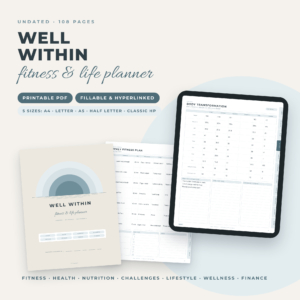
Well Within Fitness & Life Planner
Price: Original price was: $4.49.$1.19Current price is: $1.19. | Best for: gym regulars who want everything in one binder
108 undated pages in 10 sections, as a clean printable PDF and a fillable hyperlinked PDF, each in US Letter, A4, A5, Half Letter and Classic Happy Planner sizes. The fitness section includes a weekly workout planner, weightlifting log and 12-week training plan, and the nutrition section has a weekly meal planner, grocery list, meal prep planner and food diary. Print the weekly fitness plan and weekly meal planner first and keep them side by side.
The extra sections for sleep, mood and money are optional. Many people add them in month two, once the training and food habit has settled.
One page a day for busy weeks
Some people never open a weekly spread. They want a single sheet each morning that says: here is your workout, here is what you are eating, here is your water. If that sounds like you, a daily planner with fitness and food built in will get used far more than a big fitness system.
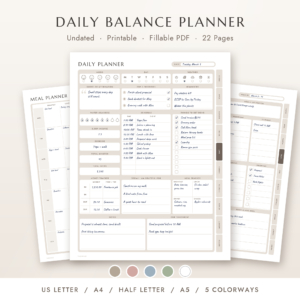
Daily Balance Planner
Price: $7.49 | Best for: people who plan one day at a time
An undated 22-page planner with a daily page that holds your schedule, exercise, water, a meal tracker and gratitude, plus a workout planner, workout log, body progress page, weekly meal planner and grocery list. It comes as printable and fillable PDFs in US Letter, A4, A5 and Half Letter, in five colorways including an ink-saver version. Start by printing seven daily pages and one weekly meal planner.
On the fillable version, the workout planner adds up your weekly minutes on its own. Nice to see the total climb from 90 to 150 over a month.
Plan on a tablet, print what you carry to the gym
Plenty of people like planning on an iPad but want a paper log in the gym, where a tablet is one dropped dumbbell away from a cracked screen. A digital planner that ships with a printable version covers both.
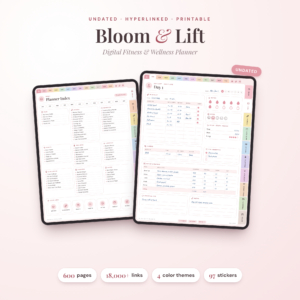
Bloom & Lift Digital Fitness Planner
Price: $3.96 | Best for: tablet planners who still like paper
An undated, hyperlinked digital planner with 600 pages in four color themes for GoodNotes, Notability and similar apps, plus a printable version in US Letter and A4 with 109 pages. Daily pages include a 10-row workout log and a meals table with calories and macros, and the nutrition section adds a weekly meal planner, grocery list and meal prep planner. Plan the week on the tablet, then print the workout log pages for the gym.
It also has 97 digital stickers, which sounds trivial until you notice how satisfying it is to drop a “PR” label on a good day.
Matching meals to training days: a worked week
Here is how one person might fill a combined planner. She trains four days, works office hours and cooks for herself and a partner.
| Day | Training | Dinner | Why it fits |
|---|---|---|---|
| Monday | Lower body, 6 pm, 50 min | Chili from Sunday’s pot | Reheats in 5 minutes after a late session |
| Tuesday | Rest | Roast chicken thighs, potatoes, greens | Longer cook on a free evening, leftovers for Wednesday lunch |
| Wednesday | Upper body, 7 am | Salmon and rice bowl | Quick, and the morning session leaves the evening open |
| Thursday | 30 min run after work | Egg fried rice with frozen veg | 15 minutes, uses Wednesday’s spare rice |
| Friday | Rest | Free night | Out with friends, nothing to plan |
| Saturday | Full body, 9 am | Homemade burgers | Treat meal on a strong day |
| Sunday | Long walk | Big pot of chili | Cooks while she plans next week |
Notice the pattern. Late sessions get dinners that are already made. Rest days get the slow recipes. Breakfast after the 7 am session is overnight oats made the night before, written in the breakfast slot so she does not skip it. None of this needs special nutrition knowledge. It just needs both plans on the same page.
A 20-minute Sunday routine
Once the binder exists, the weekly upkeep is short. Sit down on Sunday with a coffee and do this.
- Minutes 1 to 5. Look at last week’s workout log. Note one number to beat.
- Minutes 5 to 10. Write this week’s training days and times into the workout plan.
- Minutes 10 to 15. Fill dinners around those sessions: quick meals on late training nights, longer recipes on rest days.
- Minutes 15 to 20. Write the grocery list and tick anything already in the cupboard.
That’s it. Twenty minutes, and the week has a shape. For a broader look at planners built for this, our roundup of fitness planners for women compares more layouts.
Pen and paper or the fillable PDF?
Most of these planners come both ways, so you do not have to choose forever. But it helps to know which suits which job.
Paper wins in the gym and the kitchen
A printed workout log on a clipboard is quicker than unlocking a phone between sets. The same goes for the grocery list: a sheet in your pocket can be crossed off with one hand while the other steers the cart. Paper also stays put on the fridge, where the whole household sees Thursday’s dinner without asking.
Fillable wins for planning and totals
Typing the week’s meals takes about half the time of writing them, and you can copy last week’s plan and change three dinners instead of starting fresh. Fillable fields that add up minutes or money save you the maths. Many people plan on screen on Sunday, print the week, and write on the printout from Monday.
A mixed approach costs nothing extra once you own the files. Try it for two weeks, then keep whichever half you actually used.
Tracking progress without making it a chore
Progress pages are motivating right up until they are not. A daily weigh-in that bounces by two pounds can wreck a good week’s mood. So keep progress tracking light and spaced out.
- Weight: once a week, same day, same time. Write it on the weekly page, not the daily one.
- Measurements: once a month. Waist, hips and one limb is enough.
- Strength or distance: one personal record line per lift or route. Update it only when you beat it.
- Meals: a simple tick in the plan for “ate what I planned”. Seven ticks out of ten meals is a strong week.
The point is to look back after a month and see a trend, not to judge every Tuesday. When the squat number on your records page goes from 40 kg to 55 kg in eight weeks, that line in your own handwriting feels better than any badge on an app. And on the weeks when nothing moves, the meal and training pages usually show why: two missed sessions, three dinners out. No guilt. Just useful information for next Sunday.
Where combined planners go wrong
A few habits quietly kill a fitness and food planner by week three.
- Logging every gram. If counting each almond makes you dread the meal page, write meals in plain words instead. Consistency beats detail.
- Planning seven training days. Plan what you can actually do. Three sessions you finish beat six you skip.
- Forgetting lunch. Dinners get planned, lunches get bought. Add a leftovers note to every dinner that makes extra.
- Keeping the binder at home. Take the workout log to the gym or it will be blank by Friday.
- Restarting every Monday. Missed three days? Fill in Thursday and carry on. The pages are undated for a reason.
Who might be better off with something else
If you follow a coach’s program that arrives in an app every week, a printable training log may duplicate work. You might only need the meal pages. And if you prefer formulas to pens, with weekly totals and charts worked out for you, a workout spreadsheet will suit you better than paper.
People following a nutrition plan from a dietitian should keep their dietitian’s targets as the guide. A planner is a place to write those targets down, not a replacement for them.
Frequently asked questions
Is there a printable planner with both workout and meal plans?
Yes. Well Within, Daily Balance and Bloom & Lift all include workout pages and meal planning pages in the same file. Well Within has the largest printable fitness and nutrition sections, while Daily Balance keeps both on one daily page.
What size should I print a fitness planner?
Letter or A4 for a desk binder, A5 or Half Letter if it travels in a gym bag. Print a test page at 100% scale before printing a full month.
Can I fill in a printable fitness planner on my laptop?
If it includes fillable PDFs, yes. Well Within and Daily Balance both come with fillable versions you can type into with a free PDF reader, then print or keep on screen.
How many pages should I print to start?
About five: a weekly workout plan, a weekly meal planner, a grocery list, a workout log and one progress page. Add more once those feel routine.
Should I plan meals before or after my workouts?
Plan workouts first, then fit meals around them. Training times decide which nights need a quick dinner and which can handle a longer recipe.
Your next step
This Sunday, print one weekly workout page and one weekly meal page, lay them side by side, and fill in training first and dinners second. If you want those pages and a full fitness section in one printable set, start with the Well Within Fitness & Life Planner and print just those two sheets tonight.