Ask a ten-year-old who rides what a blaze is, and she will tell you in two seconds. Ask a ten-year-old who does not, and you get a blank look. Horse coloring book activities can close that gap without a single worksheet, because kids remember what they color far better than what they read.
This guide gives parents, homeschoolers and riding instructors a set of ready-to-run activities built around horse markings and coat colors. You get the plain-English names for each marking, six games that use a crayon instead of a quiz, a five-day plan, and tips for running the same ideas with a group of eight kids in a tack room. We also show the printable books on Taskdale that make the prep easy.
Quick picks for horse activity time
| Product | Best for | Price | Link |
|---|---|---|---|
| Gallop Gallery Horse Breeds Coloring Book | Markings guides, coat colors and 24 breeds | $4.99 | View |
| Indoor Activities Coloring Book Adventure | Rainy days when the lesson is cancelled | $2.99 | View |
| Pretend Play Coloring Book | Kids who love role play and story games | $2.99 | View |
Why markings are the perfect thing to learn by coloring
Markings are visual. A star is a white shape on the forehead. A sock is white on the lower leg. You could read those definitions ten times and forget them, or you could color one horse with a star and two socks and never forget again.
They are also real. Vets, breeders and riding schools describe horses by their markings, and many record them on an outline drawing so a horse can be identified. When a child learns the words, she is learning the same language the adults at the yard use. That feels grown-up, and kids love it.
And they are small. Each marking is one shape on one part of the horse. A six-year-old can manage that. Nobody has to color a whole realistic portrait to learn something.
Face markings in plain English
There are five main face markings. Read them out, then let your child color each one on a blank face before trying the games below.
- Star. A white patch on the forehead, between or above the eyes. It can be round, a diamond or a wobbly smudge.
- Strip. A narrow white line running down the front of the face, below the eyes.
- Blaze. A wider white stripe down the face, usually from the forehead to the nose.
- Snip. A small white mark between or just above the nostrils.
- Bald face. White covering most of the front of the face, often reaching out toward the eyes.
Markings combine, too. A horse can have a star and a strip that join up, or a star with a snip and nothing between. That is where the fun starts, because no two horses look quite the same.
Leg markings from hoof to knee
Leg markings are named by how high the white goes. Start at the hoof and work up.
- Coronet. A thin band of white just above the hoof.
- Pastern. White that reaches a little higher, over the short section just above the hoof.
- Sock. White that goes up past the fetlock joint, partway up the leg.
- Stocking. White that reaches the knee on a front leg or the hock on a back leg.
A handy trick for kids: socks are short, stockings are long, just like the ones in their drawer. Once they make that link, they will spot socks on every horse in every picture book they own.
Coat colors worth knowing
Coat color is the other half of describing a horse. These nine cover most of what kids will see in books and at the stables.
- Bay: brown body with black mane, tail and lower legs.
- Chestnut: reddish brown all over, with no black points.
- Black: black all over, sometimes with white markings.
- Gray: many grays are born dark and get lighter as they age.
- Palomino: golden coat with a pale cream or white mane and tail.
- Buckskin: tan or golden body with black points like a bay.
- Roan: white hairs mixed through a colored coat, giving a speckled look.
- Pinto: big patches of white and another color.
- Appaloosa: spotted patterns, from a few spots to a whole leopard coat.
For the youngest children, stick to bay, chestnut, black and palomino. Four is plenty. Add the rest once those are second nature.
A printable book with the guides already drawn
You can draw blank horse faces and legs yourself, and for a one-off game that is fine. If you want the whole set ready to print, with real breeds to practice on, a book with the guides built in saves a lot of evenings.
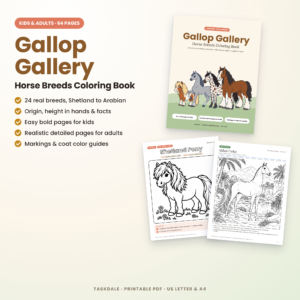
Gallop Gallery Horse Breeds Coloring Book
Price: $4.99 | Best for: kids learning horse words
Gallop Gallery has a Face Markings Guide with star, strip, blaze, snip and bald face drawn on a horse’s face, a Leg Markings Guide with coronet, pastern, sock and stocking, and a Coat Colors Guide with nine coats. There is a Design Your Own Horse page, a breed word search with an answer key and 24 breeds on easy and realistic pages. It comes as US Letter and A4 PDFs, so print the two markings guides first and use them as the answer sheet for every game below.
The book also includes a clickable My Breed Log to tick off finished pages and a Horse Breed Expert certificate. Kids who love collecting things will want to fill every box.
Six coloring games that teach markings
Each game takes 10 to 30 minutes and needs only printed pages, crayons or pencils, and a markings guide to check answers.
1. Read it, color it
Write a description on a card: “Chestnut with a blaze and two white socks on the back legs.” Your child colors a horse to match. Check it against the guide together. Then swap, and let her write one for you.
2. Markings bingo
Make a 3 by 3 grid with a marking in each square: star, snip, sock, blaze, stocking and so on. Flip through a horse book or look at photos of horses online. Each time you spot one, color that square. First full row wins.
3. Spot the twin
Color two copies of the same breed page with markings that are almost the same but differ in one place. Maybe one has a sock and the other a stocking. Your child has to find the difference and name it.
4. Design a dream horse
Tick a coat color and three markings, then color the horse. Give it a name and a stable. Kids who make up a horse remember the markings far better than kids who copy one.
5. Breed detective
Read out three clues about a breed from the facts on the page, such as where it comes from and how tall it grows in hands. Your child guesses which breed it is, then colors it.
6. The marking passport
Fold a sheet of paper in half to make a little booklet. On each page, your child draws or glues a colored horse and writes its coat color and markings underneath. It looks like a real horse ID card, and it doubles as a revision sheet before a pony club quiz.
Making a set of markings flash cards
Flash cards sound like homework. Colored ones do not. Kids make them, so they care about them, and a deck in a zip bag travels to the yard, the car and the dentist’s waiting room.
- Cut ten cards from an old cereal box or thick paper, roughly the size of a playing card.
- Color one marking per card. A small horse face with a blaze on one card, a leg with a stocking on another. Leave the name off the front.
- Write the name on the back in your child’s own handwriting, with one clue, such as “wide stripe, forehead to nose”.
- Play three rounds. First, name the marking from the picture. Second, describe it from the name. Third, mix in coat color cards and make full descriptions, like “bay, star, two socks”.
The deck grows over time. Add appaloosa and roan cards once the basics stick, and a few breed cards with the height in hands on the back. By the end of the summer, a deck of thirty cards is a small treasure.
A five-day horse markings plan
If you want structure for a school break or a homeschool unit, this plan takes about 20 minutes a day.
| Day | Focus | Activity |
|---|---|---|
| Monday | Face markings | Color the face guide, then play Read it, color it |
| Tuesday | Leg markings | Color the leg guide, then measure your own socks and stockings for fun |
| Wednesday | Coat colors | Swatch nine coats with pencils, then color one bay and one palomino |
| Thursday | Putting it together | Markings bingo and Spot the twin |
| Friday | Show what you know | Design a dream horse and fill in the marking passport |
On Friday, let your child explain her dream horse to someone else in the family, using all the proper words. Watch her face when Grandpa asks what a stocking is and she gets to teach him.
Running the activities with a group
Riding instructors, scout leaders and teachers can run every game above with eight to thirty kids. A few changes help.
- Print one guide per table. Kids share the answer sheet, which means they talk about it.
- Pair older and younger kids. A ten-year-old reads the description card and a six-year-old colors.
- Use a timer for bingo. Ten minutes keeps energy up and stops it dragging.
- Finish with a parade. Every child holds up a horse and the group names its markings out loud.
For a stable, the parade works even better with the real horses nearby. Kids color a page, then walk down the aisle and try to find a real horse with the same markings. The ones who find a match are thrilled.
When the lesson gets rained off
Every horse family knows the call. The arena is flooded, the lesson is off, and a disappointed child is now stuck indoors for the afternoon. Markings games fill an hour. After that, you need a change of scene.
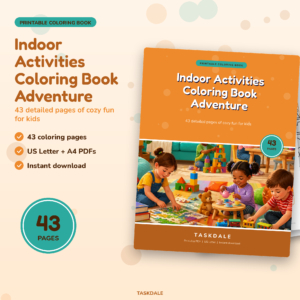
Indoor Activities Coloring Book Adventure
Price: $2.99 | Best for: rainy days stuck at home
This book has 43 detailed scenes of things kids do at home, such as building a blanket fort, baking cookies, a reading nook and a board game night. Big shapes suit younger kids and the patterned rugs and toy shelves keep older ones busy. Print a page, color it, and then try the activity it shows, so the afternoon has a plan.
One family trick: color the blanket fort page, then build the fort, then play markings bingo inside it with a torch. The cancelled lesson is forgotten by teatime.
Adding story and role play
Some kids learn best by pretending. For them, a markings game works better if it becomes a story. The dream horse needs a vet check. The vet has to fill in a form describing the horse’s markings so it can be found if it gets lost.
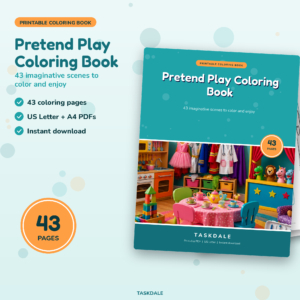
Pretend Play Coloring Book
Price: $2.99 | Best for: kids who love dressing up
This book has 43 scenes built around jobs and adventures, including a vet with a puppy on the exam table, a zoo keeper and a supermarket shopper. Each scene is packed with props to color and talk about. Print the vet page alongside a horse page, and your child can play vet for her own dream horse.
For more animal pages to mix in, our guide to animal coloring pages for safari, farm, ocean and woodland has a set for every interest. And if you still need free horse pages to start with, see our roundup of horse coloring book pages and printable breeds for kids.
Frequently asked questions
What are the main horse face markings?
Star, strip, blaze, snip and bald face. A horse can have one, several joined together, or none at all.
What is the difference between a sock and a stocking on a horse?
A sock goes up past the fetlock but stays below the knee or hock. A stocking reaches the knee or hock.
What age are horse markings activities good for?
From about five. Younger children can color the shapes, and from seven or eight most kids can read the names and play the games alone.
Can I use these activities for a pony club or riding school?
Yes. Print one guide per table, pair older and younger riders, and finish by matching colored pages to real horses on the yard.
What colors do I need for horse coat colors?
Brown, red-brown, black, gray, golden yellow, cream and tan cover all nine common coats. A white crayon is handy for roan speckles.
How do I color white markings on white paper?
Leave the marking uncolored and shade its edge with pale gray. The coat color around it does the rest, so the white shape stands out clearly.
Your next step
Pick one game from the list and play it tonight with a single printed page. If it clicks, the Gallop Gallery Horse Breeds Coloring Book gives you the markings guides, coat colors and 24 breeds to run the full five-day plan.