A horse-mad child does not want any old horse. She wants a Shetland pony with a shaggy mane, or a Friesian as black as a piano. Most free horse coloring book pages give her one generic horse standing in a field, and the novelty wears off by the third copy.
This guide is for parents, grandparents and teachers who want horse pages that hold a child’s attention. You will see where free printable horses come from, what they are good for, how to choose pages by age, and a few simple ways to sneak real horse facts into coloring time. We also show the printable breed book we sell on Taskdale and when it beats the free stuff.
Quick picks: printable horse and farm coloring books
| Product | Best for | Price | Link |
|---|---|---|---|
| Gallop Gallery Horse Breeds Coloring Book | 24 real breeds, easy and realistic pages | $4.99 | View |
| Farm Animals Coloring Book | Little kids who like barns and stables | $3.49 | View |
| Orbit Pals Printable Coloring Book | Animal fans ready for something silly | $3.99 | View |
Where free horse coloring pages actually come from
Free horse pages are everywhere, and that is the good news. Type the words into any search bar and you will get hundreds of results in a second. Most of them come from three places.
Free printable websites
These sites post single pages, usually one horse per sheet, and pay for themselves with ads. Some are lovely. Many are traced from the same handful of drawings, so you see the same rearing stallion on ten different sites. Expect pop-ups, a few clicks to reach the actual PDF, and pages sized for US Letter only.
Libraries, schools and riding clubs
Your local library may have a printer and a shelf of activity sheets, especially during summer reading programs. Riding schools and pony clubs sometimes hand out coloring sheets at open days. Ask. A seven-year-old who gets a free pony page at the stables will treasure it more than anything downloaded at home.
Your own drawing
Do not rule this out. Print a clear photo of a horse, lay a sheet of plain paper over it against a sunny window, and trace the outline with a black marker. Ten minutes, and you have a page of the exact horse your child rides on Saturdays. It will not be perfect. Kids do not mind.
We pulled together more no-cost options, from public domain books to whole PDFs, in our guide to coloring book PDFs you can print tonight.
What free pages are good for, and where they fall short
Free pages are perfect for a one-off. A rainy Tuesday, a sick day, a waiting room. Print two horses, hand over the crayons, done. No money spent and no harm if the page ends up crumpled under the sofa.
The trouble starts when your child gets hooked. A horse fan of eight or nine starts asking questions. Is that a Mustang or a Quarter Horse? Why is that one so fluffy? What does “palomino” mean? Free pages rarely say what breed the horse is, and almost never tell you anything about it.
There is also the mix problem. You end up with one cartoon pony, one photo-real stallion, one wobbly foal and three different paper sizes. Nothing matches, nothing builds, and the pile in the drawer gets messy fast. That is the point where a single book of real breeds, drawn in one style, starts to make sense.
Time counts too. Hunting down a decent Clydesdale, then a decent Arabian, then a pony that does not look like a dog, can eat a whole evening. If you only need one page, that is fine. If you need a page a day for the summer holidays, the hunting gets old by the second week.
Picking horse pages by age
Match the line thickness to the hand holding the crayon. That one rule saves a lot of tears.
Ages 3 to 5
Look for one horse per page, outlines as thick as a pencil, and almost no background. A big round belly, four legs and a tail are plenty. Fat crayons work better than colored pencils at this age, and a page should take ten minutes, not forty.
Ages 6 to 9
Now they can handle a fence, a barn, maybe a foal beside its mother. This is the age when breed names start to matter. A child who learns that a Shire is a giant and a Shetland is a tiny pony will want to color both and compare them.
Ages 10 and up
Older kids often want pages that look real. Flowing manes, muscles under the coat, a proper landscape behind the horse. Give them sharpened colored pencils and a realistic page, and they will happily spend an hour on one Arabian.
A printable book of 24 real breeds
We made Gallop Gallery for the horse fan who has outgrown generic ponies. Every breed comes twice, once as a bold easy page and once as a detailed portrait, so a younger sibling and an older one can color the same horse side by side. The breeds run from the Miniature Horse and Shetland Pony to the Clydesdale, Shire and Belgian.
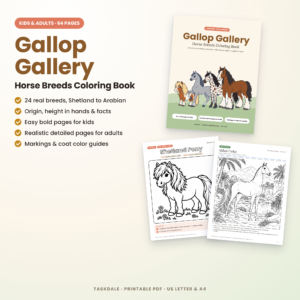
Gallop Gallery Horse Breeds Coloring Book
Price: $4.99 | Best for: horse-mad kids ages 4 and up
Inside are 24 easy pages and 24 realistic pages of the same breeds, each with its origin, height in hands and short facts. There are guides to face markings, leg markings and coat colors, a word search and a measuring chart. You get US Letter and A4 PDFs of 64 pages each, so start by printing the Shetland Pony easy page and the Shire easy page and let your child compare them.
The facts are short on purpose. Two lines on the kids’ page, three on the adult page. That is enough to start a conversation without turning a calm hour into a lesson.
Turning coloring time into horse know-how
Horse people have a language of their own, and kids love learning a secret code. Coloring is a sneaky way to teach it.
- Hands. Horses are measured in hands, and one hand is 4 inches. Measure your child’s hand with a ruler and see how close it gets. Then work out how many of their own hands tall the Shire would be.
- Coat colors. Bay means a brown body with a black mane, tail and legs. Chestnut is reddish brown all over. Palomino is golden with a pale mane. Give each one a try on scrap paper first.
- Face markings. A star is a white patch on the forehead. A blaze is a wide white stripe down the face. Let your child invent a horse with both.
Here is a small game that works well with two kids. One person secretly picks a coat color and two markings and writes them down. The other colors a horse to match from the description alone. Then compare. Laughter is guaranteed when a “chestnut with a blaze and one sock” comes out purple.
A week of horse pages, one breed a day
Kids stick with things that have a shape to them. A loose pile of pages gets ignored. A plan with a name on it, like Horse Week, gets talked about at breakfast.
- Monday: the smallest. Color a Miniature Horse or a Shetland Pony. Guess how many hands tall it is before you read the answer.
- Tuesday: the biggest. Color a Shire or a Clydesdale. Stand your child next to a doorway and talk about how a big draft horse would only just squeeze through.
- Wednesday: the fastest. A Thoroughbred, colored in bay with a white star.
- Thursday: the far-away one. An Icelandic horse or a Fjord horse, then find the country on a map.
- Friday: free choice. Let your child pick any breed and any colors, real or not.
By Friday you have five finished horses for the fridge and a child who can tell a draft horse from a pony. Not bad for twenty minutes a day.
For the youngest riders: barnyard pages
Some children are not ready for breed names yet. They just love the farm, the stable, the smell of hay. For a three-year-old, a horse by a barn with a chicken nearby is the dream page.
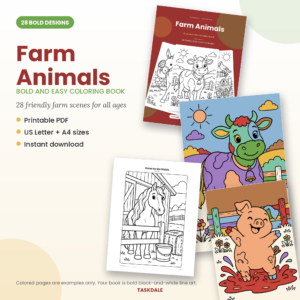
Farm Animals Coloring Book
Price: $3.49 | Best for: preschoolers who love barns and animals
This book has 28 bold scenes of cows, pigs, hens, sheep, goats and horses, including a horse by the stable. The outlines are thick and the shapes are big, so a fat crayon stays inside the lines more often than not. It comes as a printable PDF in US Letter and A4, so print the stable page first and tape the finished horse above your child’s bed.
A farm book also keeps the peace when a younger sibling wants to join in. The big kid colors a Lipizzaner. The little one colors a horse next to a duck pond. Everyone has a horse, and nobody feels left out.
Printing horse pages at home
Printing is where a good page can go wrong. A few minutes of setup saves a stack of wasted paper.
- Print at actual size. In the print box, choose 100% or Actual size, not Fit to page. Otherwise margins shrink and lines can look fuzzy.
- Pick the right paper size. If you live outside the US, use the A4 file. US Letter printed on A4 leaves an odd strip at the bottom.
- Use thicker paper for markers. Plain copier paper is fine for crayons. For markers, try 28 lb or 100 gsm paper, and slide a spare sheet underneath.
- Print one test page. Check that the black lines are dark and crisp before you print twenty copies for a birthday party.
One nice thing about printables: favorites never run out. If your daughter colors the Friesian four times in four different shades, let her. Print a fifth.
Horse coloring for parties, camps and classrooms
A stack of horse pages solves a surprising number of problems. At a horse-themed birthday, put a page at each seat with a cup of crayons. Guests color while the cake comes out, and everyone leaves with something they made.
Teachers can pair breeds with a map. Color the Icelandic horse, then find Iceland on the globe. Color the Andalusian, then find Spain. A class of 25 can each take a different breed and build a wall display of where horses come from.
Riding instructors and pony club leaders have another use. Rainy days at the stable. When the arena is flooded, ten kids in a tack room with coloring pages and a markings guide is a far calmer afternoon than ten kids with nothing to do.
When your horse fan wants something different
Even the most devoted horse lover has days when she wants a break from realism. That is fine. A silly animal page can be a nice reset, and it keeps the coloring habit going.
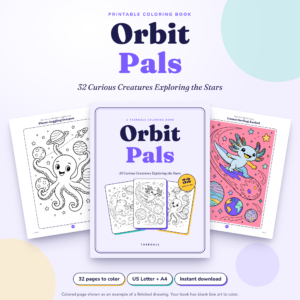
Orbit Pals Printable Coloring Book
Price: $3.99 | Best for: animal fans aged seven and up
Orbit Pals has 32 full-page drawings of animals loose in outer space, like an axolotl surfing a comet and a capybara in a moon bath. You get US Letter and A4 PDFs, a pack of single-page PNG files for reprinting, and a short print guide. Try it on a day when realistic horses feel like homework, and let your child pick any colors at all.
For more ideas on keeping kids busy without a screen, our list of printable coloring books for screen-free days has a few more favorites.
Frequently asked questions
Where can I get free horse coloring pages to print?
Free printable sites, your local library and riding schools are the easiest places to start. You can also trace a photo of a horse onto plain paper for a page of your child’s favorite horse.
What age are horse coloring book pages for?
Any age, as long as the detail fits the child. Ages 3 to 5 need thick outlines and one horse per page, while kids of 10 and up often prefer realistic portraits.
Is Gallop Gallery a free download?
No. It is a paid printable book, and the price shows live in the table above. Once you buy it, you can print the pages as often as you like for your household or class.
What colors should I use for a real horse?
Start with the common coat colors: bay, chestnut, black, gray and palomino. Brown, red-brown, black and golden yellow pencils will cover most breeds.
How tall is a pony compared with a horse?
Riders usually call anything under 14.2 hands a pony. That is 58 inches at the shoulder, about the height of a tall ten-year-old.
What paper is best for horse coloring pages?
Standard copier paper works for crayons and pencils. Use heavier paper if your child likes markers, so the ink does not bleed through.
Your next step
Tonight, print one free horse page and ask your child which breed it might be. If the questions keep coming, that is your sign. Grab the Gallop Gallery Horse Breeds Coloring Book, print the Shetland and the Shire, and let the comparing begin.