A spending tracker to catch small leaks does one job that your bank app rarely does well: it makes the little stuff visible. Big bills get noticed. Rent, the car payment and the electricity bill all have names and due dates. The $3.80 vending machine snack, the $5.99 delivery fee and the streaming trial you forgot to cancel do not. Together, they can quietly eat a few hundred dollars a month.
This guide is for anyone who earns a decent amount, pays the big bills on time, and still wonders where the money went by the 20th. You will learn which leaks are most common, how to run a simple 30-day leak hunt, what a real month of leaks can add up to, and how to plug them without feeling like you have banned all joy. We also look at three Taskdale tools for tracking by hand, by spreadsheet, or by working through the feelings behind the spending.
Quick picks: trackers for finding leaks
| Product | Best for | Price | Link |
|---|---|---|---|
| Quiet Coin Kakeibo Money Journal | Writing every purchase by hand | $5.99 | View |
| Blush & Balance Income and Expense Tracker | Ranking spending by category | $7.99 | View |
| The Money Exhale Financial Anxiety Workbook | Leaks driven by stress or habit | $17.99 | View |
What counts as a small leak?
A leak is any regular spending that you would not choose if you saw the monthly total first. It is not about whether the item is good or bad. A daily latte you love and plan for is not a leak. A daily latte you buy on autopilot, then forget about, probably is.
The usual suspects look like this:
- Convenience food: the meal deal at lunch, the snack at the fuel station, the bottled water you meant to bring from home.
- Delivery and service fees: the $4 or $6 added to every takeaway order, plus a tip and a small order charge.
- Subscriptions: streaming, music, cloud storage, fitness apps, a magazine you stopped reading in spring.
- Bank and card fees: ATM charges, monthly account fees, a late fee on a card you forgot was due.
- In-app purchases: game coins, extra lives, premium filters, often bought by kids on a shared account.
- The quick top-up shop: you pop in for milk and leave with $26 of things that were on offer.
- Upgrades: the larger size, the faster shipping, the extra legroom seat.
Each one feels too small to worry about. That is exactly why they leak.
Why small spending is so hard to see
Tapping a card or a phone takes half a second. There is no cash leaving your hand and no moment where you count change. A $6 purchase barely registers, and by the evening you have forgotten it happened.
Bank apps do not help much. They show a long list of merchant names, often in shorthand you do not recognise, sorted by date rather than by what kind of spending it was. Ten coffees scattered across thirty days look like nothing. Grouped together, they look like $47.
There is also the monthly maths problem. People think about small purchases one at a time, but they pay for them as a monthly and yearly total. A $2.99 app does not feel like $36 a year. A $12 lunch three times a week does not feel like $1,800 a year. A spending tracker fixes this by grouping and totaling, so the real number stares back at you.
Run a 30-day leak hunt
You do not need to track forever to find leaks. One honest month usually shows you everything. Here is how to run it.
- Pick a start date. The day after payday works well because you begin with a clean slate.
- Record every purchase. Every single one, including the $1.50 parking meter. Write it down the same day, ideally within an hour.
- Add a category. Keep it broad: needs, wants, subscriptions, fees, and treats.
- Mark anything under $20 with a star. This is where most leaks hide.
- Check your bank and card statements weekly. Look for anything you did not write down, especially automatic payments.
- On day 30, total the starred items. Group them by type and multiply each group by 12.
That last step is the eye-opener. Seeing a yearly figure next to each leak turns vague guilt into a clear choice. You are no longer asking “should I stop buying coffee?” You are asking “is this worth $570 a year to me?” Sometimes the honest answer is yes, and that is fine.
A worked example: one month, one ordinary household
Here is what a 30-day hunt turned up for Leah, a dental receptionist who takes home $3,100 a month and felt she was “pretty careful”. Nothing on this list is extravagant. That is the point.
| Leak | How often | Month total | Year total |
|---|---|---|---|
| Coffee on the way to work | 12 times at $4.75 | $57 | $684 |
| Takeaway delivery and service fees | 6 orders at $7.50 in fees | $45 | $540 |
| Subscriptions she rarely used | 3 services | $32 | $384 |
| Corner shop top-ups | 7 trips, average $14 extra | $98 | $1,176 |
| ATM fees | 4 withdrawals at $3 | $12 | $144 |
| Game purchases on her son’s tablet | 5 small buys | $22 | $264 |
| Total | $266 | $3,192 |
Leah did not quit everything. She kept her coffee on Fridays, cancelled two of the three subscriptions, switched to a bank with free ATM withdrawals, set a password on in-app purchases, and started taking a short list into the corner shop. Her monthly leaks dropped to about $90. That freed $176 a month, which she sent straight to a holiday fund. Six months later she had over $1,000 saved without cutting a single thing she truly missed.
Track by hand: the kakeibo way
Writing purchases by hand is slower than tapping an app. That slowness is the feature. When you have to write “crisps, $2.40” in your own handwriting for the third time this week, you notice.
Kakeibo is a Japanese household account book method built on this idea. Each month opens with four questions: how much money do you have, how much would you like to save, how much are you actually spending, and how can you improve? Purchases go into four groups: survival, optional, culture and extra. At the end of the month, you total each group and choose one gentle change for next month. Just one. That small scope is why people stick with it.
For a leak hunt, the Optional and Extra columns tend to light up. If your Optional total is twice what you expected, you have found your leak in about three minutes.
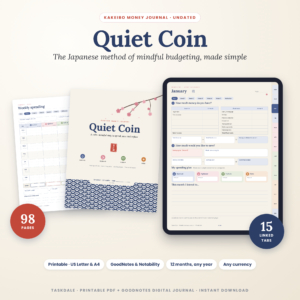
Quiet Coin Kakeibo Money Journal
Price: $5.99 | Best for: people who think better with a pen
Quiet Coin is an undated kakeibo journal as a printable PDF in US Letter (98 pages) and A4, plus a hyperlinked digital version for GoodNotes and Notability. Each month has a start-of-month plan, five weekly spending pages with a row for every day and all four category columns, and a reflection page. It also has a 30-day wish list for catching impulse buys. Print one month and start on the day after payday.
If cash helps you feel spending more sharply, our guide to cash stuffing for beginners pairs well with a handwritten journal.
Track in a spreadsheet: let the totals rank themselves
A spreadsheet does the adding for you, and it is brilliant at one thing a journal cannot do quickly: ranking. Once your purchases are in, a good tracker will sort your categories from biggest to smallest. The leak you did not suspect often jumps into the top five.
Spreadsheets also help when you have several accounts. If you pay for some things with a debit card, some with a credit card and some from a digital wallet, each account’s statement only shows part of the picture. A single log brings them together.
To get the most from a spreadsheet during a leak hunt, add your own categories for the usual suspects: Coffee and snacks, Delivery fees, Subscriptions, Bank fees and Top-up shopping. Broad categories like “Food” hide leaks inside big normal numbers. Specific ones expose them.
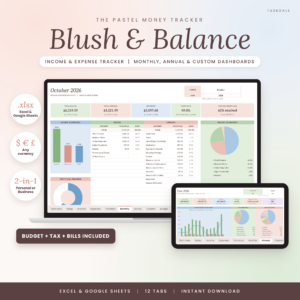
Blush and Balance Income and Expense Tracker
Price: $7.99 | Best for: households and side hustlers tracking every account
Blush and Balance works in Excel and Google Sheets with 12 tabs, up to 40 expense categories with monthly budgets, and 20 accounts. The monthly dashboard ranks your expense categories from biggest to smallest and shows your largest expense and average daily spending. Transfers have their own log, so card payments do not double count. Set up your leak categories first, then log a full month.
Plugging the leaks without feeling deprived
Finding leaks is the fun part. Fixing them is where people overdo it. If you ban every treat on day one, you will be back at the drive-through by week three, feeling worse than before. Aim for smaller, steadier changes.
Cap it, do not ban it
Instead of “no more takeaway”, try “two takeaways a month”. A cap keeps the thing you enjoy and stops the drift. Write the cap at the top of your tracker so you see it every time you log.
Add friction
Delete saved card details from shopping sites and food apps. Log out of the app after each order. Those 40 extra seconds are often enough to change your mind.
Use a 24-hour rule
For anything that is not food or a bill, wait a day. Put it on a wish list. If you still want it tomorrow, buy it without guilt.
Do a subscription sweep
Go through every recurring charge on your statements and ask one question: did I use this in the last 30 days? Our step-by-step subscription tracker guide shows how to list and cancel the ones you forgot about.
Give the saved money a job
Money saved from leaks tends to leak somewhere else unless you move it. Set up an automatic transfer for the amount you expect to save, on the day after payday. Watching that pot grow is the reward that keeps you going.
When the leak is really a feeling
Some leaks are not about convenience at all. The online order at 11 pm after a hard day. The shopping trip after a fight. The treat that becomes a daily habit because work has been grim for months. A tracker shows you the pattern. It does not always show you why.
If your leak hunt keeps pointing to the same stressful moments, it helps to add one column to your tracker: “How was I feeling?” Bored, tired, anxious, celebrating. After two weeks, the link between mood and spending is often obvious. That is not a reason for shame. It is useful information, and it means the fix might be an earlier night or a walk, not a stricter budget.
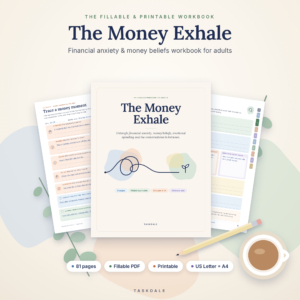
The Money Exhale Financial Anxiety Workbook
Price: $17.99 | Best for: stress spenders and money avoiders
The Money Exhale is an 81-page fillable and printable workbook in US Letter and A4. It helps you trace where your money beliefs came from, slow down emotional spending, open the mail you have been avoiding and prepare for money conversations. Gentle prompts and worked examples sit beside roomy writing spaces. Start with the emotional spending section if your tracker shows late-night or after-work patterns.
Mistakes that hide leaks instead of finding them
- Rounding. Writing $4 instead of $4.75 seems harmless, but across a month it can hide $20 or more.
- Logging at the end of the week. By Sunday, you will have forgotten the small stuff, which is the stuff you are hunting.
- Using one giant Shopping category. Split it so leaks cannot hide inside normal spending.
- Skipping cash. Cash purchases leave no statement trail. Write them down on the spot.
- Tracking without reviewing. A log nobody reads is just a diary of spending. Set a 15-minute review on day 30.
- Judging yourself. You are collecting facts, not evidence for a trial. Curiosity works better than guilt.
Frequently asked questions
How long should I track spending to find leaks?
Thirty days is usually enough to spot patterns. If your spending changes a lot by season, a second month later in the year is worth doing too.
What is the easiest way to track small purchases?
Write each purchase down within an hour, in a pocket journal or a spreadsheet on your phone. The habit matters more than the tool.
Are small purchases really a big deal?
On their own, no. As a group, they often add up to hundreds of dollars a month. Multiply each leak by 12 to see what it costs you over a year.
Should I use a spending tracker app or a spreadsheet?
Either works. A spreadsheet or a printable avoids bank logins and subscription fees, and typing or writing each purchase yourself makes you notice it more.
How do I stop emotional spending?
Add a mood column to your tracker for two weeks to spot the pattern, then plan a different response for those moments, like a 24-hour wait or a short walk.
Start your leak hunt tomorrow
Pick tomorrow as day one. Carry a pen or open a sheet on your phone, and write down every purchase, even the tiny ones. On day 30, total your starred items and multiply by 12. If you would like a calm, guided way to do it on paper, start with the Quiet Coin Kakeibo Money Journal.