The groceries envelope is empty and it is only the 19th. No card swipe to hide behind, no app to fudge the number. Just a thin, honest envelope and a decision about what to do next. That is cash stuffing in one scene, and it is why people swear by it. This guide to cash stuffing for beginners explains how the method works, how to set up your first envelopes, how to split a paycheck, and how to keep a simple record so your cash plan matches the rest of your money. No hype, just the steps.
Quick picks
| Product | Best for | Price | Link |
|---|---|---|---|
| Lantern Budget System | A cash envelope budget in Excel with sinking funds | $12.99 | View |
| Payday Bloom Paycheck Budget Planner Printable | Printable paycheck worksheets with cash stuffing pages | $2.49 | View |
| Moneybloom 6-Month Budget Binder | A printable six month binder with cash envelope pages | $8.99 | View |
What cash stuffing is, in plain words
Cash stuffing is a cash envelope budget with a trendy name. You decide how much money each spending category gets for the month. You take that amount out in cash. You put it into labeled envelopes, then spend from each envelope only. When an envelope is empty, that category is done until the next payday.
That is it. The method is old. People did it with jars and tins long before social media gave it a name. What makes it work is friction. Handing over real notes feels different from tapping a card, and most of us spend less when we can see the money shrink.
One note before we go on. This is general budgeting information, not personal financial advice. Keep your cash safe, and use the method in a way that suits your income, your bank and your local rules.
Why beginners like a cash envelope budget
There are three big reasons. First, it makes limits visible. A bank balance is an abstract number. A $40 envelope for eating out is a thing you can hold. Second, it forces choices. If your coffee envelope is empty, you brew at home, and nobody had to lecture you. Third, it is calm. There is no formula to learn, no software, no tracking every single latte in an app.
It also gives you a little hit of satisfaction. Moving cash into envelopes on payday feels like finally being in charge. Some people turn it into a ritual, with music, a snack and a clean table. Strange as it sounds, that ritual is a big part of why the habit sticks.
How to start cash stuffing for beginners, step by step
Step one: know what comes in
Write down your take-home pay for the month, or for each paycheck if you are paid more often. Use the real amount after tax. If your income varies, use your lowest recent month as the base and treat anything extra as a bonus to assign later.
Step two: cover the bills first
Rent, power, phone, insurance, loan payments. These usually stay on the bank or card, because paying in cash is risky or not possible. List them, set them aside, and make sure the money is in the account on time. Cash envelopes are for the spending that tends to leak: groceries, fuel, eating out, fun, clothes, kids.
Step three: pick your categories
Start with four to six. Too many envelopes become a chore. A good starter set is groceries, fuel or transport, eating out, personal spending, and one “everything else” envelope for small things. You can add more once the habit is steady.
Step four: set the amounts
Look at your last two or three months of card statements and see what you really spent in each category. Be honest. Then set each envelope slightly below that, so the budget gently pushes you down. If groceries ran $480, try $440. Change it after a month once you see how it feels.
Step five: withdraw and stuff
On payday, take out the total cash you need and sort it into envelopes. Write the category and the amount on the front. Keep them together in a small binder, pouch or zip wallet. Done. You have stuffed your first envelopes.
A sample paycheck split to copy
Here is an example, only for illustration. Say you take home $2,000 a month. Bills paid from the bank: rent and utilities $1,100, and phone and insurance $150. That leaves $750. Savings and debt: $150, moved straight to a savings account by transfer. That leaves $600 for cash envelopes. Groceries $300, fuel $100, eating out $60, personal spending $60, household and misc $50, and a small “oops” envelope of $30.
Yes, this is tight, and your numbers will differ. The shape is what matters. Bills and savings first, cash for everyday spending second, and a little cushion for the unexpected.
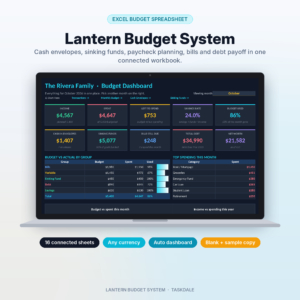
Lantern Budget System
Price: $12.99 | Best for: people who want a real cash envelope system in Excel
Lantern Budget System is a cash envelope budget spreadsheet for Excel. It comes with a sinking funds tracker, a paycheck budget, a bill calendar and a debt snowball. It suits people who want the envelope method for daily spending and a spreadsheet to keep the bigger picture in view.
Sinking funds and the envelopes you do not spend monthly
Some costs come once or twice a year. A car service, a school trip, a birthday party, holiday gifts, a vet bill. These sneak up and wreck a budget. Sinking funds fix that. You add a small envelope, or a savings line, and drop a fixed amount in each payday.
Say the car needs $360 of service in six months. Put $60 a month aside, and when the bill comes it is already paid. Boring, and wonderful. Many people keep their sinking funds in a separate savings account instead of cash, since large cash piles are not safe in a drawer. Use a mix that you are comfortable with.
Common cash stuffing mistakes
The first is starting with too many envelopes. Ten categories on day one is a recipe for quitting by day ten. The second is setting amounts you can never meet. If the groceries envelope is $200 for a family of five, you will raid other envelopes in week two. Be realistic, then tighten over time.
The third is borrowing between envelopes without a rule. A little borrowing is fine, but write it down. Otherwise one empty envelope quietly drains all the others. The fourth is carrying too much cash around. Leave most of the envelopes at home and take only what you need for the day or week.
The fifth is skipping the record keeping. Cash leaves no trail, so you have to make one. A simple note of what you took out and what is left each week is enough. Without that, you cannot tell whether the plan is working.
Keeping a simple record of your cash
Here is the easy way. Each payday, write down how much you put into each envelope. Once a week, count what is left and note it. At month end, add up what you spent in each category, and compare with the amount you assigned. That tells you whether to raise or lower next month’s amount.
A spreadsheet makes this quick, because it does the adding. A printed page works too, if you like writing by hand. What matters is that the record lives somewhere you will see it. A cash plan with no record is just a hope.
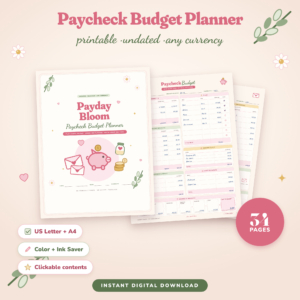
Payday Bloom Paycheck Budget Planner Printable
Price: $2.49 | Best for: people who budget paycheck by paycheck and want printable worksheets
Payday Bloom Paycheck Budget Planner is a printable set of budget by paycheck worksheets, with cash stuffing pages, sinking funds and a debt payoff tracker. It comes as a US Letter and A4 PDF. At $2.49 it is a low cost way to try cash stuffing on paper before you commit to a bigger system.
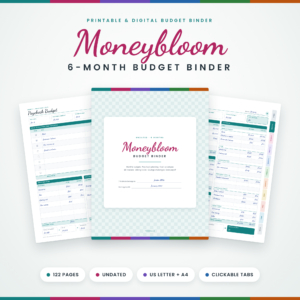
Moneybloom 6-Month Budget Binder
Price: $8.99 | Best for: people who want a printable binder with cash envelope pages
Moneybloom 6-Month Budget Binder is an undated printable budget planner with a paycheck budget, bill tracker, cash envelopes, sinking funds and savings challenges. It comes as a US Letter and A4 PDF. It suits anyone who likes to see the cash plan on paper, one six month stretch at a time.
Making cash stuffing a habit that lasts
The method works best when it is tied to your pay schedule. Pick a payday ritual and keep it short. Check the bank, move the savings, withdraw the cash, stuff the envelopes, write the amounts. Fifteen minutes, tops.
Give yourself a small reward for the first full month. Not a spending spree, just something you chose and saved for. Then review. Which envelope was always empty? Which one always had money left? Move a few dollars from the second to the first, and the plan fits you better.
And be kind when it goes wrong. You will overspend in some envelope. Everyone does. Note it, adjust and move on. The point is to learn your real spending, and an empty envelope teaches that better than any lecture.
If you share money with a partner, do the payday ritual together. Agree on the categories and the amounts, and decide who carries which envelope. Two people working from one plan beats two people guessing. If one of you keeps spending from the shared groceries envelope on lunch, a ten minute chat in week one is far cheaper than a grumpy week four.
Finally, keep it flexible. Some months you will have extra cash from a bonus or a side job. Decide in advance where extra money goes, such as the sinking fund or the savings account, so it does not vanish into the fun envelope.
Which Taskdale tool pairs well with cash stuffing?
Cash covers your daily spending, but the rest of your money still needs a home. If you like a spreadsheet and want envelopes, sinking funds, a bill calendar and a debt snowball together, Lantern Budget System is the fullest option here. If you want to try cash stuffing on paper for a few dollars, Payday Bloom has the worksheets. If you want a binder to hold the plan for six months, Moneybloom is the one. For more budgeting ideas across the year, see our roundup of the best budget planner templates.
| Product | Format | Price | Best for | Link |
|---|---|---|---|---|
| Lantern Budget System | Excel spreadsheet | $12.99 | Envelopes, sinking funds, bill calendar and debt snowball | View |
| Payday Bloom Paycheck Budget Planner Printable | Printable PDF (US Letter, A4) | $2.49 | Paycheck worksheets with cash stuffing pages | View |
| Moneybloom 6-Month Budget Binder | Printable PDF (US Letter, A4) | $8.99 | A six month binder with cash envelope pages | View |
Frequently asked questions
What is cash stuffing for beginners?
Cash stuffing is a cash envelope budget. You set an amount for each spending category, withdraw it in cash, and put it into labeled envelopes. You spend only from the matching envelope, and when it is empty, that category waits until the next payday.
How much money do I need to start cash stuffing?
You can begin with any amount. Even $100 split across a few envelopes is a fine start. Focus on the spending that leaks most, such as groceries or eating out, and add more envelopes as the habit settles in.
Which categories should I use for my first envelopes?
Start with four to six. Groceries, fuel or transport, eating out, personal spending and a general envelope for small items work well. Keep bills like rent and utilities in the bank, and add sinking funds for yearly costs later.
Is cash stuffing safe?
It can be, if you take care. Keep envelopes in a secure place, carry only what you need, and avoid storing large amounts of cash at home. Many people keep savings and sinking funds in a bank account and only use cash for daily spending.
What if I run out of cash in an envelope early?
Treat it as information. You can pause that spending, borrow from another envelope with a written note, or adjust the amount next month. Do not hide it. An empty envelope early in the month tells you the amount needs another look.
Your next step
So, the short version: choose four envelopes, set honest amounts, and stuff them on your next payday. Keep a simple record so you can adjust. If you want a full system, start with Lantern Budget System, and if you would rather try it on paper first, Payday Bloom costs just a few dollars.