A preschooler does not need a fancy page. A big circle, a fat cat, a red cup. That is enough for ten happy minutes and a proud “I did it!” The good news is that the best preschool coloring pages are simple enough that you can find plenty for free, or even draw them yourself on the back of an envelope.
This guide is for parents, preschool teachers and childminders looking after kids aged roughly 3 to 5. You will learn where free shapes, animal and everyday object pages come from, what each source is good for, how to make your own in under five minutes, and when a ready-made printable set saves you real time. We also share a simple week-long coloring plan.
Quick picks: ready-made preschool sets
| Product | Best for | Price | Link |
|---|---|---|---|
| Crayon Campus Preschool Learning Coloring Worksheets | Shapes, numbers 1 to 20, colors and counting | $4.99 | View |
| Little Explorers Preschool Coloring Book | Animals, vehicles and everyday scenes for ages 2 to 5 | $3.49 | View |
| Farm Animals Coloring Book | Barnyard animals with thick, easy lines | $3.49 | View |
Where free preschool coloring pages really come from
There is no shortage of free pages. The trick is knowing which sources give you pages a three-year-old can actually color. Here is an honest rundown.
Free printable websites
Search for “free preschool coloring pages” and you will find thousands. Many are perfectly fine. The catch is that quality varies wildly from page to page. One site has a lovely fat elephant, the next has a thin-lined, detailed scene labeled “for preschool” that a six-year-old would struggle with. Expect pop-up ads, pages that print with a website logo in the corner, and the odd download button that is really an ad. Look before you click.
Libraries and community centers
Many public libraries keep a stack of coloring sheets near the children’s section, especially around story time. They are free to take, already printed, and usually chosen by someone who knows small kids. The downside is that you get whatever theme they picked that week.
Zoos, museums and science centers
Some museums and zoos offer free activity sheets on their websites or at the front desk. These are great as a follow-up to a visit, since the child has just seen the real animal or object.
Free samples from designers
Some sellers share a few free pages from their books so you can test the style. That is a smart way to check line weight and difficulty before you buy anything. Our preschool coloring pages PDF guide includes a few free pages you can print tonight.
Your own pen
The most underrated free source is you. More on that next.
For a wider look at both free and paid options across all ages, see our guide on where to find good printable coloring pages.
Make your own pages in five minutes
A preschool page does not need art skills. It needs thick lines and one clear shape. Grab a black marker and a sheet of printer paper.
- Use a thick marker. A chisel-tip or fat felt pen gives you lines a crayon can bump against. Thin pens make lines that disappear.
- Draw one big shape. A circle the size of a saucer. Trace around a real saucer if you like.
- Turn it into something. Add two triangle ears and whiskers, and it is a cat. Add a stem and a leaf, and it is an apple. Add rays, and it is the sun.
- Write the word underneath. Big letters. “CAT.” The child sees the word every time they color.
- Photocopy or photograph it. Then you can print it again tomorrow.
Some favorite five-minute pages: a ball, a cup, a house (square plus triangle), a fish (oval plus triangle tail), a car (rectangle plus two circles), a balloon with a string. A child who watches you draw the page often loves it more than any printed one. They saw it being made, just for them.
The limit is time. Drawing one page is a joy. Drawing 20 pages for a class of 18 on a Sunday night is not.
Shapes first: why circles come before cats
Shapes are the building blocks of everything a preschooler will later draw. A child who can color a circle, square and triangle, and name them, has the start of both early math and early drawing. That is why so many preschool programs start with shape pages.
Good shape pages do more than show a circle. They hide the shape in real life. A circle becomes a clock, a cookie, a wheel. A triangle becomes a slice of pizza, a party hat, a roof. Kids start pointing at shapes on walks: “That sign is a triangle!” It is a lovely moment when it happens.
A simple shape order for ages 3 to 5
- Circle first, because it is everywhere: plates, balls, the sun.
- Square next: windows, blocks, a slice of toast.
- Triangle: roofs, pizza, mountains.
- Rectangle: doors, books, a bus.
- Star, heart and oval once the basics are solid.
If you want shapes, numbers and colors in one organized set rather than pages hunted one by one, a structured worksheet pack does the planning for you.
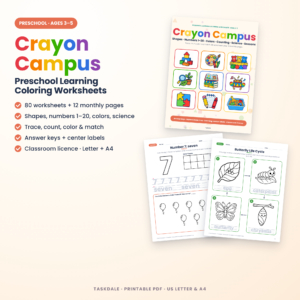
Crayon Campus Preschool Learning Worksheets
Price: $4.99 | Best for: preschool teachers and homeschool families
Eighty coloring worksheets in clear sections: Shapes, Numbers 1 to 20, Counting and Math, Colors, Matching and Science, plus 12 seasonal pages, one for each month. Each page has one simple job, a name and date line and a one-line instruction to read aloud. It includes answer keys, a skills checklist, a certificate and learning-center labels, in US Letter and A4. Start with the shapes section, one page a day.
Animals preschoolers already know
Animals are the most-asked-for preschool coloring subject, and for good reason. A child who knows the cow says “moo” will color a cow with real enthusiasm. Stick to animals they have seen in books, on farms, at the park or at home.
The best animal pages for this age show one animal, big, with a friendly face. A pig standing in a puddle. A hen with an egg. A dog with a ball. Avoid pages with lots of fur detail, grass blades or busy backgrounds. To a four-year-old, those look like a hundred tiny boxes, and they will color one corner and walk away.
Talk while they color. What does the duck say? How many legs does the horse have? Is the sheep fluffy or smooth? Five easy questions turn one page into a short language lesson.
Farm animals are often the easiest win, because the sounds give you a ready-made game.
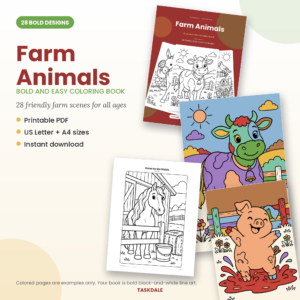
Farm Animals Coloring Book
Price: $3.49 | Best for: farm-loving kids ages 3 and up
Twenty-eight bold barnyard pages with thick outlines and large shapes: a cow in a meadow, a pig in a puddle, fluffy sheep, a hen with eggs, a goat on a fence and a rooster at sunrise. It comes in US Letter and A4 PDFs, so there is no resizing. Print the pig first and ask your child what sound it makes before they start.
Everyday objects: cups, shoes, buses and toys
This theme is often forgotten, and it is a gem. Everyday objects are the things a preschooler sees and touches all day: a toothbrush, a spoon, a teddy bear, a rain boot, a school bus. Coloring them builds vocabulary in the most practical way. A child who colors an umbrella on Tuesday is more likely to say “umbrella” on Wednesday when it rains.
Objects also make simple matching games. Color a red cup, then find the real red cup in the kitchen. Color a yellow bus, then wave at the real one on the school run. Small connections like these make coloring feel useful to kids, not just a way to fill time.
Good everyday object ideas
- Kitchen: cup, spoon, apple, banana, teapot.
- Getting dressed: sock, shoe, hat, mittens, rain boots.
- Play: ball, blocks, teddy, kite, balloon.
- Going out: car, bus, bike, fire engine, tractor.
- Weather: sun, cloud, umbrella, raindrops.
A preschool book that mixes animals, vehicles and everyday learning saves you from hunting each theme separately.
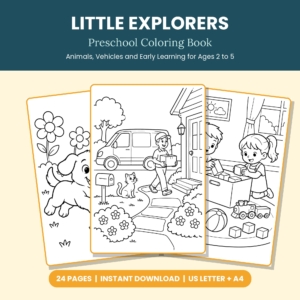
Little Explorers Preschool Coloring Book
Price: $3.49 | Best for: ages 2 to 5 at home or daycare
Twenty-four simple pages in three themes. Friendly Animals has a garden puppy and a duck family. Busy Vehicles has a digger, a fire engine and a tow truck. Early Learning covers counting ducks, a shape playground, feelings balloons, a rainy day and a tidy toy room. You get US Letter and A4 PDFs plus each page as a PNG. Try the Tidy Toy Room page and name every toy together.
When a ready-made set beats a free stack
Free pages are great for a one-off afternoon. They get harder to manage when coloring becomes a routine. Here is when a paid printable set starts to earn its place.
- You need consistency. A set drawn by one designer has the same line weight and difficulty on every page. No surprise detailed scene mixed in with easy ones.
- You are planning for a group. A teacher with 16 four-year-olds needs a stack that works for all of them, in order, without an evening of searching.
- You want a learning sequence. Shapes before numbers, numbers before counting. A worksheet pack already has that order built in.
- You are tired of ads and logos. A clean PDF prints clean.
- You want reprints. One file, any page, any time. Spilled juice on the hen? Print it again.
A fair way to decide: try free pages for two weeks. If you keep wishing for more of the same style, or you are spending 30 minutes each week searching, a set is worth it. If free pages are working, keep going. There is no wrong answer here.
A simple week of preschool coloring
Ten to fifteen minutes a day is plenty. Here is a plan that mixes all three themes.
- Monday, shape day: Color a circle page. Then go on a circle hunt around the house.
- Tuesday, animal day: Color a farm animal. Make its sound every time you change crayons.
- Wednesday, object day: Color a cup or a shoe. Find the real one and compare colors.
- Thursday, counting day: Color a page with three or four of the same thing, like ducks or apples. Count them out loud.
- Friday, free choice: Let the child pick any page from the week to color again. Repeating a favorite builds confidence.
At the end of the week, tape all five pages in a row on the wall. Kids love seeing a week of their own work lined up. It is a small gallery and a big source of pride.
Little mistakes that make preschoolers lose interest
Most of these come from good intentions. A small change fixes each one.
Choosing pages for the adult, not the child. A detailed butterfly with patterned wings looks gorgeous on screen. A four-year-old sees a puzzle with too many pieces. Pick the page with the fewest, biggest shapes.
Putting out the whole crayon box. Sixty-four colors means two minutes of choosing and one minute of coloring. Offer five or six, and swap them around through the week.
Correcting the colors. A purple dog is a fine dog. Ask about it instead: “Wow, a purple dog. What is his name?” Now you are talking, not correcting.
Expecting a finished page. Some days a child colors one ear and is done. That still counts. Write the date on it and keep it anyway.
Making it a chore. If coloring always comes right before something the child dislikes, like bath time, they may start to resist it. Pair it with something pleasant, like a snack or a favorite song.
Printing tips for small hands
A few printer settings make a real difference.
Print at actual size. “Fit to page” can shrink lines and make them thinner. Choose 100 percent.
Use slightly heavier paper for markers. Standard printer paper is fine for crayons. Washable markers can soak through, so slip a spare sheet underneath.
Print one or two pages at a time. A tall stack looks like work. One page looks like play.
Tape the corners down. Paper sliding around is a top reason preschoolers give up. A little masking tape fixes it.
Grayscale is fine. Coloring pages are black lines, so draft or grayscale mode saves ink without hurting quality.
Frequently asked questions
Where can I find free preschool coloring pages?
Free printable websites, public libraries, museum and zoo sites, and designer sample pages are all good sources. You can also draw simple pages yourself with a thick marker.
What should preschool coloring pages look like?
Thick black outlines, one big subject per page, and lots of open space. Avoid small details and busy backgrounds for kids under five.
How many coloring pages should a preschooler do a day?
One or two is plenty. A 10 to 15 minute session is a good length for most three- and four-year-olds.
Are coloring pages good for learning shapes?
Yes. Coloring a shape while saying its name, then finding it in real life, is a simple and effective way to teach circles, squares and triangles.
Can I use printable coloring pages in my preschool class?
Check the license first. Some sets include a classroom license for one teacher, and others are for personal use only.
Your next step
Tonight, draw one big circle with a thick marker, turn it into a sun or a cat, and let your preschooler color it tomorrow morning. When you are ready for a full, ordered set of shapes, numbers and colors, have a look at Crayon Campus Preschool Learning Coloring Worksheets.