Track the household expenses that change your decisions. That is the rule. Rent you already know. The $11 here and $23 there at the corner store, the water bill that crept up by a third, the dryer repair nobody planned for: those are the numbers that tell you something new.
This guide is for anyone running a home, whether that is a one-bedroom apartment or a house with four kids and a dog. You will learn which expenses to track, why each one matters, how to group them so the totals mean something, and a 15-minute weekly routine for keeping it all current. There is also a worked example from a real-looking family month, a once-a-year review, and a short list of tools if you would rather a spreadsheet did the adding.
Quick picks: tools for tracking household expenses
| Product | Best for | Price | Link |
|---|---|---|---|
| Penny & Petal Income and Expense Tracker | Families who want dashboards without linking a bank | $4.99 | View |
| Home Maintenance Tracker Spreadsheet | Homeowners logging repairs and upkeep costs | $6.99 | View |
| Quiet Coin Kakeibo Money Journal | Handwritten weekly spending logs | $5.99 | View |
| Rental Property Spreadsheet | Households that rent out a room, suite or second unit | $42.99 | View |
What counts as a household expense
A household expense is any money that leaves to keep your home and the people in it running. That covers more than most people think. It helps to sort everything into four groups, because each group behaves differently and needs a different kind of attention.
- Fixed costs. The same amount on the same date. Rent or mortgage, car payment, insurance, internet, subscriptions.
- Variable costs. Every month, but the amount moves. Groceries, gas, electricity, water, household supplies.
- Irregular costs. Once or a few times a year. Car registration, school fees, gifts, annual memberships, the vet.
- Small leaks. Little purchases nobody plans. Coffee, snacks, convenience store runs, app purchases, delivery fees.
Fixed costs need tracking once a year, when you check whether you still want them and whether a cheaper deal exists. Variable costs need monthly attention. Irregular costs need a savings plan. And small leaks need a weekly look, because that is where the surprises live.
The expenses worth tracking, and what each one tells you
You do not need 50 categories. These twelve cover nearly every home, and each one answers a useful question.
Housing and the home
- Rent or mortgage. The anchor. Compare it with take-home pay once a year to see whether it still fits.
- Utilities. Electricity, gas and water. Track by month to spot seasonal swings. A summer power bill that jumps from $110 to $240 is worth planning for in May, not discovering in July.
- Internet, phone and streaming. These creep. A household paying for four streaming services at $12 to $18 each is spending close to $60 a month, often without noticing.
- Maintenance and repairs. The cost of owning or caring for a home. Homeowners tend to underestimate this badly.
Food and daily life
- Groceries. Usually the biggest variable cost. Track weekly to catch drift early.
- Eating out and delivery. Keep this separate from groceries. Mixing them hides the real cost of convenience.
- Household supplies. Cleaning products, paper goods, toiletries. Easy to overlook, often $80 to $150 a month for a family.
- Transport. Gas, parking, transit passes, car washes, tolls.
People and plans
- Childcare and school. Daycare, after-school care, lunches, field trips, supplies.
- Health. Copays, prescriptions, glasses, dental.
- Pets. Food, litter, vet visits, grooming.
- Gifts and occasions. Birthdays, holidays, weddings, teacher gifts. These pile up in certain months.
Anything outside these twelve can go into a single “other” line. If “other” grows past about 10 percent of your spending, look inside it. Something deserves its own category.
Why tracking pays off: a worked family month
Tracking only matters if it changes something. Here is what that looks like in practice.
The Reyes family, two adults and two kids, thought they spent about $700 a month on food. They tracked every purchase for four weeks. The real numbers: groceries $812, eating out and delivery $386, school lunches and snacks bought on the go $94. Total food: $1,292. Nearly double their guess.
Nobody had been careless. The money just leaked out in small, reasonable-looking amounts. A $27 pizza on a late Tuesday. A $14 drive-through breakfast before a swim meet. Each one made sense on the day.
Seeing the total changed their choices. They planned two easy freezer meals for the busiest nights and set eating out at $200. Two months later food was down to about $1,020. That freed $270 a month, which went straight to an emergency fund that had been sitting at zero. They both said the best part was not the money. It was finally feeling like they knew where it went.
A spreadsheet that turns daily entries into a monthly picture makes this kind of review quick, especially when two people are adding purchases.

Penny & Petal Income and Expense Tracker
Price: $4.99 | Best for: couples and families with one household budget
Penny & Petal works in Excel and Google Sheets, with 12 connected tabs that update a monthly dashboard, budget, account balances and net worth from each entry. Card payments and savings moves go on a separate Transfers tab, so they never double-count as spending. Set up your categories using the twelve above, then log one week of purchases and look at the dashboard on Sunday.
How to track without it taking over your week
The best tracking system is the one you keep doing. For most people, that means a short weekly session rather than logging every purchase the moment it happens.
The 15-minute weekly method
- Open your bank and card apps (2 minutes). Look at the last seven days.
- Enter or sort each transaction (8 minutes). Assign it to one of your categories. Cash purchases come from receipts kept in one envelope or a single spot on the counter.
- Compare with the plan (3 minutes). Which categories are ahead of pace? Groceries at $480 by mid-month on a $800 budget is fine. At $650, it is time to adjust.
- Note one thing (2 minutes). A single line: “Two takeout nights because of late practices.” Patterns show up after a month of notes.
Paper, spreadsheet or both?
Spreadsheets total everything for you and make it easy to compare months. Paper slows you down in a useful way, so each purchase registers. Many households use both: a spreadsheet for the numbers and a paper page for weekly notes and reflections.
Whichever you choose, keep it in one place. A tracker split across two apps and a notebook is a tracker nobody updates. If your family already uses a planner or binder, a money section in the same spot is easy to keep up, as the ideas in our family budget planner habits guide show.
Writing it down by hand
If apps have never stuck for you, the slower route may be the one that works. The kakeibo method asks you to write each purchase into one of four simple categories and answer a few questions at the start and end of each month.
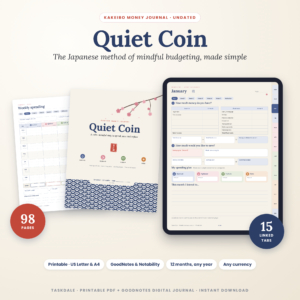
Quiet Coin Kakeibo Money Journal
Price: $5.99 | Best for: slow, handwritten weekly spending logs
Quiet Coin is an undated kakeibo journal with printable US Letter and A4 pages and a hyperlinked GoodNotes and Notability version. Each month opens with income, fixed costs and a savings goal, then weekly pages to log purchases in four categories, then a month-end review. Print one month and keep it on the kitchen counter with a pen clipped to it.
The home costs people forget to track
Renters have it easier here. When the dishwasher breaks, the landlord pays. Homeowners carry every repair, and most never track maintenance as its own category until a big bill forces them to.
Common home costs that slip through:
- HVAC servicing and filters every few months
- Gutter cleaning and roof checks
- Water heater flushes and eventual replacement
- Appliance repairs after the warranty ends
- Smoke alarm batteries and detectors
- Lawn, garden and snow removal
- Pest control
Tracking these does two jobs. It shows you what your home really costs per year, beyond the mortgage. And it lets you set aside a monthly amount for upkeep, so a $900 furnace repair comes out of a fund instead of a credit card. That alone takes a lot of stress out of owning a house.
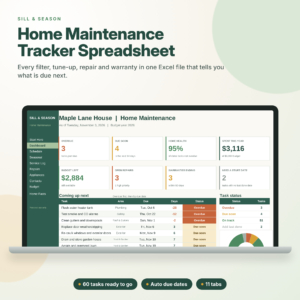
Home Maintenance Tracker Spreadsheet
Price: $6.99 | Best for: homeowners tracking upkeep and repair costs
Sill & Season is an Excel spreadsheet with 60 common home jobs already listed, each with a frequency. Enter the date you last did a task and it shows the next due date, flags overdue jobs in color, and logs costs on a Service Log. The Dashboard shows spending by area and by month, plus warranties ending within 90 days. Delete the jobs that do not apply, then enter last-done dates for the ones you remember.
If part of your home earns money
Some households rent out a basement suite, a spare room or a small second unit. That changes what you need to track. Rent coming in, plus the share of utilities, repairs and insurance that belongs to the rental, all need their own record, separate from your family’s spending.
Mixing them makes both pictures wrong. Your household budget looks better than it is, and you lose track of what the rental actually earns. A separate tracker for the rental side keeps it clean and makes tax time far less painful. The Lantern Lane Rental Property Spreadsheet in the quick picks table handles rent collection, a tenant ledger and expenses split across units if you need that level of detail.
The once-a-year expense review
Weekly tracking catches small leaks. A yearly review catches the big, slow ones. Set aside an hour each January, or on any date that is easy to remember, and go through these questions with a full year of numbers in front of you.
- Which fixed costs went up? Insurance, internet and phone plans often rise quietly at renewal. A ten-minute call to ask for a better rate can save $15 to $30 a month on a single bill.
- Which subscriptions did we actually use? Cancel anything nobody opened in the last three months.
- What did the irregular costs really add up to? Compare with what you set aside. Raise the monthly amount if you came up short.
- Which month hurt most, and why? For many families it is December or back-to-school August. Knowing that lets you start saving for it in spring.
- What should the plan look like next year? Write new monthly targets based on what actually happened, not what you hoped.
This is also a good moment to check the bigger picture: what you own and what you owe. Our net worth tracker guide shows a simple monthly way to do it, and the yearly review is the natural place to compare January with January.
Most people finish this hour feeling lighter. Even when the numbers are not perfect, knowing them beats wondering.
Mistakes that make expense tracking useless
- Tracking but never reviewing. A full log you never read is just data entry. Set a monthly review, even 20 minutes.
- Counting card payments as spending. Paying off a card is a transfer. The spending already happened when you bought things.
- Lumping groceries and eating out together. It hides one of the easiest places to save.
- Ignoring cash. Cash purchases vanish from the record unless you keep receipts or note them.
- Tracking too much. Splitting toiletries into shampoo and toothpaste is overkill. Keep categories broad.
Frequently asked questions
What are the main household expenses to track?
Housing, utilities, internet and phone, groceries, eating out, household supplies, transport, childcare, health, pets, gifts and home maintenance. Twelve categories cover most homes.
How long should I track household expenses before making a budget?
One full month at minimum. Two or three months gives a truer picture, especially for utilities and groceries that swing from week to week.
Should I track every small purchase?
Yes, at least for the first two months. Small purchases are where most surprises hide. After that you can group them into a single “small spending” line if they stay steady.
What is the easiest way to track household expenses as a couple?
Use one shared spreadsheet or one notebook, with a weekly 15-minute check together. Agree on categories at the start so you both sort purchases the same way.
How much should a household set aside for home maintenance?
Track a full year of real repair and upkeep costs first. Then divide by 12 and save that each month. Older homes and homes with older appliances usually need more.
Are household expenses the same as a budget?
No. Expenses are what you actually spent. A budget is what you plan to spend. Tracking expenses first gives you the real numbers to build a budget that holds.
Your next step
This week, pick three categories: groceries, eating out and household supplies. Log every purchase in those three for seven days, then add them up on Sunday. That one week will tell you more than a month of guessing. When you want the totals and charts done for you, set up the Penny & Petal Income and Expense Tracker and carry on from there.