A family of four and a one-person cleaning business have more in common than you might think. Both have money coming in on uneven dates, bills that cannot wait, costs that show up once a year, and a person at the kitchen table trying to make it all line up. Planning and budgeting for households and small businesses follows the same basic method. The details differ, and those details are where people get caught out.
This guide is for anyone running a home budget, a small business, or both at once, which is more common than ever. You will get the shared four-step method, a worked example for each side, the rules for keeping home money and business money apart, a monthly routine that covers both, and a few tools that take the arithmetic off your plate.
Quick picks: planning tools for home and business
| Product | Best for | Price | Link |
|---|---|---|---|
| Hearthfolio Family Budget Planner | Household budgets with several paydays | $22.00 | View |
| Petal & Profit Small Business Finance Planner | Freelancers, makers and service businesses | $9.99 | View |
| Penny Pathfinders Kids Money Workbook | Bringing children into the family plan | $10.49 | View |
One method, two kitchens
Whether the money belongs to a family or a business, good planning answers the same four questions in the same order:
- What is coming in, and when? Paychecks for a household. Sales, invoices and deposits for a business.
- What must go out, and when? Rent, utilities and loan payments at home. Supplies, software, insurance and payroll in a business.
- What is coming later that I can see now? Holiday gifts and car registration at home. Equipment replacement and quarterly tax in a business.
- What is left, and what job does it get? Savings and debt payoff at home. A cash reserve, owner pay or growth in a business.
The method is identical. What changes is how predictable the numbers are. A salaried household knows its income to the dollar. A florist knows February and May will be big and July will be thin. So a household budget leans on a monthly plan, while a small business leans harder on cash flow: the timing of money in versus money out.
The household side: a family plan that holds up
Take the Okafor family: two adults, two kids aged 8 and 11, combined take-home of $6,200 a month. One parent is paid biweekly, the other twice a month. That mismatch alone causes a lot of the stress, because the mortgage leaves on the 1st and only one paycheck has arrived by then.
Their plan, in broad strokes:
| Group | Monthly plan |
|---|---|
| Mortgage, utilities, phones, internet | $2,480 |
| Groceries and household | $1,050 |
| Transport: two cars, fuel, insurance | $720 |
| Kids: activities, school costs, allowances | $310 |
| Sinking funds: holidays, car repairs, birthdays, back to school | $420 |
| Savings and retirement top-up | $600 |
| Eating out, fun, clothes | $470 |
| Extra on the car loan | $150 |
| Total | $6,200 |
The plan balances. The trick is the timing. The Okafors moved the mortgage to come out of the first two paychecks of the month, and everything else follows the later ones. Twice a year, the biweekly parent gets a third paycheck in a month, and that one goes straight to the sinking funds. Small change, big relief.
A spreadsheet that places paychecks on their real dates makes this far easier to see than a single monthly total does.
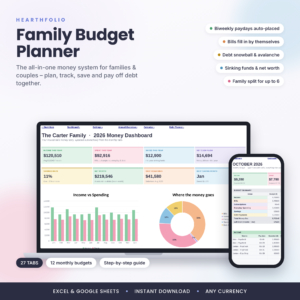
Hearthfolio Family Budget Planner
Price: $22.00 | Best for: families with mixed paydays
Hearthfolio is a family budget spreadsheet for Excel and Google Sheets. Enter one payday and it places every paycheck on its real date for the year, including months with three biweekly checks, while monthly, quarterly and yearly bills fill in on the right months. It has a bill calendar, account tracking, debt payoff and sinking funds, works in any currency, and locks calculated cells so they are hard to break. Set your paydays and recurring bills first.
The small business side: planning around uneven money
Now take Dana, who runs a mobile dog grooming van on her own. Some months bring in $7,800. January brought in $3,900. Her costs are fairly steady: van payment, fuel, shampoo and supplies, insurance, booking software, phone. Then there is the one many new owners forget: tax on the profit.
A small business plan has three layers:
The annual budget
Twelve months of expected sales and costs, based on last year if you have it. Dana’s shows a busy spring, a summer peak and a slow January and February. Seeing the dip on paper months in advance is half the battle.
The monthly budget
Planned costs for this month against actual costs, just like a household. If supplies are running $90 over, she knows by the 20th, not at year end.
The cash flow view
When money actually lands and leaves. A $1,200 invoice to a doggy daycare paid in 30 days is income on paper now and cash next month. For a fuller walk-through, our guide to using a cash flow forecast template covers the timing side in detail.
Dana’s simple rules: pay herself a fixed $3,000 a month, even in busy months. Set aside a fixed share of every payment for tax in a separate account, a figure she agreed with her accountant. Keep a reserve equal to two months of business costs to carry her through January. Everything above that is either growth or a bonus to herself in December.
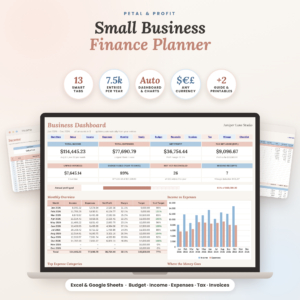
Petal and Profit Finance Planner
Price: $9.99 | Best for: freelancers, makers and service businesses
Petal and Profit is a small business finance planner for Excel and Google Sheets that keeps bookkeeping, a budget tracker, invoices, a quarterly tax planner and mileage in one workbook. Type each sale and expense once and the dashboard, monthly and yearly profit and loss and budget pages update, with eight KPI tiles including estimated tax set-aside and unpaid invoices. Start by setting your categories, then log last month’s sales and expenses to see your first report.
Keeping home money and business money apart
This is the single most useful habit for anyone running both. When business costs come out of the family account, two things go wrong. You cannot tell whether the business is actually profitable, and tax time turns into an archaeology dig through a year of statements.
The rules are simple:
- Separate bank accounts. One for the business, one for the household. Even a free second checking account will do to start.
- Pay yourself on a schedule. Move a set owner’s pay from business to home on the same date each month, like a salary. The household budget then treats it like any paycheck.
- No business costs on the family card. If it happens by accident, pay it back from the business account the same week and note it.
- Separate tax savings. A third account just for tax money means you never spend it by mistake.
A baker selling at weekend markets who keeps everything in one account often thinks she is making $900 a month. Once the flour, boxes, stall fees and fuel come out, it might be $340. That is still worth knowing. It just changes the decisions.
Bringing the kids into the household plan
Children notice money long before they understand it. They see the card tapped at the checkout and assume the money is endless. Including them in small parts of the family plan helps them, and it often helps the budget too, because a child who understands “we have $60 for fun this weekend” argues less about extras.
Start small. Let an eight-year-old choose between two outings with the same budget. Give an eleven-year-old an allowance and a simple spend, save, share split. Ask older kids to help compare grocery prices on a list. A kid whose savings goal finally hits $40 for a new skateboard learns more from that moment than from any lecture.

Penny Pathfinders Kids Money Workbook
Price: $10.49 | Best for: families with children aged 7 to 12
Penny Pathfinders is a printable kids money workbook for ages 7 to 12, laid out as six themed trails with short activities of 10 to 20 minutes, badges to color, a quiz, a certificate and an answer key. Children learn money basics, earning, needs versus wants, saving and planning, including a chore tracker and a lemonade stand business plan. Print the trail map first and do one activity a week together.
For families who also run a business, that lemonade stand page is a gentle way to explain what Mom or Dad does all day: costs in, sales out, profit left over.
A monthly money routine that covers both
If you run a household and a business, one combined monthly session saves time and stops either one from being neglected. Ninety minutes on the first Sunday of the month is enough for most people. Here is the order:
- Close the business month first. Log the last sales and expenses, check unpaid invoices, and move the tax share into its account.
- Pay yourself. Transfer owner’s pay to the household account.
- Close the household month. Compare plan with actual, note any big gaps.
- Plan the household month ahead. Income includes your owner’s pay, now a known number.
- Look three months ahead for both. Any big bills, slow business months, school trips, insurance renewals?
Do the business first for a reason. Its numbers decide what the household gets, not the other way round. Many owners also keep a short daily checklist for the shop or service itself; the daily operations checklist for small businesses pairs well with this monthly money session.
Paper, spreadsheet or both?
The right tool depends on how many numbers you handle and who else needs to see them. A household with one income and a dozen bills can run happily on a single printed page stuck inside a kitchen cupboard. A business that logs forty sales a week cannot. Adding up that many lines by hand invites mistakes, and you will want reports at tax time anyway.
Many people land on a mix. The business lives in a spreadsheet, because it needs profit and loss, invoice tracking and a tax figure. The household plan lives wherever the family will actually look at it. For some that is a shared spreadsheet both partners can open on their phones. For others it is a printed monthly sheet on the fridge with the grocery figure circled in red.
A useful test: if a tool has gone unopened for two weeks, it is the wrong tool. Swap it without guilt. The plan matters, not the format it lives in.
Where households and businesses plan differently
The method is shared, but a few habits belong to one side more than the other.
- Reserve size. A household with steady pay can start with a $1,000 buffer and grow it. A small business usually needs a bigger cushion, often a couple of months of costs, because income can swing by half from one month to the next.
- Tax. Employees usually have tax taken from their pay. Business owners usually have to set it aside themselves. Ask a local accountant what share makes sense for you.
- Growth spending. A household rarely “invests” in a new oven expecting money back. A business might, and the plan should show when that spending pays for itself.
- Review rhythm. Monthly suits most households. A business with daily sales benefits from a quick weekly look at cash in the bank and unpaid invoices.
Mistakes that hurt both
Some planning errors show up at home and at work in exactly the same way.
- Planning on the best month. Budget from a normal or slow month. Good months then feel like a bonus, not a baseline.
- Ignoring yearly costs. A $1,400 annual insurance bill hurts either way. Divide it by twelve and save monthly.
- No buffer. One late client payment or one broken fridge should not trigger a credit card spiral.
- Not looking back. A plan you never compare with reality slowly turns into fiction.
Catching any one of these early is a small win. Catching all four puts you ahead of most people.
Frequently asked questions
What is the difference between a household budget and a business budget?
The method is the same: income, costs, future costs, then what is left. Business budgets add tax set-aside, uneven income, invoices and a profit figure, and lean more on cash flow timing.
Should I use the same spreadsheet for my home and my business?
Use separate files, or at least separate tabs with separate accounts. Mixing them hides whether the business is profitable and makes tax time harder.
How much cash should a small business keep in reserve?
Many owners aim for a couple of months of regular costs, more if income swings a lot through the year. Start smaller and build it in good months.
How do I budget when I am self-employed?
Pay yourself a fixed monthly amount from the business, set aside tax from every payment, and build your household budget on that fixed pay rather than on sales.
How often should I review a small business budget?
A full review monthly, plus a quick weekly glance at cash in the bank and unpaid invoices. Seasonal businesses benefit from a three-month look ahead each month.
Your next step
This week, open a separate bank account for any business income if you do not already have one, and pick a fixed date for your owner’s pay. Then set up the business side in the Petal and Profit Small Business Finance Planner and log last month’s sales before the weekend.