Profitable businesses run out of money all the time. It sounds backwards, but it happens: a big client pays 60 days late, the VAT bill and the annual insurance land in the same month, and suddenly there’s a profitable business with $400 in the bank. A cash flow forecast template is how you see that coming, weeks or months ahead, while you can still do something about it.
This guide explains how a cash flow forecast works, how to build one that’s actually useful, and how to read it without an accounting degree.
Profit and cash are not the same thing
Profit is what you earned minus what you spent, on paper. Cash is what’s in the bank right now.
The gap between them comes from timing. You invoice $8,000 in March, but the client pays in May. You buy $3,000 of stock in April that you’ll sell over the summer. You owe tax on last quarter’s profit, which you’ve already spent on growth. Your profit and loss looks great. Your bank account doesn’t.
A forecast tracks the cash side: when money will actually arrive and when it will actually leave.
How a cash flow forecast template is laid out
Every forecast follows the same basic shape, one column per period (week or month):
- Opening cash: what’s in the bank at the start of the period
- Cash in: customer payments, other income, loans received
- Cash out: rent, wages, suppliers, software, tax, loan repayments, owner drawings
- Net cash flow: cash in minus cash out
- Closing cash: opening plus net. This becomes next period’s opening cash.
Here’s a three-month example:
| Jan | Feb | Mar | |
|---|---|---|---|
| Opening cash | 8,000 | 8,800 | 5,500 |
| Cash in | 12,000 | 9,500 | 14,000 |
| Cash out | 11,200 | 12,800 | 11,500 |
| Closing cash | 8,800 | 5,500 | 8,000 |
Look at February. Nothing dramatic, but cash drops by $3,300 in one month. If your minimum comfortable balance is $6,000, February is your problem month, and now you know it in December.
Step by step: building your forecast
1. Start with real opening cash
Use today’s actual bank balance across your business accounts. Not what it “should” be. What it is.
2. Forecast cash in by when it lands, not when you invoice
This is where most forecasts go wrong. If your clients usually pay in 30 to 45 days, an invoice sent in March is April or May cash. Look at your history and be a little pessimistic. A forecast that assumes everyone pays on time will always look better than reality.
Split income by source if you can (retainers, one-off projects, product sales). Recurring income is more predictable, so it’s useful to see how much of next quarter is already fairly certain.
3. List every cash outflow, including the lumpy ones
Fixed costs are easy: rent, software, insurance, salaries. The ones that cause trouble are irregular: annual renewals, quarterly tax or VAT, equipment, a trade show deposit. Go through last year’s bank statements and mark every payment that wasn’t monthly. Put each one in its month.
Don’t forget what you pay yourself. Owner drawings are real cash out, even if they don’t appear on the P&L the same way.
4. Find the lowest point
Scan the closing cash row for the smallest number. That’s the single most useful thing a forecast tells you. If the lowest point is comfortably above your safety buffer, relax. If it’s near zero or negative, you have time to act: chase invoices sooner, delay a purchase, arrange a credit line, or bring a payment forward.
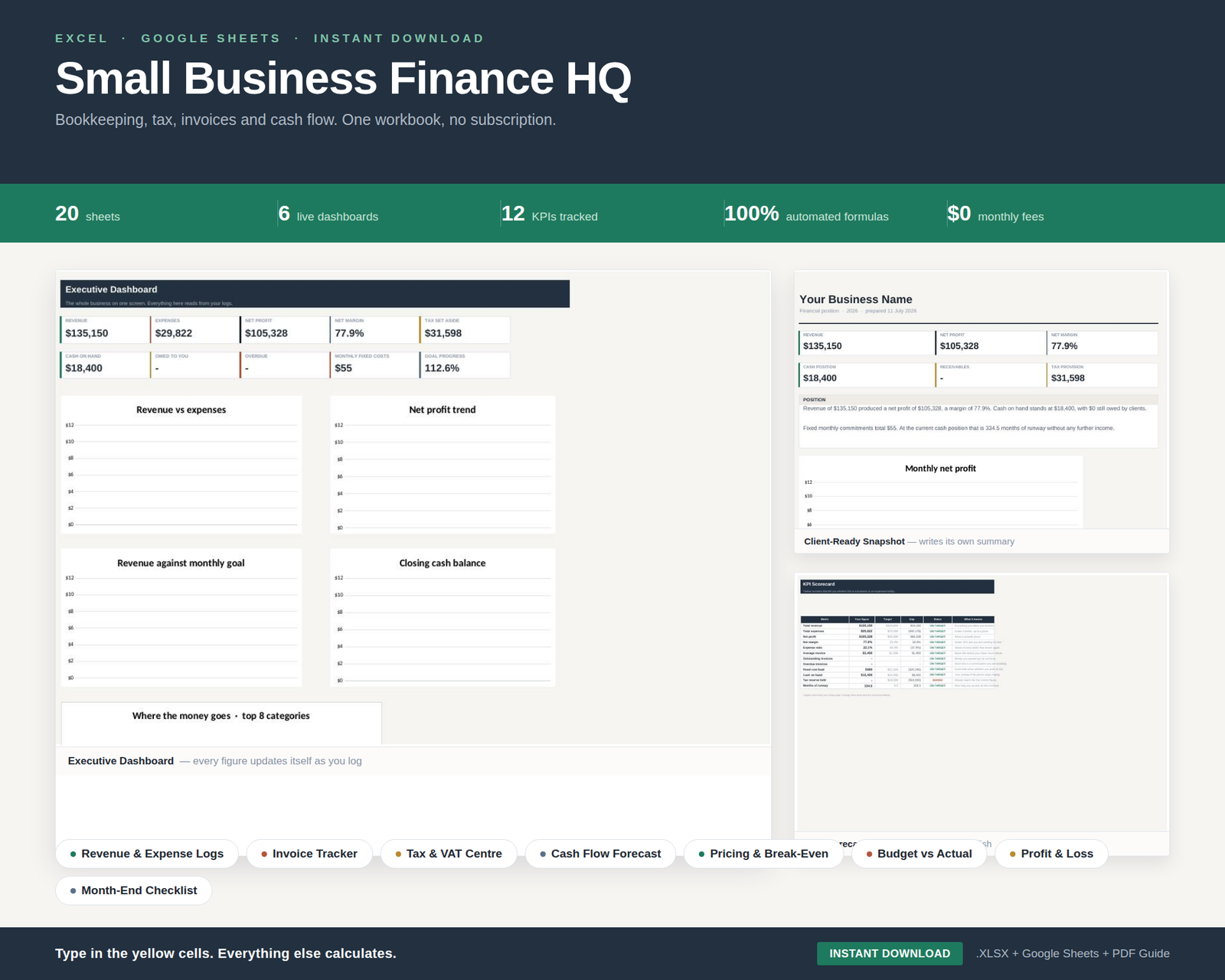
The Small Business Finance HQ workbook includes a Cash Flow Forecast with exactly this lowest-point warning. Because it sits alongside revenue and expense logs, an invoice tracker and a Tax Centre with a monthly reserve plan, the forecast can reflect money owed to you and the tax you’ll need to pay, not just a guess typed into a blank grid.
5. Update it and compare with reality
A forecast is a living thing. Each month, replace the forecast figures for the month just finished with actuals, then roll forward. Note where you were wrong. If cash in is always 15% lower than forecast, adjust your assumptions.
Weekly or monthly?
A 12-month forecast by month is great for planning: seasonal dips, hiring, big purchases. A 13-week forecast by week is better when cash is tight and you need to know whether payroll on the 28th is safe.
Most small businesses do well with a monthly forecast most of the time, switching to weekly when the lowest point gets close to zero.
Test “what if” before you commit
The real power of a forecast is testing decisions. What if you hire a part-timer at $1,800 a month from June? What if your biggest client leaves? What if you raise prices 10%?
The Ultimate Small Business Spreadsheet Dashboard is strong on this. Its rolling 12-month cash-flow forecast takes expected revenue, recurring costs, one-off expenses, tax payments and owner withdrawals to show estimated closing cash and runway month by month. Its scenario planner lets you test a new client, a price increase, an overhead cut, time away or a contractor, and shows each one’s estimated effect on profit, tax and cash. It’s designed for Excel 2021 and Microsoft 365.
FAQ
What is a cash flow forecast template?
It’s a spreadsheet laid out to project opening cash, money in, money out and closing cash for each future week or month. A good template does the arithmetic and highlights the periods where cash runs low.
How far ahead should a small business forecast cash?
Twelve months by month is a solid default. Switch to a 13-week weekly view when cash is tight or you’re planning around a big payment.
How accurate does my cash flow forecast need to be?
It doesn’t need to be perfect. It needs to be roughly right and updated regularly. The aim is spotting problems early, not predicting to the dollar.
What’s a healthy cash buffer?
Many owners aim for one to three months of fixed costs. Businesses with lumpy income or long payment terms often want more. Pick a number and treat the forecast’s lowest point as your check against it.