Realistic ways to save money on groceries and bills are the ones you can still do in a tired week. Not driving to four stores for the best deals. Not clipping coupons for an hour on Sunday. Just a handful of habits and one or two phone calls that keep paying off month after month.
This guide is for households where food and bills eat most of the paycheck and there never seems to be much left. You will learn how to find your real numbers, plan meals around what is already in the cupboard, audit every bill once a year, and make sure the money you save goes somewhere useful. We also point to a few Taskdale tools that make the tracking easier.
Quick picks: tools for cutting grocery and bill costs
| Product | Best for | Price | Link |
|---|---|---|---|
| Spoonwise Weekly Meal Planner Spreadsheet | Grocery lists that subtract what is in your pantry | $17.99 | View |
| Penny & Petal Income and Expense Tracker | Seeing the true yearly cost of every bill | $4.99 | View |
| Money Bloom Digital Budget Planner | iPad users who want a bill calendar and shopping budget | $12.99 | View |
| Money, Unscripted Money Mindset Workbook | Working on the habits behind overspending | $6.49 | View |
Start with what you actually spend
You can’t cut what you haven’t measured. Pull your last two months of bank and card statements and add up two numbers: everything spent on food, and everything spent on household bills. Count takeout, delivery, school lunches and the gas-station sandwich as food. Count phone, internet, energy, water, insurance and subscriptions as bills.
One family of four did this and found $1,150 a month on food. They had guessed $800. The gap was almost all takeout and small top-up shops: $14 here, $23 there, never feeling like much. Seeing the real total was uncomfortable for about five minutes. Then it was useful, because now they knew exactly where to look.
Write both numbers at the top of a page. Those are your starting lines. Every change you make from here can be measured against them, and watching them come down is one of the more satisfying things you can do with a spreadsheet.
Plan meals around the pantry, not the recipe book
Most meal plans start with what sounds good, then send you to the store for twelve ingredients. A cheaper plan starts with what you already have. Open the fridge, the freezer and the cupboard. Half a bag of rice, two cans of chickpeas, frozen spinach, eggs, a sweet potato. That is two dinners before you buy a thing.
The five-dinner rule
Plan five dinners a week, not seven. One night is leftovers. One night is a clear-out meal, like fried rice, an omelette or a big tray of roasted vegetables with whatever needs using. Fewer planned meals means fewer ingredients bought and less food going soft at the back of the fridge.
Know your cost per serving
A pot of lentil soup that feeds six for $7 is about $1.17 a serving. A frozen lasagna that feeds four for $12 is $3 a serving. Neither is wrong, but once you know the numbers you can mix cheap meals with treat meals on purpose. Aim for three or four low-cost dinners a week and keep the rest for the meals your family looks forward to.
A meal planner spreadsheet can do this arithmetic for you, and the good ones check your pantry before writing the shopping list.
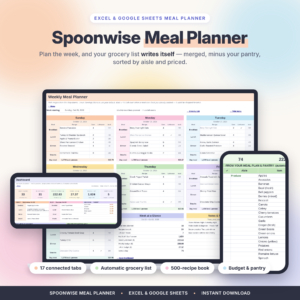
Spoonwise Weekly Meal Planner Spreadsheet
Price: $17.99 | Best for: families shopping on a weekly budget
Spoonwise is a weekly meal planner spreadsheet for Excel and Google Sheets. Pick recipes for the week and it writes your grocery list for you, merging duplicate ingredients, subtracting what is already in your pantry and sorting items by store aisle. It also estimates each week’s cost against your grocery budget and tracks monthly food spending. Start by filling in your pantry list, then plan five dinners.
Shop smarter without clipping a single coupon
Coupons can save money, but they cost time and often push you toward things you weren’t going to buy. These habits save more for most people, and they take almost no effort once they stick.
- One main shop, one small top-up. Every extra trip adds impulse buys. A family that went from four shops a week to two cut around $40 a week, mostly in snacks and drinks.
- Read the unit price. The small label under the big price shows cost per ounce or per pound. The bigger box isn’t always cheaper.
- Try the store brand once. Swap five items for the store brand for one month. Keep the ones you can’t tell apart. Most people keep at least three.
- Cook cheaper proteins twice a week. Eggs, beans, lentils, canned fish and chicken thighs cost far less than steak or salmon.
- Shop with a list and stick to it. Leave one line on the list called treat, so you don’t feel trapped.
- Buy what is in season. Strawberries in June, apples in October. In-season produce tends to be cheaper and tastier.
For more ideas on trimming the weekly shop, our piece on meal planning on a budget covers the habits that shrink the food bill week after week.
Takeout: plan it, don’t ban it
Banning takeout tends to fail by the second Friday. Planning it works better. Pick one night a week as takeout night and set a number, say $35. It stops the random weeknight orders, which are where the money really goes, and it gives everyone something to look forward to.
Stop paying for food you throw away
Food waste is money in the trash, quietly. A bag of salad, half a loaf, a tub of yogurt past its date. It adds up to a fair few dollars every week in many homes, and it is one of the easiest leaks to plug.
A few small changes go a long way. Put new groceries behind the old ones. Keep a use-it-first shelf in the fridge at eye level. Freeze bread, bananas and leftover rice before they turn. And check the fridge before you write the list, not after you get home. Our list of ways to reduce food waste at home has more practical fixes.
Do a yearly bill audit in one evening
Bills are where a single hour of work saves money for a whole year. Prices creep up quietly at renewal, and loyal customers often pay more than new ones. Once a year, sit down with a cup of coffee and every bill in front of you.
- List every bill with the monthly cost and the yearly cost. A $79 phone bill is $948 a year. Seeing the yearly figure changes how you feel about a phone call.
- Phone: check how much data you really use. Many people pay for far more than they need. Moving from a $79 plan to a $45 plan saves $408 a year.
- Internet: call and ask what offers are available for existing customers. Be polite and say you are comparing providers. Ten minutes on hold is often worth it.
- Insurance: get two or three quotes before renewal. Raising a deductible slightly can also lower the premium, if you have savings to cover it.
- Subscriptions: list every streaming service, app, box and membership. Cancel anything you haven’t used in a month. Rotate streaming services instead of keeping four at once.
- Bank fees: look for monthly account fees or overdraft charges that a different account would avoid.
Write the date of each renewal in your calendar with a reminder two weeks before. Next year’s audit becomes a ten-minute job.
A tracker that shows the yearly cost of each bill makes this audit painless, and it flags anything due in the next week.

Penny and Petal Income and Expense Tracker
Price: $4.99 | Best for: anyone auditing bills and subscriptions
Penny & Petal is an income and expense tracker for Excel and Google Sheets. Its bills and subscriptions tab shows each bill’s next due date, the days left, a 7-day alert and the true yearly cost, with weekly to yearly bills supported. Dashboards show your top 5 spending categories and compare each month with the last. Enter your bills first and sort by yearly cost to see where to start.
Small habits that trim energy and water bills
Energy and water bills respond to habits more than people expect. None of these require new appliances or a renovation.
- Wash clothes on cold. Most everyday laundry comes out just as clean, and heating water is one of the bigger energy costs in a home.
- Turn the thermostat down a degree or two in winter and up a degree or two in summer. Wear a sweater. Use a fan.
- Swap the most-used bulbs to LED. Start with the kitchen and living room, where lights are on for hours.
- Block drafts. A rolled towel at the bottom of a door costs nothing and makes a cold room noticeably warmer.
- Switch off at the wall. TVs, game consoles and chargers draw power on standby. A power strip with a switch makes it a one-second job.
- Fix the drip. A leaking tap or a running toilet wastes water around the clock.
Track your energy bill for three months before and after. The change might be $15 or $30 a month depending on your home and climate. Small, but it repeats, and it is yours.
Make sure the savings don’t disappear
Here is the frustrating part. You cut $60 from groceries and $50 from bills, and a month later your bank balance looks exactly the same. The savings were real. They just leaked into other spending because nobody gave them a job.
The fix is simple. Each time a cut becomes permanent, raise your automatic savings transfer by the same amount on the same day. Phone bill down $34? Savings transfer up $34. Keep a short list of every cut and what it saves, and add them up after three months. That total is often a very pleasant surprise.
If you plan on an iPad, a digital planner with a bill calendar, a shopping budget and a price comparison page keeps all of this in one place.
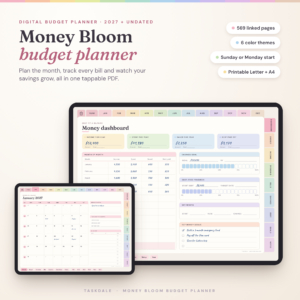
Money Bloom Digital Budget Planner
Price: $12.99 | Best for: iPad and GoodNotes planners
Money Bloom is a hyperlinked PDF budget planner for GoodNotes and other iPad note apps, in a 2027 dated version and an undated one, with six themes and 64 printable pages. Each month has a budget, paycheck planner, bill tracker, expense log and savings and debt page, and the spending section includes a shopping budget, price comparison and no-spend challenge. Open the yearly bill calendar first and fill in every due date.
What isn’t worth your time
Some money-saving advice costs more than it saves. Skip these unless you truly enjoy them.
Driving to three stores for the best prices. The fuel and the hour you lose often cancel out the few dollars saved.
Bulk-buying fresh food. A giant bag of spinach is only a bargain if you eat it before it turns.
Switching providers every few months for tiny savings. The hassle adds up, and some deals have fees that cancel the benefit.
Cutting every treat. A $5 weekly treat you love is not your problem. The forgotten $18 subscription is.
A four-week plan to get started
- Week 1: add up two months of food and bill spending. Write your two starting numbers down.
- Week 2: do a pantry check and plan five dinners. Shop once with a list, then a small top-up.
- Week 3: do the bill audit. Make one phone call and cancel one subscription.
- Week 4: raise your savings transfer by whatever you have cut so far. Set calendar reminders for each bill renewal.
After a month, compare your new numbers with your starting lines. Even a drop of $100 a month is $1,200 over a year, without a single coupon.
Frequently asked questions
How can I cut my grocery bill without coupons?
Plan meals around what you already have, shop once a week with a list, compare unit prices and try store brands. Planning one takeout night instead of random orders also saves a lot.
Which household bills are easiest to lower?
Phone plans, subscriptions and internet are usually the quickest. Insurance can also drop when you compare quotes before renewal.
How much should a family spend on groceries each month?
It depends on where you live, your family size and your diet. Start by tracking what you spend now, then aim to bring it down a little each month rather than picking a number from someone else’s budget.
Is meal planning really cheaper?
For most households, yes. A plan means fewer extra trips, less wasted food and fewer last-minute takeout orders, which is where a lot of food money goes.
How do I keep the money I save on bills?
Raise your automatic savings transfer by the same amount as soon as a cut goes through. If the money stays in checking, it usually gets spent.
Your next step
Tonight, open the fridge and cupboards, write down what needs using, and plan five dinners around it. Then put your list into the Spoonwise meal planner spreadsheet so next week’s grocery list and cost estimate build themselves.