A three-year-old does not need 26 dinosaurs. They need one big T. rex with a fat outline, a chunky crayon and someone nearby to say “Roar!” at the right moment. A dinosaur coloring book for preschoolers should be built around that: big shapes, few lines, and pages a small child can finish before their attention runs out.
This guide is for parents, childminders and preschool teachers with dinosaur fans aged roughly 2 to 5. You will learn what a good big-shape page looks like, which crayons small hands actually manage, how to sneak counting, shapes and new words into coloring time, and how to plan a gentle dinosaur week. There are three printable picks on Taskdale along the way.
Quick picks for little dinosaur fans
| Product | Best for | Price | Link |
|---|---|---|---|
| Roar to Z Dinosaur Coloring Book A to Z with Names and Facts | Big-shape dinosaur pages that grow with your child | $4.49 | View |
| Little Explorers Preschool Coloring Book | Animals, vehicles and early learning for ages 2 to 5 | $3.49 | View |
| Friendship Fun Coloring Book | Kind, everyday scenes for siblings to share | $2.99 | View |
What a big-shape dinosaur page looks like
Most dinosaur coloring pages are drawn for older kids. Scales, teeth, ferns in the background, a volcano puffing smoke. To a preschooler that is a wall of tiny boxes, and they give up after two scribbles.
A good preschool page is different in four clear ways.
- Thick outlines. Lines about as wide as a marker stroke. They act like the bumpers at a bowling alley, so crayon stays roughly in the right place.
- Few spaces. Somewhere around 10 to 20 areas to color. Body, legs, tail, a few plates or horns, a ground line.
- One animal, filling the page. No crowd of dinosaurs, no busy jungle behind.
- Friendly faces. A smiling Triceratops beats a snarling one for a child who is still a bit unsure about monsters.
Hold a page at arm’s length. If you can count every space in ten seconds, it is right for a three-year-old.
A dinosaur book that starts simple and grows
Preschoolers grow fast. The child scribbling on a big T. rex at three will want real names and facts at five. A book with both levels saves you buying a new one each birthday.
Roar to Z has a separate section called Little Paleontologists: 8 big-shape pages with extra-thick outlines for T. rex, Triceratops, Stegosaurus, Brachiosaurus, Spinosaurus, Ankylosaurus, Pteranodon and a baby dinosaur hatching from its egg. Each has the name in big outline letters and one short sentence to read together.
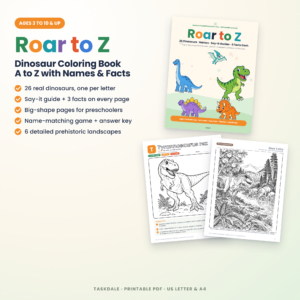
Roar to Z Dinosaur Coloring Book
Price: $4.49 | Best for: Preschoolers now, bigger kids later
A printable PDF in US Letter and A4 with 8 big-shape preschool pages, 26 A to Z dinosaur pages with say-it guides and three facts each, games, fact cards and 6 detailed landscapes for older kids and adults. For a preschooler, print the 8 Little Paleontologists pages first, read the single sentence on each aloud, and save the A to Z section for when they start asking for real names.
That baby dinosaur hatching from its egg is often the favorite. Small children love babies of any kind, and a cracked shell is a satisfying shape to color.
Crayons and tools that suit small hands
The wrong crayon can ruin a good page. Thin crayons snap, fine-tip markers poke holes, and colored pencils need more pressure than a two-year-old can manage.
| Tool | Good for | Watch out for |
|---|---|---|
| Chunky or egg-shaped crayons | Ages 2 to 3, palm grip | Pale color unless pressed hard |
| Triangular crayons | Ages 3 to 5, early finger grip | Few downsides, roll less too |
| Washable thick markers | Bright quick color, ages 3 and up | Can bleed through thin paper |
| Dot markers | Very young or easily frustrated kids | Fun but messy, not for detail |
| Jumbo colored pencils | Ages 4 to 5 moving toward school | Need regular sharpening |
Offer four or five colors, not forty. A full box turns coloring into choosing, and choosing can take the whole session.
Learning that hides inside a dinosaur page
Preschool coloring is never only coloring. With a few questions, a single page practices numbers, shapes and new words.
Counting
“How many horns does Triceratops have?” Three, and the clue is in the name. “How many legs does Brachiosaurus stand on?” Count them together and touch each one. Stegosaurus plates are great for counting past five.
Shapes
Point out the triangles along a Stegosaurus back, the circle of an egg, the long rectangle of a Brachiosaurus neck. Ask the child to color all the triangles one color.
Big and small
Compare the baby dinosaur with the grown-up one. Which is bigger? Which is smaller? Whose tail is longer? Opposites are a big preschool skill, and dinosaurs make them obvious.
New words
Spikes, horns, plates, claws, crest, egg, hatch, fossil. Use one new word per page and repeat it while they color. By the end of the week, a four-year-old saying “Ankylosaurus has a club on its tail” is a proud moment for everyone in the room.
Questions to ask while they color
Talking turns a quiet coloring session into language practice. Keep questions open and easy, and let the child do most of the talking. A few that work with almost any dinosaur page:
- “What is your dinosaur’s name?” (Not the real name. The pet name. Expect “Mr Crunchy”.)
- “What does it like to eat?”
- “Where does it sleep at night?”
- “Is it a mummy, a daddy or a baby?”
- “What noise does it make?” Then make the noise together.
- “Who is its best friend?”
Write the best answer at the bottom of the page in your neatest handwriting. Months later, “Mr Crunchy eats spaghetti and sleeps under the slide” is the line that makes you laugh when you find the page in a drawer. It also shows a child that their words are worth writing down, which is the first step toward wanting to write them down themselves.
Mixing in other big-shape themes
Even the most loyal dinosaur fan has days when they want a fire engine or a puppy. Keeping a second simple book alongside means you always have a page that matches the mood, and the skills carry straight over.
Think of a damp Thursday at nursery: eight children, three who only want dinosaurs, two who want trucks, and three who want “the bunny one”. Having both books printed in a tray means nobody waits.
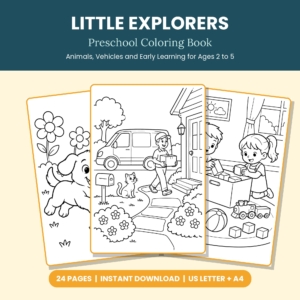
Little Explorers Preschool Coloring Book
Price: $3.49 | Best for: Toddlers and preschoolers aged 2 to 5
24 simple pages with thick outlines and open spaces in three themes: Friendly Animals, Busy Vehicles and Early Learning with counting, shapes, feelings and big-and-small. It is an instant download PDF for printing at home or in a setting. Pair a counting page from Early Learning with a dinosaur page on the same day so the same skill shows up twice.
For a wider look at what works for this age, our guide to preschool coloring pages covers line thickness, page counts and how to tell when a child is ready for more detail.
A gentle dinosaur week for preschoolers
Preschoolers love repetition, so a themed week works well. Ten to fifteen minutes a day is enough.
| Day | Page | Mini activity |
|---|---|---|
| Monday | T. rex | Stomp like a T. rex around the room. Big feet, tiny arms. |
| Tuesday | Triceratops | Count the three horns. Make horns with play dough. |
| Wednesday | Stegosaurus | Color the plates in a pattern: red, yellow, red, yellow. |
| Thursday | Brachiosaurus | Stretch tall like a long neck. Reach for a leaf on a shelf. |
| Friday | Baby dinosaur | Hide a toy in a plastic egg. Let it hatch. |
Pin each finished page on a low wall at child height. By Friday there is a little dinosaur parade, and children will tell visitors every name. Childminders who plan by the week can fold this into their routine; the kindergarten and daycare lesson plan guide shows a simple way to lay it out.
Calm, shared coloring for siblings
Coloring can also be a quiet way to practice taking turns and sharing crayons. Two children at one table with one tin of crayons is a small lesson in patience, whether they like it or not.
Older siblings, often five to eight, enjoy pages with a bit more to them while the younger one sticks to big shapes. Scenes of friends doing kind things together give you something to talk about, too: “What are they sharing? Who is helping?”
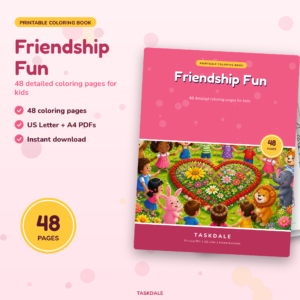
Friendship Fun Coloring Book
Price: $2.99 | Best for: Siblings and friends coloring together
48 scenes of friends doing things together, such as holding hands in a meadow, building a block tower and sharing a picnic, each with a short kind line at the top. Big shapes like the sun and the sofa give younger children quick wins, while patterned details keep older kids busy. Print one scene for each child at the same table and read the kind line aloud before you start.
When a preschooler gets frustrated
Some children throw the crayon down after thirty seconds. Usually it is not about dinosaurs at all. It is tired hands, a page that is too busy, or a worry that it will not look right.
A few fixes that help:
- Color one part together. “You do the tail, I will do a leg.” Shared work feels lighter.
- Swap to dot markers. Stamping color into a big space gives a fast result with no need for control.
- Cut the page in half. Half a T. rex is still a T. rex, and finishing it feels like a win.
- Move to the floor. Lying on the tummy with the page on a hard book changes posture and often resets the mood.
And sometimes the right answer is to stop and go outside. The page will still be there after lunch.
A small dinosaur party for four-year-olds
Four-year-old parties are short, loud and mostly about cake. A coloring corner gives the quieter guests somewhere to go, and gives you ten calm minutes while the last parents arrive.
- Print one big-shape dinosaur per guest plus four spares. Write each child’s name at the top beforehand.
- Put chunky crayons in small cups on a low table, one cup per two children.
- Add a sign with a picture of a dinosaur egg and the words “Color your dinosaur”.
- When the page is done, children choose a sticker egg to put on it.
- Pages go home in the party bag, rolled up with a ribbon.
Total prep time is about twenty minutes. Several parents usually ask where the pages came from, which is its own small pleasure.
Who big-shape pages are not for
Big-shape dinosaur pages are made for ages 2 to 5. A seven-year-old who already reads dinosaur encyclopedias will find them babyish within a page or two. They want real names, three facts, and detailed scenes with ferns and rivers. If you are buying for a mixed-age family, choose a book that covers both levels, so the older child is not left coloring something that feels beneath them.
Printing tips for preschool pages
- Print at actual size. Shrinking a page to fit makes thick lines thin.
- Use slightly heavier paper if markers are in play. Copy paper is fine for crayons.
- Tape the page to the table with two strips of masking tape. Small children press hard and the paper slides.
- Laminate one favorite and use it with dry-erase crayons in the car or at a restaurant.
- Keep a folder of spares. When a page tears, which it will, print another without fuss.
If you need more free pages for a busy week, our roundup of free coloring book PDFs lists sources you can print tonight.
Common mistakes with preschool coloring
- Expecting neat work. Coloring outside the lines is normal until about age five. Praise the effort, not the edges.
- Sessions that run too long. Stop after ten minutes or as soon as the crayon starts flying. End on a good note.
- Scary pages. Big teeth and roaring jaws can upset some three-year-olds. Start with friendly faces.
- Too many choices. One page at a time. A stack of ten makes a child flip, not color.
- Coloring for them. It is tempting to “fix” a page. Resist. Their purple tail is their pride.
Frequently asked questions
What age can a child start dinosaur coloring pages?
Many children enjoy big-shape pages from about age 2 with chunky crayons. Expect scribbling at first, which is a normal and useful stage.
What makes a coloring page good for preschoolers?
Thick outlines, about 10 to 20 spaces, one main animal and a friendly face. If you can count the spaces in ten seconds, it fits.
Which dinosaurs should I start with for a 3-year-old?
T. rex, Triceratops and Stegosaurus. Their shapes are easy to recognize and the names are fun to say.
How long should a toddler color for?
Five to fifteen minutes is typical. Stop while they are still enjoying it so they come back keen tomorrow.
Are crayons or markers better for preschoolers?
Chunky or triangular crayons are best for building grip. Thick washable markers are fun for quick, bright color.
Can coloring help with getting ready for school?
It practices grip, hand control, color names, counting and listening, all skills that help in the first year of school.
Your next step
Print one big-shape T. rex tonight, put out four chunky crayons and tape the page to the table. Tomorrow, color it together and stomp around the kitchen afterward. When your preschooler wants more, the 8 big-shape pages in the Roar to Z Dinosaur Coloring Book are ready, with the A to Z section waiting for later.