Picture a room of twenty five-year-olds, a tub of glue sticks, and a plan you scribbled on the back of an envelope. By 9:40 the plan is gone. That is kindergarten and daycare life. Little ones do not follow schedules, which is exactly why you need one. A good kindergarten lesson plan template gives you a simple frame for the day, so when things wobble you know where to steer. Below, I will show you what to put in it, how to fill it in fast, and three Taskdale printables that make the job easier.
Quick picks: lesson plan templates for little learners
| Product | Best for | Price | Link |
|---|---|---|---|
| Brightside Printable Lesson Planner Kit | Preschool, kindergarten and daycare | $1.49 | View |
| Brightweek Printable Lesson Planner Kit | Weekly planning, teacher or homeschool | $2.29 | View |
| ChalkBright Lesson Plan Kit | Daily, weekly and unit plans plus sub plans | $1.99 | View |
Why young learners need a different kind of lesson plan
Lesson plans for older students often list a topic, a worksheet and a quiz. That does not work at five. Small children learn through circle time, songs, play, snack, outdoor time and a lot of movement. A plan for them has to hold all of that, in short chunks.
Attention spans are short. Ten or fifteen minutes on one activity is plenty, then you switch. So a kindergarten day often has eight or nine small blocks, not four big ones. If your template only has room for four lines, you will cram or skip.
There is also the mix of ages. In a daycare, you might have three-year-olds and five-year-olds in one room. A good plan notes who needs what, so the younger ones are not lost and the older ones are not bored.
And then there are the adults. Assistants, parent helpers, a substitute on a sick day. If your plan lives only in your head, nobody else can run the room. Written plans protect you.
What a kindergarten lesson plan template should include
The good ones are simple. Here is what I would insist on in any kindergarten lesson plan template.
A clear daily rhythm
Morning meeting, literacy, math, snack, play, story, outdoor time, quiet time. Whatever your day looks like, the template should let you list it in order with a time next to each block. Kids feel safe when the day has a pattern, and so do you.
Space for a goal
One line per activity: what are we trying to teach or practice? Counting to 10. Naming a letter sound. Sharing a toy. Without a goal, an activity is only a way to fill time.
Materials and prep notes
A small box for what you need. Scissors, paint, picture cards, a book. Nothing wrecks a morning like hunting for the glue at 8:55. If you write supplies down on Friday, you can gather them before you leave.
A weekly view
A week on one page helps you see balance. Too much seated work on Tuesday? Too little outdoor play on Thursday? You spot it in two seconds. We have a post on how to plan a themed week that shows this approach step by step.
Notes for next time
The most underrated part. A line at the bottom for what worked and what flopped. Memory fades fast, and a note like “dinosaur stomp was a hit” is gold next year.
Our picks for a kindergarten lesson plan template
Here are three printable kits from Taskdale. I chose them from their product titles, which say what each one includes.
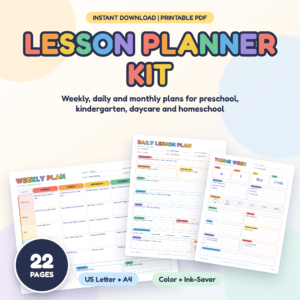
Brightside Printable Lesson Planner Kit
Price: $1.49 | Best for: preschool, kindergarten, daycare and homeschool
Brightside includes weekly and daily lesson plan templates made for preschool, kindergarten, daycare and homeschool. It comes as a Letter and A4 PDF. It is the one that most directly matches this topic, and at $1.49 it is easy to try.
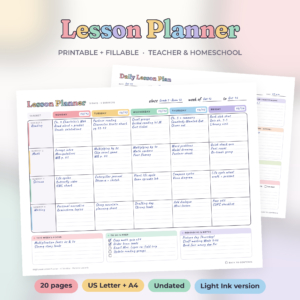
Brightweek Printable Lesson Planner Kit
Price: $2.29 | Best for: teachers and homeschool parents who plan by the week
Brightweek is a fillable weekly lesson plan template for teachers and homeschoolers. It is an undated PDF in US Letter and A4, so you can start any week of the year. Undated means no wasted pages when school breaks or holidays interrupt.
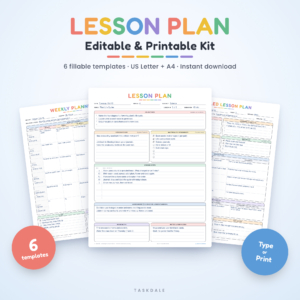
ChalkBright Lesson Plan Kit
Price: $1.99 | Best for: teachers who want daily, weekly and unit plans in one kit
ChalkBright is an editable lesson plan template and fillable PDF with daily, weekly and unit planners, plus a sub plan. It comes in US Letter and A4. If you want to type your plans rather than handwrite them, the editable format helps.
Comparison: kindergarten and daycare lesson planners
| Product | Format | Price | Best for | Link |
|---|---|---|---|---|
| Brightside | Letter and A4 PDF, weekly and daily templates | $1.49 | Preschool, kindergarten, daycare | View |
| Brightweek | Fillable undated PDF, US Letter and A4 | $2.29 | Weekly planning | View |
| ChalkBright | Editable and fillable PDF, US Letter and A4 | $1.99 | Daily, weekly, unit and sub plans | View |
How to fill in a daily lesson plan in 15 minutes
You do not need a perfect plan. You need a usable one. Here is a quick method.
First, pick a theme for the week. Farm animals, weather, my family. A theme gives your books, songs, crafts and counting games something to share. It also saves you from reinventing the wheel every morning.
Next, drop in the fixed parts of the day. Arrival, snack, lunch, nap or rest, pick-up. These are not negotiable, so write them down first and plan around them.
Then add one learning goal per block. Keep it small. “Count five bears” is a goal. “Learn math” is not. Small goals are easier to check off, and children can actually reach them.
After that, list materials. Walk through the day in your mind, block by block, and write what you will touch. Doing this on paper beats doing it at 8:50.
Finally, leave a little slack. Leave one block blank each day. Rain, a surprise visitor, a tantrum that needs a quiet corner. A blank block lets the day breathe without throwing the plan out of the window.
A sample kindergarten morning
Here is how a morning might look. Use it as a starting point, not a rule.
- 8:30 Arrival and free play. Goal: settle in and greet friends.
- 9:00 Circle time. Calendar, weather song, one story. Goal: listen and take turns.
- 9:25 Letter of the week. Trace it, sing it, find it in the room. Goal: name the letter and its sound.
- 9:50 Snack and wash hands.
- 10:10 Counting game with blocks or buttons. Goal: count to 10.
- 10:35 Outdoor play. Goal: gross motor movement.
Notice how short each block is. That is not laziness. It matches how small children focus. And the plan leaves room for the unexpected: the ant parade on the playground that turns into an impromptu science lesson.
Weekly planning versus daily planning
Should you plan by the day or by the week? Honestly, both. The weekly view shows the shape, and the daily view fills in the detail.
On Friday afternoon, sketch next week on one page. Theme, books, one big activity per day, and any events like a trip or visitor. That takes ten minutes.
Then each morning, or the evening before, flesh out the day. Add times, materials, and notes for helpers. A weekly page like Brightweek works well for the first step, while the daily templates in Brightside suit the second.
If you want more on the weekly side, our guide to the weekly lesson plan template shows how to plan a week in about 30 minutes.
Making a kindergarten lesson plan template work for your room
A template is a skeleton. You still add the muscle. The first week you use a kindergarten lesson plan template, expect to tweak it. Maybe snack runs longer than you thought. Maybe the story needs to move before outdoor play, because the kids are wiggly after sitting.
That is fine. Use pencil, or save a copy you can edit. After two weeks you will know your room’s real rhythm, and your plan will match it.
Daycare providers often find the plan is more of a promise to parents than a script. Parents love seeing a weekly sheet on the door. It shows that the day has shape and purpose, and that play is doing real work. A printed kindergarten lesson plan template with a theme and a few goals does that job quietly.
Homeschool parents can use the same pages with one or two children at the kitchen table. The blocks may be shorter, and the goals more personal. Maybe it is “write my name” for one child and “sound out cat” for another. The structure still helps, because it keeps you from drifting into the laundry.
Small touches that make planning easier
Keep a folder or binder with a spare copy of every plan. Over a year you will build your own bank of ideas, and recycling a good week in spring is a joy.
Color code if you like. Green for movement, blue for quiet, yellow for creative time. One glance and you can see if the day is balanced.
Share the plan with helpers. An assistant who knows what is coming can prepare materials and support children more calmly. Hand them the page at drop-off, and watch the room run smoother.
Finally, put the plan where you can see it. On a clipboard, on the wall, on a stand. A plan hidden in a drawer is no plan at all.
Mistakes to avoid with early years lesson plans
Over-planning is the classic one. Seven activities in a morning looks great on paper and leaves everyone frazzled. Plan fewer things and do them well.
Another is forgetting transitions. Moving from carpet to tables to coats takes time with small children. Count it in. A two-minute song between activities saves ten minutes of chaos.
Third, ignoring movement. Five-year-olds are not built for long sitting. Alternate quiet activities with active ones, and your day runs smoother.
And fourth, skipping the sub plan. If you are out sick, a stranger has to run your room. A page that lists the routine, the names of helpful children, allergies and where things live is a kindness. ChalkBright includes a sub plan for this reason. Our post on what to put in a substitute teacher plan template has more ideas.
Which lesson plan template should you pick?
For preschool, kindergarten or daycare, start with Brightside. It names those settings directly and costs $1.49. If you mostly plan weekly and like fillable pages, Brightweek is a good match. And if you want to type your plans, build unit plans and have a sub plan ready, ChalkBright covers that.
Some people buy two. A weekly overview plus a daily template is a common pairing, and at these prices it won’t hurt your budget.
Kindergarten lesson plan template FAQ
What should a kindergarten lesson plan include?
A good plan lists the time blocks of the day, a goal for each activity, materials you need, and notes for next time. It should also leave space for movement and play. Short blocks work best because young children focus for brief stretches.
How long should kindergarten activities last?
Most teachers keep a single activity to about ten to fifteen minutes, then switch. That varies by child and by day. Watch the room. If the group is restless, move on early, and note it in your plan for next time.
Can I use one template for daycare and homeschool?
Yes. Brightside is made for preschool, kindergarten, daycare and homeschool, so the same layout works across those settings. Adjust the time blocks and goals to match your children’s ages and your own routine.
Is a weekly or daily plan better?
Use both if you can. A weekly plan shows the theme and balance of the week. A daily plan adds times, materials and helper notes. Together they take about twenty minutes and cover almost everything you need.
Are these templates printable or editable?
Brightside and Brightweek are printable PDFs, and Brightweek is described as fillable. ChalkBright is described as an editable template and fillable PDF. Check each product page for the details of how you can edit it.
Your next step
Print one week from Brightside this weekend, fill in a theme and the fixed parts of your day, and see how Monday feels. You can always add more later. Start small.