Some coloring books ask you to color. Others ask you a question. “Who lives in this castle?” “What are you thankful for today?” “Which song takes you right back in time?” That small line of text under a picture changes everything. The page stops being a quiet task and becomes a conversation, a story or a game.
This guide is for parents, teachers, caregivers and adult colorists curious about interactive, unique coloring books with puzzles, prompts and storytelling. You will learn the main kinds of interactive pages, how to use each one with different ages, simple ways to add prompts and puzzles to any coloring page you already own, and who may prefer a plain book instead.
Quick picks: coloring books that talk back
| Product | Best for | Price | Link |
|---|---|---|---|
| Turret & Tiara Princess and Castle Coloring Book | Story prompts for ages 3 to 8 | $4.49 | View |
| Roar to Z Dinosaur Coloring Book | Facts, say-it guides and a matching game | $4.49 | View |
| Thankful Feathers Turkey Pages | Gratitude prompts, maze and word search | $3.49 | View |
| Porchlight Memories Large Print Book | Memory prompts for seniors | $8.99 | View |
What makes a coloring book interactive
“Interactive” covers a lot of ground. Most interactive coloring books mix two or three of these features:
- Story prompts. A question or sentence starter under the picture, often with writing lines. The child colors, then imagines what happens next.
- Reflection prompts. Gratitude, feelings or journaling questions. Common in books for older kids, teens and adults.
- Memory prompts. Gentle questions that invite older adults to share a story from their past.
- Puzzles and games. Mazes, word searches, matching games, bingo and dot-to-dots between coloring pages.
- Facts and learning. Short facts, pronunciation guides or labels, so coloring doubles as a mini lesson.
- Personalization. A name typed once that appears on the cover and pages, which makes the book feel like it was made for one child.
The common thread is that the page asks something of you beyond picking a color. That small ask is what keeps a seven-year-old at the table for 25 minutes instead of 5, and what turns a quiet visit with a grandparent into an hour of stories.
Story prompts: color first, then tell the tale
Story prompts are the most popular kind of interactive page for young kids. A castle picture with “What is hiding behind the little round door?” invites a child to make something up. There is no wrong answer, which is exactly why it works.
How to use story prompts by age
- Ages 3 to 5: read the prompt aloud, let them color, and write down their answer for them. Children this age tell wonderful stories. They just cannot write them yet.
- Ages 6 to 7: they write one word or a short sentence. Spelling does not matter. Getting the idea down does.
- Ages 8 and up: they fill the lines on their own and often keep going on the back of the page.
Prompts also help with a child who stalls. A five-year-old staring at a blank castle may not know where to start. Ask the prompt first, and their answer often tells them what to color: “The dragon is hiding behind the door, so the door has to be green.”
Keep the finished pages together. After a few weeks you have a little book of your child’s stories, in their own words. Parents tend to treasure these far more than any store-bought keepsake.
Turret and Tiara Princess and Castle Coloring Book
Price: $4.49 | Best for: story-loving kids ages 3 to 8
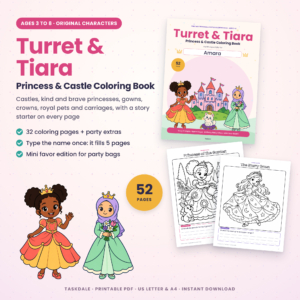
Turret & Tiara has 32 original princess and castle pages, each with a story starter question and writing lines, such as how the princess and the little dragon became friends. Type a child’s name once and it appears on the cover, the name pages, favor bag toppers and a certificate. A half-size Mini Party Favor Edition prints two pages per sheet for party bags. Begin with the castle page and write down your child’s answer together.
Facts and games for curious kids
Some children are not storytellers. They are collectors of facts. They want to know how big, how old, how fast. For these kids, an interactive book with real facts and a game or two is the hook that keeps them coloring.
Fact-based pages work best when the facts are short and the words are big. Three facts per page is plenty for a six-year-old. A pronunciation guide is a lovely bonus, because nothing makes a child prouder than saying a very long dinosaur name correctly at dinner.
Facts also give quieter kids a way into conversation. A child who rarely speaks up at school may happily explain to a grandparent how long a dinosaur was, using the page as their script. That small moment of being the expert matters.
Games add another layer. A matching game after every eight or ten pages gives a natural pause and a sense of progress, and it gives parents a quick way to see what has stuck.
Roar to Z Dinosaur Coloring Book
Price: $4.49 | Best for: fact-loving kids ages 3 to 10
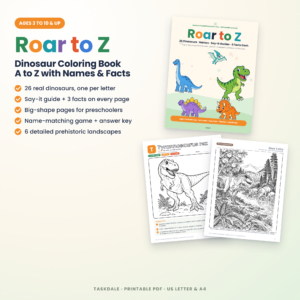
Roar to Z covers 26 real dinosaurs and prehistoric reptiles from A to Z, each with its name in outline letters, a “Say it” pronunciation guide, what the name means and three kid-friendly facts. There is a big-shape section for preschoolers, a name-matching game and six detailed landscapes for older kids and adults. It prints on US Letter or A4. Color the Ankylosaurus page first, then quiz each other on its three facts.
Gratitude and reflection prompts
Reflection prompts ask a gentle question about feelings or thankfulness. “I am thankful for…” “Today I felt…” “My favorite fall food is…” They suit kids from about 5 up, as well as teens and adults who like to journal a little while they color.
These pages work beautifully around holidays and at the end of a long week. A family can color the same page at the kitchen table on Sunday night and read their answers aloud. A teacher can collect a class set and pin them up as a gratitude wall. Twenty-eight answers from 28 children, all different, all honest, is quite a thing to read.
Puzzles mixed in between the reflection pages help too. A maze or word search breaks things up and keeps younger kids engaged when writing feels like too much.
Thankful Feathers Turkey Pages
Price: $3.49 | Best for: families and classes in November
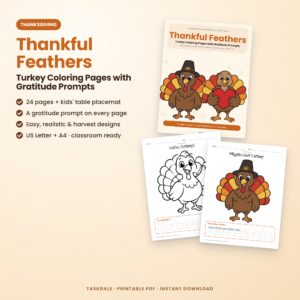
Thankful Feathers has 24 turkey and harvest pages, each with a gratitude prompt and writing lines, from bold cartoon turkeys to realistic wild turkeys and detailed harvest scenes. Extras include a gratitude tree with ten leaves, thankful leaves to cut out, a word search, a maze, four place cards and a kids’ table placemat. It prints on US Letter or A4. Start with the gratitude tree and add one leaf a day.
Memory prompts for older adults
For older adults, especially those in assisted living or living with memory loss, the most meaningful prompt is often a simple question about the past. “Where did you go on Sunday drives?” “What was the best pie you ever ate?” Questions like these have no right answer and no pressure, and they open doors that a direct “How are you?” rarely does.
A tip for visitors: ask the question, then wait. Let the silence sit for a few seconds while the pencils move. Many older adults need a moment to reach a memory, and rushing in with a second question can close the door before the story arrives.
The picture helps. A diner, a radio, a sewing table, a front porch at evening. Hands are busy, eyes are on the page, and the talk comes more easily. Family members on visits and activity staff both use these pages to turn a quiet half hour into real connection. For more on why coloring helps people unwind, see our piece on coloring books for relaxation and stress relief.
Porchlight Memories Large Print Book
Price: $8.99 | Best for: seniors, families and care staff
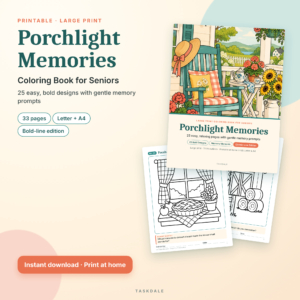
Porchlight Memories has 25 easy, nostalgic pages, each with a large-print Memory Moment question under the picture. Every design comes in a Classic-Line and a Bold-Line edition for different eyesight and hand steadiness. A coloring journal, a Family and Caregiver Guide with group activity ideas and a certificate are included, in US Letter and A4. Start with Front Porch Evening and its question.
How to make any coloring book interactive
You do not need a special book to add prompts and puzzles. A pencil and two minutes turn almost any coloring page into an interactive one. Write the prompt at the bottom of the page before you hand it over.
Story prompts that fit nearly any picture
- What is this character’s name, and how old are they?
- What happened just before this picture?
- What happens next?
- What sound would you hear if you stood here?
- Who is this character’s best friend?
- What is hiding just outside the edge of the page?
Puzzles you can add in seconds
- I spy: “Can you find three circles on this page?”
- Counting: “How many leaves? Color every fifth one red.”
- Hidden letters: draw a tiny letter somewhere in the picture and ask the child to find it.
- Color code: “Everything you can eat is green. Everything that moves is blue.”
A tired parent at 6 pm can use the same page three nights in a row this way, with a different prompt each time. The child gets a fresh game. The parent gets a bit of peace.
Interactive coloring for teens and adults
Teens and adults often like a lighter touch. They do not want to be asked a question on every page, but a small prompt or a margin for notes can make the habit more meaningful.
- A one-line journal. Write the date and one sentence about your day on the back of each finished page.
- A mood palette. Choose colors to match how you feel before you start, and note them in the margin.
- A gratitude corner. One thing you are glad about, written in the bottom corner before you put the pencils away.
- Swap and finish. Color half a page, then hand it to a partner or friend to finish.
Couples and friends enjoy the swap idea more than you might expect. Two people, one page, a pot of tea and a running joke about who got the harder half. It is a cheap, low-key evening that feels a bit like doing a puzzle together.
Teens in particular respond to choice. Offer the prompt, but make it optional. Our guide to coloring pages for teens has designs that suit this age without feeling babyish.
A week of interactive coloring at home
If you want to try interactive coloring without overthinking it, here is a simple five-day plan for a family with kids between 4 and 10. Each session takes about 20 minutes, usually after dinner.
- Monday, the story page. Color a picture with a story prompt. Everyone shares their answer out loud.
- Tuesday, the fact page. Color a page with facts. Then take turns quizzing each other.
- Wednesday, the puzzle break. A maze or word search, then a quick page with an “I spy” challenge.
- Thursday, the thankful page. One gratitude prompt each. Pin the answers on the fridge.
- Friday, the swap. Everyone colors half a page, then swaps to finish someone else’s and give it a title.
By Friday night you have a little stack of pages that say something about each person in the house. Keep the best one from each child in a folder labeled with the month. It is a quiet record of what they cared about that week, and you will be glad of it later.
Who may prefer a plain coloring book
Interactive books are wonderful, but they are not for everyone. Some people want coloring to be completely wordless and quiet. Prompts can feel like homework to them, and that is a fair reason to skip them.
- Very young toddlers, under about 3, usually just want big shapes and a crayon. Prompts are for the grown-up to read aloud, not something they need on the page.
- Adults who color to switch off. If your goal is to stop thinking, a plain mandala or cozy scene may suit you better.
- Children who find writing stressful. Keep the prompts spoken, not written, or choose a book where writing is optional.
Many families keep both kinds in the house: an interactive book for shared time, a plain one for quiet time alone.
Frequently asked questions
What is an interactive coloring book?
A coloring book that adds something beyond the picture, such as story prompts, reflection questions, puzzles, games, facts or personalization.
Are coloring books with story prompts good for kids who cannot write yet?
Yes. Read the prompt aloud and write down the child’s answer for them. Many children ages 3 to 5 tell rich stories out loud.
Do interactive coloring books help seniors?
Pages with gentle memory questions can make visits and group sessions more social. Large print and bold lines make them easier to use.
Can I add prompts to a normal coloring page?
Yes. Write a simple question at the bottom, like “What happens next?” or “Can you find three circles?”, before handing the page over.
What age is best for coloring books with puzzles?
Simple mazes and matching games suit ages 4 to 6. Word searches and longer puzzles suit ages 7 and up.
Your next step
Pick one coloring page you already have, write “What happens next?” at the bottom, and hand it to someone tonight. See how long they stay with it. If you have a young storyteller aged 3 to 8, start with the castle pages in Turret & Tiara and keep their answers in a folder.