A budget is a plan. Your books are the record of what really happened. A small business needs both, and they only help each other when they speak the same language: the same categories, the same timing and the same habit of checking one against the other every month. That is what budget accounting basics for small businesses come down to.
This guide is for owners who run their own numbers, or want to understand the numbers their bookkeeper sends. No accounting degree needed. You will learn the difference between cash and accrual in plain words, how to set up a short category list that fits both your budget and your tax return, a weekly bookkeeping routine that takes about 30 minutes, how to read a profit and loss statement quickly, and how to compare budget with actual without drowning in detail. There is a worked example from a small cleaning company with every figure shown.
Quick picks: bookkeeping and budget spreadsheets
| Product | Best for | Price | Link |
|---|---|---|---|
| Small Business Finance Planner (Petal & Profit) | Bookkeeping, budget, invoices and a quarterly tax planner | $9.99 | View |
| Blush & Balance Income and Expense Tracker | A simple log that turns into P&L and tax estimates | $7.99 | View |
| Small Business Finance HQ | Budget vs actual, cash forecast and a month-end checklist | $7.99 | View |
| Orchid Business Hub | Goals, budget, P&L and marketing in one planner | $6.99 | View |
Where budgeting and accounting meet
Owners often treat these as two separate jobs. The budget gets made once in January, and the bookkeeping happens in a rush before taxes are due. Neither does much good on its own.
A budget without books is a guess you never check. Books without a budget are a history lesson: they tell you what happened but not whether it was good. Put them together and you get the useful question every month: did we do what we planned, and if not, why?
For that comparison to work, three things have to line up:
- Same categories. If the budget has “Marketing” and the books split it into “Ads”, “Printing” and “Sponsorship”, you will spend every review regrouping numbers.
- Same timing. Both should use the same basis, cash or accrual. More on that next.
- Same rhythm. Books updated weekly, compared to the budget monthly.
Get those three right and your monthly review becomes a 30-minute conversation with your own numbers instead of an afternoon of untangling.
Cash or accrual: pick one and stay with it
This sounds technical. It is really a simple question: when do you count money as earned or spent?
- Cash basis. You record income when the money lands and costs when the money leaves. If you do a job in March and get paid in April, it is April income.
- Accrual basis. You record income when you earn it and costs when you incur them, whenever the cash moves. That same March job is March income, with an unpaid invoice sitting in your records until April.
Most very small businesses and freelancers keep their books on a cash basis because it is simpler and matches the bank. Businesses with stock, larger revenue or certain legal structures may need accrual. The rules vary by country and situation, so check with an accountant before you choose for tax purposes.
For budgeting, the main point is consistency. If your books are on a cash basis, budget on a cash basis too. Mixing them makes every comparison wrong. A café owner who budgets March revenue as “sales made in March” but records catering invoices only when paid will see a March shortfall that is not real, then a fake April windfall.
Set up a short category list that serves both jobs
In accounting, your list of categories is called a chart of accounts. For a small business, it does not need to be long. Fifteen to twenty-five categories covers most firms. Too many, and entries get scattered; too few, and you cannot see where money goes.
A starter list
- Income: Sales or service income, split by main product or service line if useful. Other income.
- Direct costs: Materials or stock, subcontractors, job-related supplies, shipping, payment processing fees.
- Overheads: Rent, utilities, insurance, software and subscriptions, phone and internet, marketing, professional fees, vehicle, travel, office supplies, bank fees, training.
- People: Wages, payroll taxes, contractor fees for non-job work.
One tip saves a lot of pain at tax time: name your categories to match the lines on your business tax return as closely as you can. Then your year-end totals drop straight into the return, or straight into your accountant’s hands, with no reshuffling.
Use this same list for your budget. Every category in the books should have a budget line, even if the budgeted amount is small.
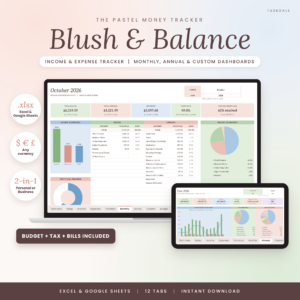
Blush & Balance Income and Expense Tracker
Price: $7.99 | Best for: freelancers and small shops new to bookkeeping
Blush & Balance is an income and expense tracker for Excel and Google Sheets. You type each payment and purchase into a simple log, and twelve tabs turn the rows into dashboards, budgets, account balances, profit and loss and tax estimates for any month, year or date range. There are no macros or add-ons. Set your categories to match your tax return lines first, then enter last month’s transactions to see your first P&L.
A weekly bookkeeping routine that takes 30 minutes
Bookkeeping falls apart when it piles up. Three months of receipts in a shoebox is a weekend of misery. Thirty minutes every Friday is barely noticeable.
The Friday half hour
- Gather receipts (5 minutes). Photos on your phone, paper in one tray, emailed invoices in one folder.
- Log income (5 minutes). Every payment received this week, with client and invoice number.
- Log expenses (10 minutes). Every business purchase, with category and a short note. Attach or file the receipt.
- Reconcile (5 minutes). Compare your log with the bank statement. Every bank line should match a log line. Anything missing? Add it now.
- Check unpaid invoices (5 minutes). Who owes you? Send a polite reminder to anyone past due.
Reconciling is the step people skip, and it is the one that keeps the books honest. A $45 software charge you forgot about, or a client payment logged twice, shows up immediately when the bank and the books do not agree.
Tie this routine to your other weekly business habits and it sticks. Our daily operations checklist for small businesses shows how to build end-of-week tasks into an open-to-close routine.
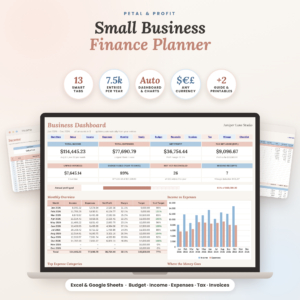
Small Business Finance Planner (Petal & Profit)
Price: $9.99 | Best for: makers, salons, coaches and service businesses
Petal & Profit is a small business finance planner for Excel and Google Sheets that keeps bookkeeping, budget, invoices, taxes and mileage in one workbook. Eight live KPI tiles show income, expenses, net profit, margin, estimated tax set-aside, unpaid invoices, budget used and missing receipts, and every entry has a Status check that flags missing dates or unknown categories in plain English. Start by entering your categories and budget, then log this week’s sales and costs.
Reading your profit and loss in five minutes
A profit and loss statement, or P&L, is simply income minus costs for a period. Once your books are up to date, it builds itself. The skill is reading it quickly and knowing which lines matter.
Worked example: a three-person cleaning company, one month
| Line | Amount |
|---|---|
| Revenue | $18,400 |
| Cleaner wages | $8,100 |
| Cleaning supplies | $620 |
| Fuel | $540 |
| Gross profit | $9,140 |
| Insurance | $310 |
| Software | $95 |
| Phone | $120 |
| Marketing | $450 |
| Accounting | $150 |
| Vehicle lease | $480 |
| Net profit | $7,535 |
What to look at, in order
- Revenue. Up or down on last month and on the same month last year?
- Gross margin. Gross profit divided by revenue. Here it is about 50 percent. If it slides to 45 percent next month, either prices are too low or job costs crept up.
- Overheads. $1,605 here. These should be fairly steady. A jump means a new cost that deserves a second look.
- Net profit. What is left before the owner’s pay and tax, depending on how your business is set up. About 41 percent here.
Five minutes, four lines, and you know how the month went. Do this every month and you start to feel your business’s rhythm in the numbers.
Budget versus actual, in plain words
Here is where budget and books finally meet. Put the planned amount next to the actual amount for each category, and look at the difference. Accountants call the difference a variance. You can just call it the gap.
| Line | Budget | Actual | Gap |
|---|---|---|---|
| Revenue | $17,500 | $18,400 | +$900 |
| Cleaner wages | $7,800 | $8,100 | $300 over |
| Supplies | $500 | $620 | $120 over |
| Fuel | $450 | $540 | $90 over |
| Overheads | $1,605 | $1,605 | On budget |
| Net profit | $7,145 | $7,535 | +$390 |
How to read the gaps
Revenue came in $900 above plan, so it makes sense that wages, supplies and fuel ran higher: more jobs mean more hours, more product and more driving. The real question is whether costs rose in proportion. Wages rose about 4 percent against a 5 percent revenue rise. Fine. Supplies rose 24 percent. That one deserves a look. Maybe a new client’s office needs a pricier product, or bulk buying slipped.
That is the whole method. Ignore small gaps. Investigate gaps that are large in dollars or large in percentage. Write one line about each one you investigate. Over a few months, those notes turn into better budgets.
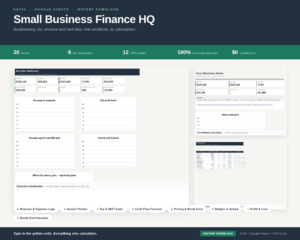
Small Business Finance HQ
Price: $7.99 | Best for: owners who want budget vs actual done for them
Small Business Finance HQ is a 20-sheet workbook for Excel and Google Sheets with revenue and expense logs, an invoice tracker, profit and loss, a tax and VAT section with a monthly reserve plan, a cash flow forecast and a Budget vs Actual sheet that shows where you went over. There are six dashboards and a month-end checklist. Type in the yellow cells only, and run the Budget vs Actual sheet at your first month-end.
Money in your account that is not yours
One of the most common small business surprises is a healthy bank balance that turns out to be spoken for. Three kinds of money sit in your account temporarily and belong elsewhere.
- Sales tax or VAT collected. If you charge it, you are holding it for the government until it is due.
- Payroll withholding. Tax and other deductions taken from staff pay must be paid over on schedule.
- Your own income tax. Profit is taxable. A share of every profitable month belongs to a future tax bill.
The fix is simple: move these amounts to a separate savings account as soon as you collect them, and leave them out of your budget’s spendable cash. Ask your accountant what percentage to set aside for income tax, since it depends on your location, structure and profit level. Clear, numbered invoices make sales tax easier to track too, which our guide to invoice templates in Word, Excel and PDF covers.
Month-end checklist
- All income and expenses logged for the month
- Bank and card accounts reconciled
- Unpaid invoices listed and chased
- Sales tax and income tax amounts moved to the tax account
- P&L reviewed: revenue, gross margin, overheads, net profit
- Budget versus actual reviewed, one note per big gap
- Receipts filed for the month
Common mistakes
- Mixing personal and business spending. Open a separate business account, even as a sole trader.
- Logging owner draws as expenses. In many setups, money you take out for yourself is not a business expense. Ask your accountant how to record it for your structure.
- Too many categories. If a category gets fewer than three entries a year, merge it.
- Skipping reconciliation. Unreconciled books drift, and the drift compounds.
Frequently asked questions
What is the difference between a budget and bookkeeping?
A budget is your plan for income and costs. Bookkeeping is the record of what actually happened. Comparing the two each month shows whether the business is on track.
Should a small business use cash or accrual accounting?
Many very small businesses use cash basis because it is simpler. Some businesses must use accrual depending on size, stock and local rules. Check with an accountant, then budget on the same basis.
How many expense categories should a small business have?
Fifteen to twenty-five is plenty for most. Match them to your tax return lines where you can.
How often should I do my bookkeeping?
Weekly works best for most small businesses: about 30 minutes to log, reconcile and chase invoices. Review the P&L and budget monthly.
What does budget variance mean?
It is the gap between what you planned and what actually happened for a category. Look into gaps that are large in dollars or percentage.
Can I do small business bookkeeping in a spreadsheet?
Yes. A well-built spreadsheet handles income, expenses, P&L, budget and tax set-aside for most small businesses. Larger firms with payroll and stock often move to accounting software.
Your next step
This Friday, block 30 minutes and run the weekly routine once: gather receipts, log the week, reconcile with the bank, and chase one unpaid invoice. Then write your category list beside your budget and make sure they match. When you want the books, budget and tax planner tied together, set them up in the Petal & Profit Small Business Finance Planner.