Financial budget planning for households is more than a monthly spending plan. A monthly budget keeps the lights on. A good household plan also sees the car registration coming in March, has a cushion for the boiler that breaks in January, and knows roughly where the family wants to be in five years. Three layers, working together.
This guide is for families, couples and shared homes who want to move from “getting through the month” to actually planning. You will see how to set up each layer, from the monthly budget to a yearly money calendar to longer goals, plus the safety nets every household needs and how to talk about money at home without it turning into a row. Three Taskdale tools come up along the way: one spreadsheet for the numbers and two workbooks for the harder, human side of money.
Quick picks: household money planning tools
| Product | Best for | Price | Link |
|---|---|---|---|
| Fernleaf Home Budget Planner Spreadsheet | A shared household budget in Excel | $7.49 | View |
| The Calm Money Method | Households where money feels stressful | $11.99 | View |
| Rooted & Rich Money Mindset Workbook | Partners setting shared goals | $17.99 | View |
Plan in three layers: month, year and beyond
Most households only plan one layer: this month. That is why so many feel ambushed. The monthly budget looks fine, then a $900 insurance renewal lands, or the car needs tyres, or a school trip appears with a two-week deadline. None of those were surprises, really. They just lived outside the monthly view.
Thinking in three layers fixes that.
- This month: income, bills, everyday spending and savings. The working budget.
- This year: every cost that comes once or twice a year, spread into monthly savings. Plus a calendar of money tasks.
- The next five years: the big goals. A bigger home, a car paid off, a child starting school, a career change, retirement contributions.
Each layer feeds the one below it. A five-year goal becomes a yearly target, which becomes a monthly savings line. That chain is what turns a hope into a plan.
The monthly layer: a budget everyone can read
The monthly budget is the engine. It needs to be clear enough that every adult in the house understands it in under a minute. If only one person can read it, only one person will follow it.
Start with take-home income from every earner. List fixed bills with due dates. Set everyday spending categories based on what you actually spent last month, not what you wish you spent. Add savings and extra debt payments as their own lines, paid on payday. Give each adult a small amount of personal money that nobody questions.
Picture the Mensah household: two adults, one teenager, combined take-home pay of $7,400. Their monthly plan has 14 categories. Groceries at $1,150 is the biggest flexible line, which surprised them, because a teenager eats a lot more than they expected. Pairing the budget with a weekly meal plan pulled it back to about $980 within two months. Our guide to meal planning on a budget has eight habits that help.
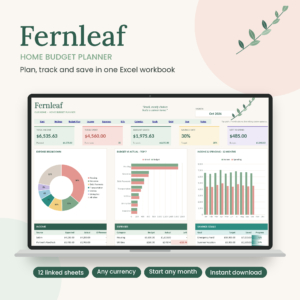
Fernleaf Home Budget Planner Spreadsheet
Price: $7.49 | Best for: families sharing one household budget
Fernleaf is an Excel budget planner built for real homes. Every purchase goes into one Expenses list and every paycheck into one Income list, and a dashboard shows any month you pick from a dropdown. It includes a bill calendar, savings pots and debt payoff with a real debt-free date, and your budget year can start in any month. Type your categories into the white boxes, then log last week’s shop.
The yearly layer: sinking funds and a money calendar
The yearly layer is where most household stress disappears. The idea is simple. List every cost that does not come monthly, add them up, divide by 12, and save that amount every month into a separate pot. These pots are called sinking funds.
Here is what a year might hold for a family:
| Month | Expected cost | Amount |
|---|---|---|
| January | Annual software and streaming renewals | $180 |
| March | Car registration and insurance | $1,050 |
| May | Two birthdays | $200 |
| July | Family holiday | $2,400 |
| August | School uniforms and supplies | $450 |
| October | Car service and tyres | $620 |
| December | Holiday gifts and food | $900 |
| Year total | $5,800 |
That is about $484 a month. It looks like a lot written down. It is much less painful than finding $2,400 in July or $1,050 in March. Many households split this into three or four named pots, like Car, Holiday, Gifts and School, so each one is clearly earmarked. Our explainer on what sinking funds are and how to set them up goes through it step by step.
Add a simple money calendar too. Note the months when insurance renews, when tax is due, when contracts end and can be renegotiated. A five-minute check of the calendar each month means fewer auto-renewals at higher prices.
Safety nets every household needs
Planning is not just about known costs. It is about being ready for the ones you cannot see coming.
An emergency fund
A common guideline is three to six months of essential costs, meaning housing, utilities, food, transport, insurance and minimum debt payments. For the Mensahs, essentials come to about $5,200 a month, so a full fund would be $15,600 to $31,200. That is a big number. Start with a first milestone of $1,000, then one month of essentials, then build from there. Households with one income, irregular pay or a self-employed earner may want to aim toward the higher end.
An insurance check
Once a year, list every policy the household holds: health, home or renters, car, life, income protection if you have it. Ask three questions of each. Does it still cover what we need? Are we paying for cover we do not need? Has anything changed, like a new child, a new car or a home renovation, that needs updating? This is general housekeeping, not advice on which cover to buy, but a yearly look often catches gaps or overlaps.
Important documents in one place
Keep policies, account details, wills if you have them, and key contacts somewhere both adults can find. If one person handles all the money and is suddenly ill, the other should not have to guess where anything is.
A debt plan for the whole household
Debt is easier to tackle as a household when everyone can see it. List every debt on one page: who owes it, the balance, the interest rate and the minimum payment. Seeing it all together can be uncomfortable. It is also the first step to shrinking it.
Pick an order. The snowball method pays off the smallest balance first for quick wins. The avalanche method targets the highest interest rate first to pay less interest overall. Both work. What matters is choosing one and sticking with it.
Then make it visible. A simple chart on the fridge, with one box to color for every $100 paid off, turns a grim number into a shared project. Kids often enjoy coloring the boxes too, and it quietly teaches them that debt is something you pay back, not something that just exists.
The long-range layer: goals for the next five years
The long-range layer asks: where does this household want to be? Not in vague terms. In numbers and dates.
Sit down once a year and list your bigger goals. Common ones include a home deposit, paying off a car, a fund for a child’s education, a career break, a bigger emergency fund and regular retirement contributions. For each one, write a target amount, a target date and the monthly saving it needs.
A household aiming for a $20,000 home deposit in four years needs about $417 a month. If that does not fit today, you have three honest choices: push the date, lower the target or find room elsewhere. Writing it down makes the choice clear rather than leaving it as a background worry.
For retirement and investment decisions, plans depend heavily on your country, age and situation, so it is worth getting advice from a qualified professional. The household plan’s job is to make sure there is a line for it and that the line gets paid.
Money roles and money talks at home
Numbers are the easy part. The hard part of household planning is people. Two adults rarely grew up with the same money habits. One saves every spare dollar. The other believes life is short. Neither is wrong, and both can turn a simple budget meeting into a tense evening.
A few practices help:
- Agree on roles. One person might pay the bills while the other tracks the budget. Swap roles once a year so both stay in the loop.
- Hold a monthly money meeting. Twenty minutes, same day each month, with a snack. Review last month, plan next month, check one goal.
- Start with what went well. “We came in $60 under on groceries” sets a better tone than “why did fuel go over?”
- Talk about feelings, not just numbers. If money makes one of you anxious, say so. It explains a lot of reactions.
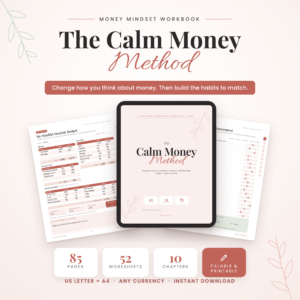
The Calm Money Method
Price: $11.99 | Best for: households where money feels tense
The Calm Money Method is an 85-page money mindset workbook and financial planner, fillable and printable in US Letter and A4. It starts with where money habits come from and what sets off spending, then moves into goals, a monthly budget, saving, debt and a plain-English introduction to investing. Later chapters add weekly money dates and monthly check-ins. Work through chapter one separately, then compare notes at your first money meeting.
When you cannot agree on what matters
Sometimes the real problem is not the budget. It is that two people want different things. One dreams of travel. The other dreams of paying off the mortgage early. Both goals compete for the same money, and every budget meeting turns into the same argument.
The way through is usually to step back from the numbers and talk about values first. What does each of you want money to do for this family? Security? Freedom? Experiences? Generosity? Once you understand each other’s reasons, it is far easier to split the savings between goals in a way that feels fair. Maybe 60 percent toward the mortgage and 40 percent toward a trip every second year. The compromise matters less than both people feeling heard.

Rooted and Rich Money Mindset Workbook
Price: $17.99 | Best for: partners working out shared goals
Rooted and Rich is an 83-page printable and fillable workbook in US Letter and A4, with an Ink-Saver edition. It has nine short lessons, 34 guided worksheets and nine bonus tools covering money beliefs, spending patterns, budgeting, saving and financial goals. Couples can each use their own copy to understand one another’s money personality. Fill in the first chapter separately, then share what surprised you.
A household money calendar for the year
Pull the three layers together with a simple yearly rhythm.
- Weekly: log spending and check the bills due this week. 10 minutes.
- Monthly: a 20-minute money meeting to review the budget, move money to sinking funds and check one goal.
- Quarterly: review subscriptions, check sinking fund balances against upcoming costs, and look at debt progress.
- Yearly: review insurance, update the list of yearly costs, set five-year goals and celebrate what you achieved.
That yearly celebration is not optional. Paid off a card? Built the first month of the emergency fund? Took the holiday without borrowing? Mark it. A family dinner out, paid from the fun budget, with a toast to the plan. Households that notice their wins tend to keep going.
Frequently asked questions
What is financial budget planning for a household?
It is planning household money across three time frames: a monthly budget for everyday costs, a yearly plan for irregular costs like insurance and holidays, and longer goals like a home deposit or education fund.
How big should a household emergency fund be?
A common guideline is three to six months of essential costs. Start with a smaller first milestone, like $1,000, and build up over time.
How do we plan for costs that only come once a year?
List them all, add up the yearly total, divide by 12 and save that amount each month into sinking funds. When the bill arrives, the money is already there.
How often should a household review its budget?
Check spending weekly, hold a short money meeting monthly, review subscriptions and funds quarterly, and set goals and check insurance once a year.
What if we disagree about money as a couple?
Talk about what you each want money to do before talking about numbers. Agree on roles, give each person some personal money, and split savings between your goals in a way you both accept.
Hold your first money meeting this month
Pick a date in the next two weeks, put it in both calendars, and bring three things: last month’s statement, a list of yearly costs and one goal each. Build the monthly layer first, then add sinking funds. If you want one shared file for the numbers, start with the Fernleaf Home Budget Planner Spreadsheet.