The line is the whole game at age three. A thin, sketchy outline gets lost under the first wobbly crayon stroke, and the dinosaur disappears. A thick, bold outline holds its shape no matter what happens inside it, so the child still sees a T. rex when they are done. That is why free dinosaur coloring pages for preschoolers with simple, bold outlines are worth seeking out, and worth fixing when the free ones fall short.
This guide is for parents, childminders and preschool staff with little dinosaur fans aged about 2 to 5. You will learn how to judge outline thickness on a free page in seconds, how to make a thin page bolder at home, and seven ways to fill a bold dinosaur outline that go beyond crayons. You will also find two printable books with properly thick lines, plus a flower set for the days when dinosaurs are off the menu.
Quick picks with properly bold outlines
| Product | Best for | Price | Link |
|---|---|---|---|
| Roar to Z Dinosaur Coloring Book A to Z with Names and Facts | Eight extra-thick dinosaur pages for little hands | $4.49 | View |
| Little Explorers Preschool Coloring Book | Animals, vehicles and early learning for ages 2 to 5 | $3.49 | View |
| Bold Florals Flower Coloring Book | Big-petal flowers for kids and grown-ups together | $3.49 | View |
Why bold outlines matter so much at this age
Preschoolers are still building the hand control to stay inside a shape. Most use a fist or a clumsy finger grip, press hard and move fast. A thick outline works like the walls of a bowling lane with the bumpers up: the crayon still wanders, but the shape stays clear.
Bold lines also help in quieter ways:
- They are easy to see. A child can tell where one part ends and another begins without squinting.
- They give a target. “Color inside the big black line” is an instruction a three-year-old can understand.
- They hide mistakes. A small slip over the edge is swallowed by the thick line, so the page still looks good. That small win matters.
- They make the finished page look finished. Even a scribbled T. rex looks like a T. rex when the outline is strong.
How to judge a free page’s outline in five seconds
Free dinosaur pages are easy to find. Bold ones are less common, because many are drawn for older children. Use this quick test before you print.
- The marker test. Hold a thick felt-tip marker up to the screen. Is the line at least as wide as the marker stroke? Good. Thinner? Keep looking or plan to thicken it.
- The squint test. Squint at the page. If the dinosaur’s outline is still clear while small details blur away, it will work for a preschooler.
- The count test. Count the separate spaces. Around 10 to 20 is right for ages 2 to 4. Fifty is too many.
- The background test. A busy jungle or volcano behind the dinosaur adds dozens of tiny spaces. A plain background or a simple ground line is better.
How to make a thin free page bolder
Found the perfect Stegosaurus but the lines are too thin? You can fix it in a few minutes.
The marker method
Print the page, then trace over every outline with a thick black marker. Skip any tiny inside details you do not want, such as scales or teeth. Photocopy or scan the result, and you have a bold master to reprint.
The printer method
Some printers have a “darker” or “bold text” setting in the print options. It will not double the line width, but it makes gray lines crisp and black, which helps.
The free software method
Open the page in a free browser editor such as Photopea. Use a minimum or dilate filter, or a stroke on the line layer, to thicken every line by a couple of pixels. Then use a threshold adjustment so all lines are solid black. It takes about five minutes once you know where the buttons are.
The simplify method
While you are thickening, erase what is not needed. A preschool T. rex needs a body, head, legs, tail, an eye and a smile. Everything else can go. Fewer lines, bigger spaces, happier child.
Where free bold pages tend to hide
Free bold-line dinosaurs are out there, you just have to look in the right corners. Search terms that include “toddler”, “preschool” or “easy” usually turn up thicker lines than plain “dinosaur coloring page”. Early years teacher resource sites often draw for small hands on purpose. Library story-time sheets are usually simple, bold and friendly. And many free coloring sites have an “easy” or “for little kids” category that is worth checking first.
Expect to open five pages to find one that passes the marker test. That ratio improves once you know which sites draw for little ones.
Draw your own with a cookie cutter
No printer? No problem. A dinosaur-shaped cookie cutter makes a perfect stencil. Lay it on paper, trace around the outside with a pencil, then go over the line with a thick black marker. Add one big eye and a smile. Trace three or four on one sheet in different sizes for a dinosaur family. Children often want to try tracing the cutter themselves, which is excellent practice for pencil control and makes them prouder of the page than anything you could print.
Free bold pages versus a ready-made set
Thickening a free page is satisfying once. Doing it for ten pages every week gets old. A printable book drawn with thick outlines from the start saves that time, and every page matches.
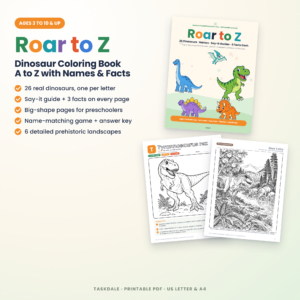
Roar to Z has a section called Little Paleontologists with 8 big-shape pages drawn with extra-thick outlines: T. rex, Triceratops, Stegosaurus, Brachiosaurus, Spinosaurus, Ankylosaurus, Pteranodon and a baby dinosaur hatching from its egg. Each has the name in big outline letters and one short sentence to read together.
Roar to Z Dinosaur Coloring Book
Price: $4.49 | Best for: Preschoolers who want real dinosaurs
A printable PDF in US Letter and A4. For preschoolers, the 8 Little Paleontologists pages have extra-thick outlines and large simple shapes, each with the name to color and one sentence to read aloud. The rest of the book, with A to Z pages, games and fact cards, waits for when they are older. Print the hatching baby dinosaur first; little ones adore it.
Seven ways to fill a bold dinosaur outline
Crayons are only one option. A big, bold outline is a perfect frame for all sorts of play, and switching methods keeps a dinosaur page fresh for weeks.
1. Dot markers
Stamp dots to fill the body. No control needed, very satisfying, and it builds hand strength. Lay newspaper underneath.
2. Sticker mosaic
Give the child a sheet of small round stickers and ask them to fill the Stegosaurus plates. Peeling stickers is excellent fine motor practice, and the result looks bright and bumpy like real armor.
3. Torn paper collage
Tear scraps of colored paper and glue them inside the outline. Tearing is easier than cutting for a three-year-old, and the texture looks great on a T. rex.
4. Cotton bud painting
Dip cotton buds in washable paint and dab dots of color. Each dab is controlled and small, which suits children who find brushes tricky.
5. Play dough on a laminated page
Laminate a page or slide it into a plastic sleeve. Roll play dough into snakes and press them along the outline, then fill the spaces with flattened blobs. Wipe clean, start again.
6. Crayon rubbing
Put a textured surface under the page, such as a leaf, a placemat or a piece of sandpaper, and rub a crayon on its side over the dinosaur. Suddenly it has scales.
7. Finger painting
Messy, joyful, and for many children the best part of the week. Use a page printed on thicker paper so it does not tear when wet.
Rotate one method per day across a week and the same dinosaur stays interesting. A Monday crayon T. rex and a Friday sticker T. rex look completely different, and children love comparing them.
A five-day bold-page plan
| Day | Dinosaur | Fill method |
|---|---|---|
| Monday | T. rex | Chunky crayons |
| Tuesday | Stegosaurus | Sticker plates |
| Wednesday | Triceratops | Torn paper collage |
| Thursday | Brachiosaurus | Cotton bud dots |
| Friday | Baby dinosaur in egg | Finger paint |
Ten to fifteen minutes a day. By Friday you have five very different dinosaurs on the wall, and a child who has practiced five different hand skills without ever being asked to “practice”.
Mixing in other bold themes
Even dinosaur-mad preschoolers have days when they want a digger or a puppy. Keeping a second bold book handy means you can follow the mood. The same fill methods work on any thick outline, so a sticker digger is just as much fun as a sticker Stegosaurus.
Little Explorers Preschool Coloring Book
Price: $3.49 | Best for: Toddlers and preschoolers aged 2 to 5
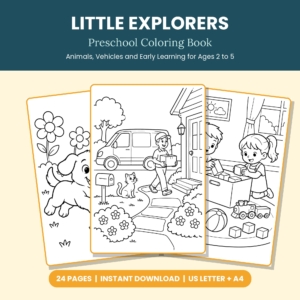
24 simple pages with thick outlines and open spaces in three themes: Friendly Animals, Busy Vehicles and Early Learning with counting, shapes, feelings and big-and-small. It is an instant download PDF. Print a digger from Busy Vehicles and try the torn paper collage method on it, then put it on the wall beside the dinosaurs.
Bold pages in a calm-down corner
Bold coloring pages are a gentle tool for big feelings. A child who is upset often cannot manage fine detail, but a thick outline and a fat crayon give their hands something steady to do. Keep a small folder of bold dinosaur pages and a cup of chunky crayons in a quiet corner, and invite the child to color when they need a moment.
No pressure to finish. Scribbling hard on a T. rex can be exactly what a frustrated three-year-old needs. For more on setting up a quiet space, see our guide to calm down corner ideas.
Coloring side by side with a grown-up
Little ones color longer when a grown-up colors next to them. You do not need a dinosaur. A bold flower page works beautifully, because the thick petals match the style of a preschool page and you can both work at the same easy pace. Children love comparing: “Your flower is pink, my dinosaur is pink too!”
Bold Florals Flower Coloring Book
Price: $3.49 | Best for: Grown-ups coloring with little ones
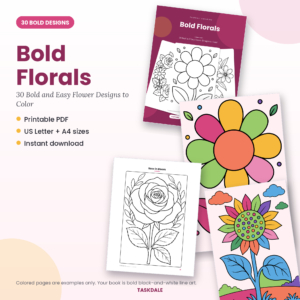
30 bold and easy flower designs with thick outlines and big petals, as a printable PDF in US Letter and A4, made for adults and kids. Pages include a smiling daisy, a sunflower, a tulip pair and a flower pot garden. Print a smiling daisy for yourself and a dinosaur for your child, and color at the same table.
For a spring theme week, our guide to flower coloring pages has more bold picks that pair well with preschool dinosaurs.
Printing tips for bold preschool pages
- Print at actual size. Fit to page shrinks lines.
- Use thicker paper for wet methods. Paint, glue and finger paint need at least 120 gsm, or cardstock.
- Tape it down. Two strips of masking tape stop the page sliding under heavy pressing.
- Make a master folder. Keep one clean, bold copy of each favorite so you can reprint in seconds.
Mistakes to avoid
- Thin, sketchy pages. They frustrate small children. Thicken or skip.
- Too many details inside the dinosaur. Scales and teeth turn into dozens of tiny spaces.
- Expecting tidy coloring. Outside the lines is normal at this age. The bold outline does the tidying.
- Only ever using crayons. Stickers, dots and collage keep interest high.
- Scary dinosaurs. Snarling jaws can unsettle some toddlers. Friendly faces first.
Frequently asked questions
Why do preschoolers need bold outlines on coloring pages?
Thick lines are easier to see and act as a clear boundary, so the picture stays recognizable even when coloring goes over the edge.
How can I make coloring page lines thicker?
Trace them with a thick black marker and copy the result, or thicken them in a free editor like Photopea using a dilate or stroke effect.
What can preschoolers use besides crayons?
Dot markers, stickers, torn paper, cotton bud paint, play dough on a laminated page and finger paint all work well inside bold outlines.
How many spaces should a toddler coloring page have?
About 10 to 20 separate areas is a good range for ages 2 to 4.
Are free dinosaur coloring pages good for toddlers?
Some are. Check the outline is at least as thick as a marker stroke and the background is simple before printing.
What crayons are best for a two-year-old?
Chunky, egg-shaped or triangular crayons. They fit a fist grip, do not snap easily and roll less off the table.
Can I laminate coloring pages to reuse them?
Yes. Laminate a bold page or slide it into a plastic sleeve, then use dry-erase crayons or play dough and wipe it clean afterward.
Your next step
Find one free T. rex page tonight and do the marker test. If the lines are thin, trace them with a thick black marker and copy it. Tomorrow, fill it with stickers instead of crayons. When you want eight dinosaurs drawn bold from the start, the Little Paleontologists pages in the Roar to Z Dinosaur Coloring Book are ready to print.